


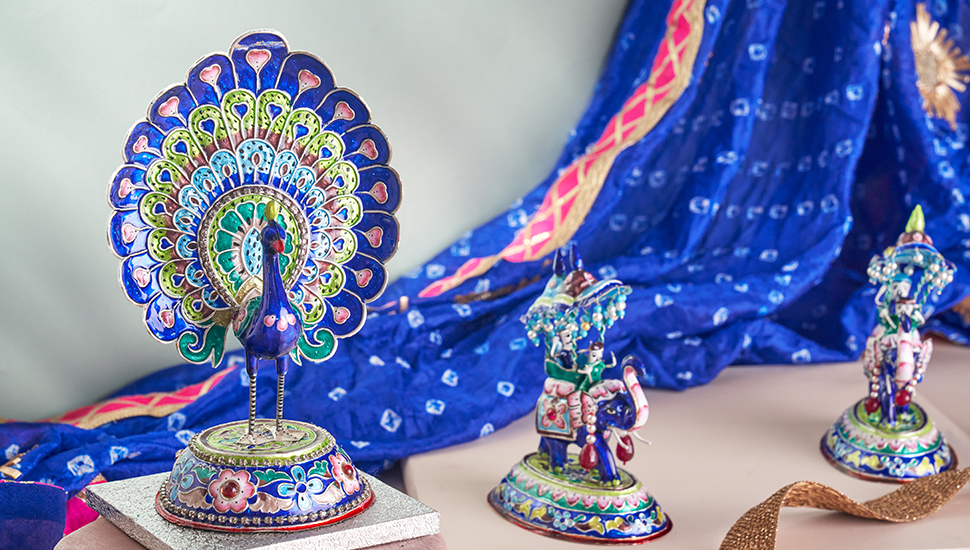
In the bustling alleys of Varanasi, amidst the chants of priests and aroma of incense, a 200-year-old art form quietly thrives — Banaras Gulabi Meenakari. Known for its delicate pink enamel work on silver and gold, this traditional craft is one of the most exquisite and rarest forms of enamel artistry in India. It not only represents artistic brilliance, but also a living connection to Mughal and Persian influences that once defined India’s royal aesthetic.
In This Article:
What is Banaras Gulabi Meenakari?
A Blend of Silver, Enamel and History
- Gulabi Meenakari refers to a form of enamel work (meenakari) where pink hues dominate the palette.
- The craft involves intricate hand-painting on silver with natural motifs like flowers, birds, and paisleys.
- Designs are later fired in a kiln to permanently fix the enamel, creating a polished, radiant finish.
- What makes Banaras’s version unique is its signature use of pink, derived from natural minerals and imported powders.
A Craft Introduced by the Mughals, Perfected in Kashi
- Gulabi Meenakari was brought to India during the Mughal era, initially flourishing in Lahore and Jaipur.
- It found a new identity in Banaras, where artisans customized the style to reflect the city’s spiritual and floral motifs.
- Today, only a handful of families, primarily in the Gai Ghat and Thatheri Bazaar areas of Varanasi, continue to practice this craft.
Recognition and Revival Efforts
- In 2006, Banaras Gulabi Meenakari received the Geographical Indication (GI) tag, officially recognizing it as an exclusive heritage art form.
- Master artisans like Shilp Guru Rajkumar Singh and Late Krishna Kumar, have been honored with national awards for their contribution to its preservation.
- Institutions like the National Handicrafts and Handlooms Museum (Delhi) and Banaras Hindu University (BHU) are actively documenting and promoting the art form.
Challenges in the Modern Era
- Despite its GI tag, the number of skilled artisans is rapidly shrinking.
- Lack of awareness, low profit margins, and competition from machine-made jewelry are pushing many craftsmen to abandon the art.
- Young artisans often shift to more commercially viable trades due to lack of patronage and platforms.
The Road Ahead – Reviving the Pink Legacy
There is renewed interest in Gulabi Meenakari thanks to design collaborations, exhibitions, and social media exposure. Luxury brands and government initiatives like ODOP (One District One Product) are helping revive its market. With the right push, Banaras’s delicate pink jewel may reclaim its royal place — not just in museums, but also in modern homes and global fashion.
By – Nikita