


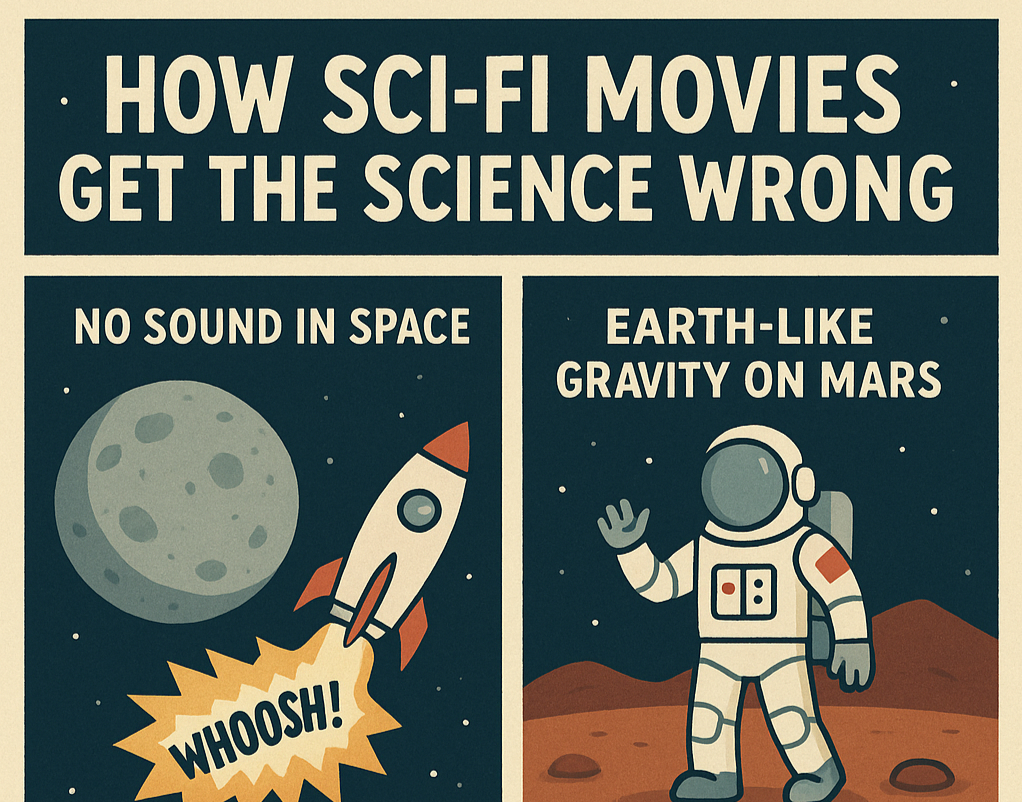
Science fiction films captivate audiences with thrilling visuals, futuristic technologies, and imaginative worlds. But while these movies may succeed in entertainment, they often fail the test of scientific accuracy. From sound in space to gravity-defying physics, Hollywood frequently sacrifices realism for drama — leaving scientists and educators shaking their heads.
In This Article:
Based on verified insights, and experts like physicist Rhett Allain, here’s a look at the most common ways sci-fi movies bend, break, or completely ignore the laws of science.
Sound in Space
The Myth: Explosions and roaring engines in outer space
The Reality: Space is a vacuum, and sound can’t travel without a medium like air.
Yet in Star Wars and Guardians of the Galaxy, epic battles come with thunderous booms — a scientifically impossible effect.
Instantaneous Space Travel and Warp Speed
The Myth: Warp drives and hyper-speed allow ships to jump across galaxies in seconds.
The Reality: Even with theoretical constructs like wormholes, faster-than-light travel remains entirely speculative and violates Einstein’s relativity.
Movies like Interstellar tried to consult physicists, but others like Star Trek often oversimplify.
Unrealistic Explosions and Physics
The Myth: Fireballs erupt in space or characters get thrown dramatically across rooms.
The Reality: Newton’s laws apply — no air, no fireball, no shockwave. Plus, energy behaves differently in low-gravity or vacuum environments.
Scenes in Armageddon and Independence Day are guilty of such cinematic liberties.
Artificial Gravity Without Explanation
The Myth: Characters walk and run normally on spaceships without visible gravity solutions.
The Reality: Artificial gravity in orbit would require centrifugal force, magnets, or other engineering—rarely shown or explained.
Films like 2001: A Space Odyssey got it partially right, but most ignore this completely.
Surviving in Space Without Protection
The Myth: Humans exposed to outer space can survive for several seconds or more.
The Reality: Exposure to vacuum causes unconsciousness in 15 seconds, with rapid decompression injuries and eventual death.
Mission to Mars and Total Recall dramatize these scenes with inaccurate physics and biology.
Moving Forward – Science Matters More Than Fiction Thinks
Sci-fi doesn’t need to be 100% realistic — after all, imagination drives the genre. But when movies consistently disregard basic science, it can misinform audiences and perpetuate myths. The best science fiction doesn’t just dazzle with effects — it respects the laws of nature, or at least explains when it breaks them.
As physicist Rhett Allain noted: “It’s okay to stretch science, but don’t pretend it’s accurate when it’s not.”
By – Nikita