


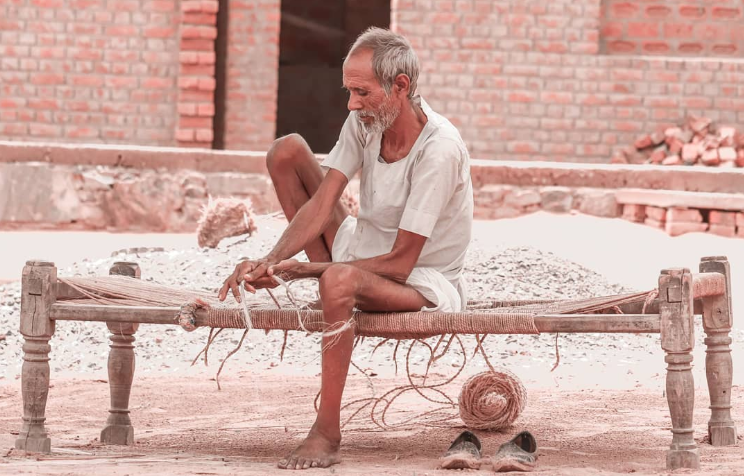
India has long been known for its handcrafted heritage — from the charpai (khatiya) woven by nimble fingers in village courtyards to terracotta pots, brass diyas, hand-stitched quilts, and woven baskets that told stories of lineage, land, and culture. But today, with mass-produced, machine-made goods flooding markets, the question arises: Is handmade India losing ground to mechanisation?
In This Article:
Once celebrated for their durability and cultural value, traditional items are increasingly being replaced by plastic chairs, steel beds, ceramic substitutes, and machine-glazed cookware. The concern is not just about commerce — it’s about the erosion of livelihoods, heritage, and generational skill sets.
The Case of the Khatiya – From Courtyards to Curios
- The khatiya, a four-legged rope cot, was once a staple of Indian homes.
- Its frame, often made from local neem or bamboo, and ropes twisted from jute or coir, made it breathable, eco-friendly, and symbolic of rural life.
- But with low-cost, factory-produced furniture available at online and urban retail chains, the demand for khatiyas has sharply declined.
- Many artisans who once specialized in charpai-making are now taking up daily wage labor or abandoning the craft altogether.
Pottery and the Threat of Imitation
- Handmade clay pots, once prized for their earthy texture and natural cooling, now face stiff competition from machine-made pots that are cheaper and uniformly shaped.
- Traditional potters (kumhars) across Uttar Pradesh, Rajasthan, and Gujarat report dwindling income as ceramic and plastic kitchenware takes over urban and rural homes.
- The rise of factory-stamped diyas during Diwali is one of many examples of how machine-made has infiltrated even the most cultural moments.
The Price of Convenience
- Time, cost, and uniformity are the biggest reasons buyers now opt for machine-made goods.
- Artisanal products, which take days or even weeks to make, often struggle to match the speed and pricing of factories.
- However, this “convenience-first” model comes at a hidden cost:
- Loss of livelihoods for lakhs of craftspeople
- Decline in traditional knowledge systems
- Cultural homogenisation
- Loss of livelihoods for lakhs of craftspeople
What’s Being Done?
- Initiatives like GI tagging, government-run haats, and digital marketplaces like GeM and Etsy are helping artisans reach new audiences.
- NGOs and state governments are promoting rural skill revival through training and exhibitions.
- The rise of slow living, sustainability, and organic lifestyles is also prompting a renewed interest in handcrafted goods—but challenges remain.
Moving Ahead – Saving Handmade Before It’s Too Late
The struggle between handmade and machine-made is not just economic — it’s existential. The more we choose fast and cheap, the more we risk erasing the soul of Indian craftsmanship. Whether it’s the rustic khatiya, the humble matka, or the clay diya, each handmade object carries a piece of India’s collective memory. Preserving it may require more than nostalgia — it demands conscious action.
By – Nikita