


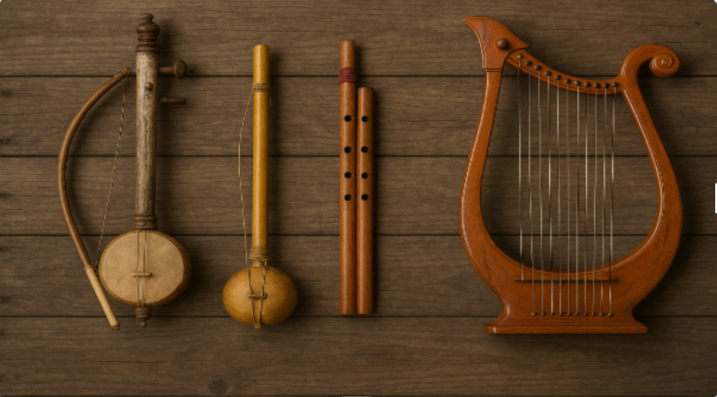
Through dusty village squares and neon-lit city nights, a revival of India’s near-forgotten folk instruments, the Ravanhatha, Ektara, Algoza and their kin, is orchestrating a quiet revolution. Young artisans, musicians, and ensembles across Rajasthan, Bengal, Punjab, and Tamil Nadu are bringing these culturally rich instruments into the modern spotlight.
In This Article:
Ravanhatha: The Desert Bowed Voice
The ravanhatha is a centuries-old bowed fiddle, often crafted from coconut shells, bamboo, and animal hair strings. Believed to echo the mythic music of Ravana himself, this instrument delivers a haunting, voice-like resonance.
In places like Rajasthan and Bengal, artisans are painstakingly hand-crafting these instruments using traditional materials and techniques. Workshops and NGOs are now training young players, while festivals and folk music circuits embrace these raw, evocative sounds. Cultural historians suggest the ravanhatha may even have inspired ancestors of the violin via migration through Persia and Europe.
Ektara: One-Stringed Soul
The ektara, literally “one string,” is treasured across Bengal, India, and Nepal, often accompanying Sufi chants or Baul kirtans. Its deep drone fosters spiritual connection and storytelling.
Modern revivalists are blending the ektara’s simplicity with experimental styles. Whether sustaining ancient ragas or fusing with electronic beats, its plaintive voice is finding fresh freedom.
Algoza and Other Flutes: Double the Breath
The algoza, a pair of flutes played via circular breathing, remains a staple of Punjabi and Rajasthani folk life. Its hypnotic rhythm often bridges devotional, dance, and festival traditions.
Festivals like Jodhpur RIFF feature young maestros like Idu Khan Langa on algoza, showcasing its place in global folk dialogues. Meanwhile, organizations like Aathun in Rajasthan support folk artists introducing rural art forms to urban audiences.
Craft + Innovation: Uru Music Collective
From Chennai, the Uru Music Collective is reviving the yazh, an extinct harp-like Tamil instrument. Led by architect-musician Tharun Sekar (26), they recreated the yazh using historical texts and engineering insight, introducing tweaks like modern tuners and tuning to the global C-major scale.
Their electric adaptation and live performances demonstrate how ancient instruments can evolve without losing their soul. Uru’s ongoing mission expands into education, instrument creation, and fusion performances .
Fusion Bands & Cultural Currents
Ensembles like Rajasthan Roots, Swaraag, and Sufi Rang include instruments like ektara and algoza in their globally-tinged Sufi and folk-fusion repertoires. They bridge traditional balladry and contemporary global sounds, reaching broader audiences through platforms like Spotify and collaborative festivals.
Why It Matters
- Cultural Resurgence: These revivals keep intangible heritage alive, echoing landscapes, legends, and voices sidelined by digital media.
- Innovation & Adaptation: Projects like Uru show that revering the past doesn’t prevent modernization—it invites it.
- Community Building: Cross-disciplinary workshops bind luthiers, musicians, historians, and audiences in shared guardianship.
Looking Ahead
The movement is gaining momentum but needs structural support: funding, institutional collaboration, and digital archiving. Initiatives like Krishnendu’s planned cultural center and Joydeep Mukherjee’s efforts to revive extinct Bengali instruments show that passion often precedes policy.
These young custodians are blending scholarship, craftsmanship, and experimentation—showing us that preserving heritage does not mean preserving stasis. It means ensuring that ancient echoes continue to sing, resonate, and evolve.
In Harmony with the Future
As the bow glides, the ektara drones, and flutes ripple through air, the music of bygone eras returns, shaped by new hands, new ears, and new hearts. These spotlight-fading instruments—ravanhatha, ektara, algoza, yazh, are rediscovered not as relics, but as living dialogues between past and present. And in their revival, we see a future that sings with memory.
By – Sonali