


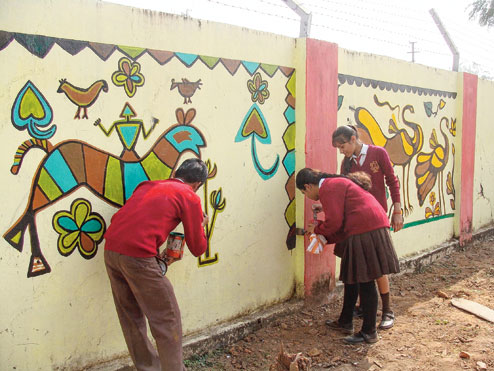
Bhitti Chitra, literally “wall picture” in Sanskrit, is a centuries-old mural art tradition from Odisha, where entire walls narrate mythological tales, depict deities, and celebrate local rituals. Often seen in temples and traditional homes, this art form continues the visual storytelling legacy of Odisha’s famed Pattachitra, but on a larger, architectural scale.
In This Article:
- Origins & Historical Roots
- Technique & Materials
- Themes & Aesthetic Style
- Cultural Significance
- Contemporary Revival
- Challenges & Future Outlook
- A testament to Odisha’s living heritage
Origins & Historical Roots
Emerging during the Ganga dynasty (11th–15th centuries), Odisha’s Bhitti Chitra echoes the same narrative ethos found in Pattachitra, focusing on religious lore and vibrant mytho-epic scenes. Temple walls in Puri, Konark, and Bhubaneswar preserve these colourful frescoes that have withstood centuries.
Despite their fragility, remnants of such murals offer glimpses into Odisha’s sacred art heritage, marked by intricate lines, stylized figures, and bold, natural pigments.
Technique & Materials
Wall Preparation:
Walls, often mud or plaster, are coated with lipai, a smooth layer made from clay, cow-dung, and water, creating a firm base for painting.
Natural Pigments:
Odisha’s artists use:
- Geru (red ochre), hingula-mineral reds
- Haritala-yellow stone
- Ramaraja (indigo)-blue
- Black from lamp soot or burnt coconut shells
- White lime or conch shell paste
These pigments are often bound with natural gums or oils like tisi (flaxseed).
Brushes:
Made from bamboo sticks with animal or plant-fiber tips, sometimes even mouse hairs for fine detailing.
Execution Process:
- Sketching: Figures and motifs are sketched directly onto the prepared wall.
- Filling: Flat, vivid color fills define figures and background.
- Outlining: Bold, stylized outlines and ornate borders are added in final layers, occasionally with gold or silver leaf.
Themes & Aesthetic Style
Bhitti Chitra shares thematic richness with Pattachitra, drawing from:
- Jagannath triad (Jagannath, Balabhadra, Subhadra)
- Krishna-Leela, Dashavatara, Ramayana & Mahabharata
- Temple festivals like Rath Yatra and Dola Yatra
- Local folk scenes and ritual events
The style is defined by:
- Bold, angular lines
- Flat color palettes with limited shading
- Frontal or profile figures with elongated eyes
- Dense decorative borders and floral motifs
- Minimal background landscapes
Cultural Significance
Bhitti Chitra is both devotional and communal. It transforms walls into temples of narrative, embedding mythic discourse into everyday space. Unlike portable art, these murals are site-specific and integral to temple architecture and domestic environments, connecting people with history and belief through immersive visual storytelling.
Contemporary Revival
Though many ancient murals are fading, pockets of resurgence thrive in artisan hubs like Raghurajpur. Here, Chitrakar families apply Bhitti Chitra tradition to both temple walls and modern homes, keeping the craft alive through commissions and cultural advocacy.
This revival extends to Rajasthan and Chhattisgarh, where the shared technique of wall painting persists. Today, Odisha’s version stands out for its direct link with Pattachitra and temple architecture.
Challenges & Future Outlook
Bhitti Chitra faces challenges:
- Durability: Natural pigments and exposed walls deteriorate over time.
- Patronage: Modern housing materials often favor plain finishes over elaborate murals.
- Transmission: As artisans age, younger generations may leave the craft for urban careers.
To secure its future, experts suggest:
- Conservation efforts for existing murals
- Incentives and apprenticeships to train young artists
- Integrating Bhitti Chitra into cultural tourism and contemporary décor
A testament to Odisha’s living heritage
Bhitti Chitra stands as a testament to Odisha’s living heritage, an art where walls are canvases, and color breathes life into legend. Its survival depends not only on preservation but also on contemporary appreciation. Nurturing this visual language ensures that the grand, colorful walls of Odisha continue to narrate the tales of gods, culture, and community for generations to come.
By – Sonali