


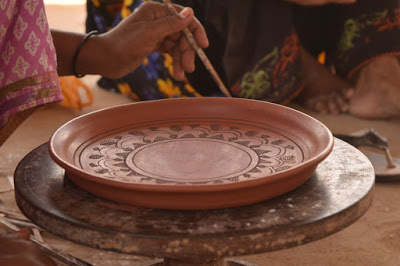
In the salt-scorched plains bordering the Great Rann of Kutch, the small village of Khavda is keeping alive a millennia-old craft: Khavda pottery. Revered for its striking visual style and deep historical roots in the Indus Valley civilisation, this pottery reflects both heritage and resilience.
In This Article:
- Historic Roots and Archaeological Link
- The Artisans and Their Techniques
- Cultural Importance and Local Economy
- Challenges and Preservation Efforts
- Tourism Potential and Cultural Impact
- Outlook: Tradition in the Modern World
- Headline in Focus
Historic Roots and Archaeological Link
Archaeological excavations of Dholavira, a UNESCO World Heritage site about an hour’s drive from Khavda, uncovered ceramics bearing striking resemblance to those still produced by local potters. These include bold black patterns on red clay bodies, confirming a direct link to Harappan traditions. Scholars confirm that Khavda pottery preserves continuity with ancient craftsmanship from the Bronze Age.
The Artisans and Their Techniques
Khavda’s pottery is crafted primarily by families of Kumbhar and Prajapati communities, whose roots in the region trace back to Sindh. The artisans use locally sourced “Rann ki Mitti,” a reddish clay mined near seasonal lakes, and shape vessels on traditional potter’s wheels.
Decoration is a two-color affair. A red base from ochre (“geru”) gives the clay its signature hue. Artisans then apply geometric and abstract motifs in natural black pigment, and women paint fine white dots using bamboo twigs. Subjects vary from stylised animals and floral motifs to abstract line work.
Cultural Importance and Local Economy
Khavda is known locally as a handicrafts hub, producing not only pottery but also leatherwork, embroidery and handmade dolls. Artisans are proud of their heritage, and many now rely on craft to support their families. The village is home to about 4,062 people across 885 families, with Meghwal and Muslim communities forming the principal population groups.
While buffalo-rearing and seasonal labour have traditionally supported livelihoods, many artisans now depend on craft sales both locally and in festivals such as the Rann Utsav, which draws tourists to the broader Kutch region.
Challenges and Preservation Efforts
Despite its cultural value, Khavda pottery faces serious challenges. Younger generations are drifting away from the craft, and there is limited formal documentation or institutional support for training and commercialization. The art is at risk of fading unless deliberate efforts are made to nurture it.
In response, local NGOs such as Khamir—the Kutch Crafts Trust have launched initiatives to revitalize Khavda pottery. They bring artisans together to experiment with glazes, new forms, and broader markets. Some collaborations aim to combine traditional designs with contemporary usage (e.g., lamps, trays, and even decorative phone amplifiers).
Tourism Potential and Cultural Impact
Situated just under 70 km north of Bhuj, Khavda is often the final stop before entering the stark white desert. Tourists passing through frequently pause to admire local crafts or to spot flamingoes that migrate to the nearby Jamkundaliya lake between October and March.
Pottery workshops double as cultural exhibits. Travelers witnessing live throws and hand-painting in dusty huts are often struck by the art’s simplicity and depth. For many artisans, tourism has become a lifeline, offering both income and pride.
Outlook: Tradition in the Modern World
Khavda pottery embodies the delicate balance between heritage and survival. Each hand-shaped vessel echoes ancient history, yet its future hinges on markets, innovation, and cultural pride.
Efforts to preserve the craft, by NGOs, government rural-tourism initiatives, and festival platforms, must intensify. Without them, centuries-old techniques that once flourished in the Indus civilization may vanish. But there is cause for hope: in recent years, artisan workshops and festivals have begun to highlight Khavda’s distinct style, and some younger potters are re-engaging through training programs.
Headline in Focus
Khavda’s Clay Legacy: Ancient Indus-Valley Pottery Flourishes in Modern Gujarat captures the essence of a traditional craft rooted in archaeology yet facing contemporary challenges. As cultural tourism grows and craft advocates work to broaden markets, Khavda pottery may yet secure its place in both history and the modern economy.
By – Sonali