


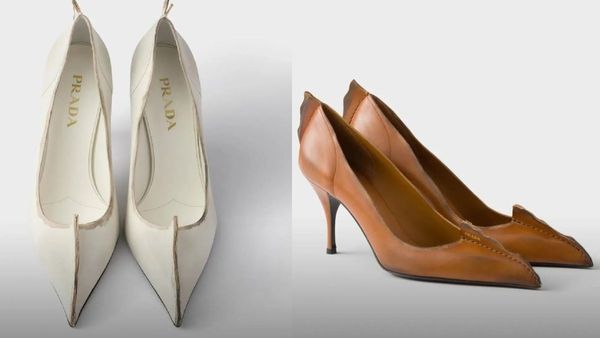
On July 24, 2025, Italian luxury brand Prada unveiled its ‘Antiqued Leather Pumps’ at Milan Fashion Week, priced at $1,450 (Rs. 1.25 lakh), igniting fury across India’s 547-million OTT audience for their striking resemblance to traditional Punjabi and Rajasthani juttis. Barely a month after backlash over Kolhapuri chappal-inspired sandals, Prada faces accusations of cultural appropriation, with artisans and netizens demanding credit for India’s heritage. Prada’s failure to acknowledge jutti roots fuels debates on ethical fashion.
In This Article:
- A Cultural Clash
- Echoes of the Kolhapuri Controversy
- Why Prada’s Obsession with Indian Footwear?
- A Path Forward
A Cultural Clash
Prada’s pumps, described as “original and unconventional” with pointed toes, visible stitching, and raw-cut leather edges, mirror the handcrafted juttis of Punjab, Rajasthan, and Uttar Pradesh. These flat, embroidered shoes, retailing locally for Rs. 400–2,000, are cultural staples worn at weddings and festivals. In Amritsar, shopkeeper Akash said, “Our livelihood depends on juttis. Prada’s Rs. 1.25 lakh price mocks our craft,” highlighting the economic disparity. Footwear designer Rashmi Tomar noted the pumps’ toe shape and silhouette scream Rajasthani mojaris, not innovation.
Echoes of the Kolhapuri Controversy
This isn’t Prada’s first misstep. In June 2025, its spring/summer 2026 menswear show featured ‘Toe Ring Sandals’ resembling Maharashtra’s GI-tagged Kolhapuri chappals, priced at Rs. 1 lakh. Artisans like Harish Kurade, who crafts durable buffalo-hide sandals for Rs. 400, were outraged at the lack of credit. A public interest litigation in Bombay High Court demanded compensation. Prada’s belated acknowledgment, after Maharashtra’s Chamber of Commerce intervened, promised artisan collaboration, yet no concrete action followed. The jutti scandal reignites distrust, with 70% of Indian Gen Z on X, per a 2024 YouGov survey, calling for accountability.
Why Prada’s Obsession with Indian Footwear?
Prada’s fixation reflects a global trend: Indian designs’ vibrant aesthetics—juttis’ intricate embroidery and Kolhapuris’ T-strap weaves—offer exotic appeal to Western markets. India’s $200 million footwear craft industry, rooted in 12th-century traditions, is a treasure trove. Yet, artisans like Sadashiv Sanake, earning $8 per pair, see no profits from Prada’s $1,000 sandals, per reports. Critics argue luxury brands exploit cultural heritage for profit, with 80% of Indian artisans in unorganized sectors, per MACCIA.
A Path Forward
The outrage has boosted jutti and Kolhapuri sales, with Google Trends showing a 30% spike. Artisans like Shanti from Kolhapur hope for global recognition, saying, “If Prada collaborates, we can thrive.” India’s push for international patents, per MACCIA, aims to protect crafts like juttis, which lack GI tags. As #EthicalFashion trends, Prada’s pattern—repeating appropriation without upfront credit—demands reform. Will the brand engage artisans or continue repackaging India’s heritage? For now, India’s youth and artisans, like Akash, demand respect over replication.
-By Manoj H