


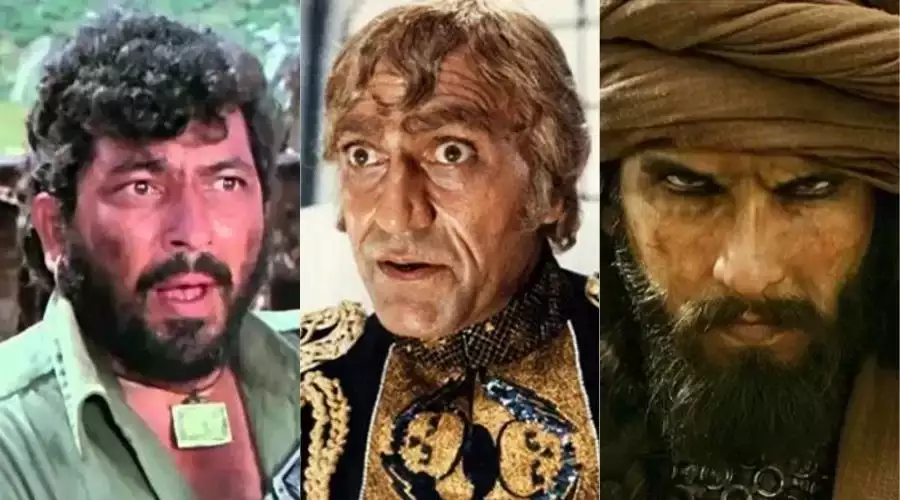
Bollywood’s cinematic landscape in Mumbai and beyond reflects a seismic shift in villainy. The larger-than-life rogues of yesteryears—Gabbar Singh from Sholay (1975) and Mogambo from Mr. India (1987)—once ruled with cackling menace, while today’s morally grey antagonists like those in Drishyam 2 (2022) and Sacred Games (2018) weave complex tapestries of motive and redemption. Audiences crave depth, mirroring real-world ambiguities, driven by OTT’s nuanced storytelling. Through layered scripts and stellar performances, this evolution captivates India’s 900 million internet users, sparking debates on X with #VillainEvolution.
The Golden Era’s Iconic Evil
Gabbar, with Amjad Khan’s gravelly laugh and iconic “Kitne aadmi the?” line, embodied pure chaos—his sadistic glee and black attire painted him as an untouchable force of nature. Mogambo, brought to life by Amrish Puri with his theatrical “Mogambo khush hua,” was a megalomaniac dictator, his gold-laden lair a symbol of unbridled power. These villains thrived in a binary world of good versus evil, offering escapism to a post-independence India seeking clear moral anchors. Their larger-than-life presence—Gabbar’s ₹1 lakh bounty, Mogambo’s sci-fi lair—made them unforgettable, but their one-dimensionality feels dated today.
The Rise of the Grey Shade
Contrast this with modern antagonists. Ajay Devgn’s IG Vijay Salaskar in Sacred Games blurs lines—his ruthless policing masks a personal vendetta, making viewers question justice. Akshaye Khanna’s IG Tarun Ahlawat in Drishyam 2 is a relentless pursuer, yet his grief over a lost child humanizes his obsession. These characters, born in the OTT era, reflect a society wrestling with corruption, morality, and survival. Their flaws—Salaskar’s rage, Ahlawat’s tunnel vision—resonate with audiences tired of cartoonish evil, offering a mirror to India’s complex socio-political fabric.
Why the Shift?
Today’s viewers, shaped by global cinema and real-time news, demand authenticity. A 2024 Ormax Media survey found 68% of Indian OTT users prefer characters with relatable motives over outright villains. The digital age—streaming Mirzapur’s Kaleen Bhaiya or Paatal Lok’s Hathiram—exposes grey realities: power struggles, personal loss, and ethical dilemmas. Nostalgia for Gabbar’s bravado fades as Gen Z, with its 65% engagement in moral debates per YouGov 2025, seeks villains who challenge rather than dictate.
A Creative and Human Angle
Imagine Amjad Khan’s grandson, now a budding actor, watching Sacred Games and pondering Gabbar’s legacy—could his grandfather’s snarl have softened into Salaskar’s grit? This evolution reflects actors’ willingness to embrace complexity, moving from Puri’s bombastic delivery to Khanna’s understated intensity. Yet, purists argue the old-school villain’s charm—unapologetic and larger-than-life—offers a cathartic release absent in grey shades.
A New Dawn for Darkness
As #VillainRedefined trends, Bollywood’s villains evolve from symbols of fear to reflections of humanity. The shift from Gabbar’s tyranny to Ahlawat’s anguish signals a cinema ready to embrace the grey, challenging audiences to rethink morality.
-By Manoj H