


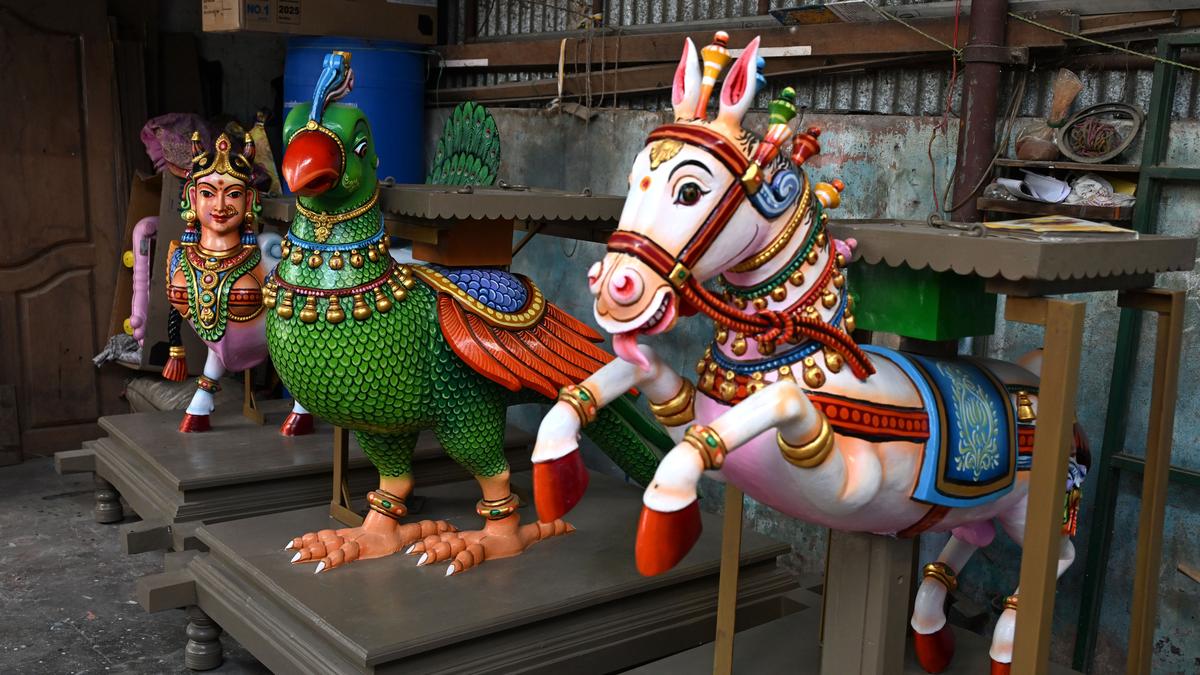
In the quiet village of Thiruvathigai, where the whisper of chisels against wood has resonated for generations, an extraordinary legacy unfolds with each carved curl of timber. Here, skilled artisans continue an ancient tradition that transforms humble wood into sacred vessels, the magnificent vahanas and rathams that carry deities through temple festivals across Tamil Nadu.
Heritage Village Sustains Sacred Craft Through Generations
Thiruvathigai, nestled near the Kedilam River in the Cuddalore district, has earned recognition as a unique cultural heritage center where “talents in wooden crafts” have flourished “over nine generations.” This ancient village, renowned for its Veerateeswarar Temple dating back to the 9th century, has become synonymous with the specialized artistry required to create processional temple vehicles that are integral to Hindu religious festivals.
The traditional craft encompasses the creation of elaborate temple cars (rathams) and various processional mounts (vahanas), including elephants, horses, lions, bulls, mythical birds like Garuda, and serpent vehicles. These intricately carved wooden structures serve as mobile shrines during religious processions, transforming into “temples in motion” during festivals.
Master Artisans Follow Ancient Architectural Principles
The craft of temple vahana construction in Thiruvathigai follows principles established in ancient texts like the Mayamata and Sulabha Sutras, which describe detailed methods and measurements for creating these sacred vehicles. Local artisans, traditionally from the Kammalar caste, have preserved techniques that demand “60% knowledge of carpentry, 30% of carving work, and 10% of idol making.”
Each temple car functions as “a representation of the cosmos with the Divine in the form of the Uthavamurti seated at the center.” The structures incorporate complex proportional systems where measurements of components like wheels (chakram), platforms (pada), and the tower-like structures (vimana) are mathematically related to create visual harmony and structural stability.
The artisans utilize wood from the iluppai maram (mahua tree), selected for its oil content and durability. The construction process involves creating multiple set-in panels featuring deities, mythical animals like yaalis and makaras, real animals, celestial beings (ganas), dancers, and decorative floral motifs. These high-relief carvings demonstrate remarkable sensitivity and attention to detail.
Intricate Craftsmanship Creates Mobile Temples
Temple cars from Thiruvathigai can range from 1 to 8 meters in height and feature intricate carving work that rivals the finest temple architecture. These structures serve as “huge vimanas resting on 4-8 massive wheels” and function as both shrines and platforms for deities during festivals. The vahanas are enhanced with brass plating, silver plating, or silver-with-gold embossing, work often completed by the carpenter-artisans themselves.
During festivals, particularly the ten days preceding Tamil New Year, these creations come alive as deities are taken out in procession on various mounts, including singam (lion), kaamadhenu (winged cow), annapakshi (mythical bird), vimaana (flying chariot), vrishabham (bull), horse, smaller temple cars, ratha, and pushpalaka shrines.
Modern Challenges Threaten Ancient Traditions
Despite their cultural significance, the traditional craft faces considerable challenges. The “patronage of traditional crafts demanding fine detailing has petered out, so the number of craftsmen practicing the art has decreased.” Many temple cars across Tamil Nadu require urgent restoration, with the HR & CE department identifying 73 temple cars statewide that need repair.
The wooden structures, despite their durability, have maximum lifespans of approximately 300 years due to exposure to various climates. Some temples have modernized by replacing traditional wooden wheels with iron ones, with public sector companies like BHEL becoming suppliers. However, restoration efforts now focus on returning these chariots to their “original glory” using traditional techniques and materials.
Cultural Preservation Efforts Gain Momentum
Recognition of the craft’s importance has led to documentation and preservation initiatives. Museums now house collections of temple car components, particularly wooden elements, to showcase the “artistic skills of sculptors who lived among us years ago.” The Government of Tamil Nadu, through outlets like Poompuhar, has initiated training programs and marketing support for traditional crafts.
The craft represents more than mere artisanship; it embodies the philosophical concept that viewing these structures can “free one from the repeated cycle of life and death.” As stated in ancient texts, the principle holds that “only if a temple is constructed correctly according to the mathematical system can it be expected to function in harmony with the universe.”
By – Sonali