


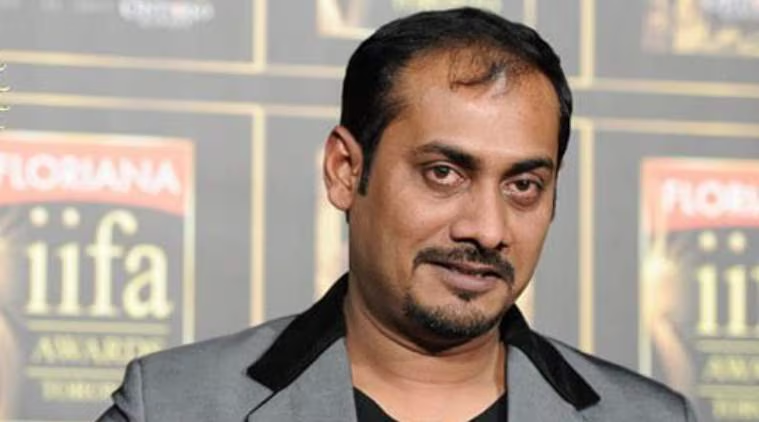
In a revelation that has reignited one of Bollywood’s most iconic controversies, Dabangg director Abhinav Kashyap has claimed that Salman Khan and Arbaaz Khan were not in favor of Malaika Arora performing the cult hit Munni Badnaam Hui. According to Kashyap, the Khan brothers, despite being part of the film, were “conservative” about Malaika’s costumes and were uncomfortable with her being labeled an “item girl.”
The Clash Over Costumes and Conservatism
Speaking about the incident, Kashyap said that Arbaaz Khan, who was married to Malaika at the time, was hesitant about letting her do the song.
- He feared the “item girl” tag would follow her.
- Salman, too, reportedly sided with his brother, objecting to Malaika’s revealing outfits.
- Kashyap bluntly called the brothers “conservative Muslims,” adding that they preferred women in their family to dress modestly.
Malaika, however, wasn’t willing to back down. The filmmaker credited her for standing her ground, convincing Arbaaz that the number was simply a dance performance surrounded by family members in the sequence.
“Malaika is strong and independent. She told Arbaaz it’s nothing vulgar, just dancing. Eventually, she got her way — and the song went on to break records,” Kashyap recalled.
The Song That Changed the Game
What’s ironic is that Munni Badnaam Hui not only became the highlight of Dabangg, it turned into a cultural phenomenon. From wedding dance floors to political rallies, the track was everywhere. Kashyap admitted that the Khans eventually gave in — and the success silenced all doubts.
Interestingly, actor Sonu Sood had earlier revealed that the song was originally meant as a solo sequence for his character, Chhedi Singh. Salman reportedly insisted on joining in, claiming it was the “best song” of the film. Kashyap restructured the sequence to make space for him, which, in hindsight, only amplified its impact.
A Glimpse of Bollywood’s Double Standards?
This revelation is more than just behind-the-scenes trivia. It shines a light on the double standards of Bollywood stardom — where female performers often face restrictions, while male stars step in at will. Malaika’s eventual triumph with Munni not only boosted her career but also exposed how creative decisions are shaped by egos and power equations in the industry.
The Legacy of Dabangg
Released in 2010, Dabangg introduced Sonakshi Sinha, brought back the swagger of Salman Khan as Chulbul Pandey, and established item songs as career-defining. The film’s roaring success spawned two sequels — Dabangg 2 (2012) directed by Arbaaz and Dabangg 3 (2019) helmed by Prabhu Deva. Yet, more than a decade later, it’s Munni Badnaam Hui that continues to steal the spotlight.
By – Nikita