


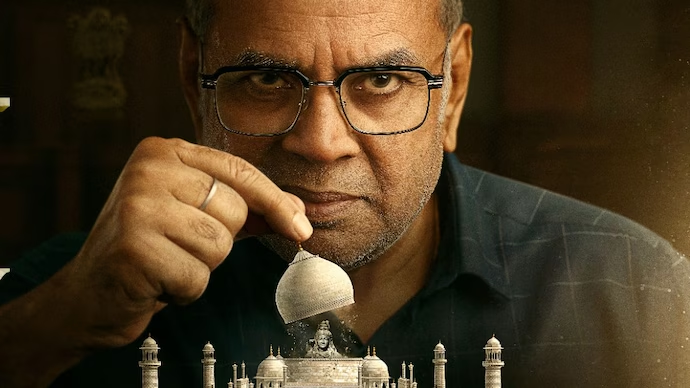
The unveiling of the motion poster for Paresh Rawal’s upcoming film The Taj Story sparked fierce debate on social media this week, as fans and critics alike decried an image depicting a Shiva idol seemingly emerging from within the dome of the Taj Mahal. Following widespread criticism, the film’s producers issued a public clarification to quell concerns over alleged religious messaging.
Poster Sparks Controversy
On Monday, Paresh Rawal shared the film’s official motion poster on X (formerly Twitter), featuring a striking visual: the iconic white marble dome of the Taj Mahal, with the silhouette of Lord Shiva’s idol appearing to break through its apex. Many social media users interpreted the imagery as an implicit assertion that the 17th-century Mughal mausoleum was built atop a pre-existing Hindu temple.
Critics accused the filmmakers of exploiting a long-debated fringe theory to stir controversy. “This is irresponsible,” one user tweeted. “The Taj Mahal is a UNESCO World Heritage Site with no credible evidence of any Shiva temple beneath it.” Others warned that the poster risked inflaming communal sensitivities.
Within hours of the backlash, Rawal deleted his initial post and shared a statement from the production team clarifying the film’s intentions.
Makers Clarify Intent
Swarnim Global Services Pvt. Ltd., the lead production house behind The Taj Story, issued a disclaimer emphasising that the movie “does not deal with any religious matters, nor does it claim that a Shiv temple resides within the Taj Mahal.” The statement urged audiences to view the film for themselves before drawing conclusions:
“The makers of The Taj Story clarify that the movie focuses solely on historical facts and does not wade into religious controversies. We request you to watch the film and form your own opinion. Thank you.”
Paresh Rawal echoed this position in his follow-up message on X, reposting the disclaimer and reiterating that the film’s narrative is grounded in documented history rather than unverified theories.
Historical Debate Over Taj Mahal’s Origins
Since its completion in 1653, the Taj Mahal, commissioned by Mughal emperor Shah Jahan as a mausoleum for his wife Mumtaz Mahal has captivated scholars, tourists, and conspiracy theorists alike. Despite mainstream historians overwhelmingly agreeing the structure was designed and built by the Mughal court’s architects, a persistent fringe narrative alleges the monument sits atop a Hindu temple.
No credible archaeological or archival evidence has substantiated this theory. The Archaeological Survey of India and various UNESCO reports confirm the cohesive Mughal design, including the marble inlay work, Persian inscriptions, and original construction records.
Nonetheless, the notion has resurfaced periodically in political and cultural debates, reflecting broader conversations over India’s layered past. Some historians caution that such claims, when presented without rigorous scholarship, can distort public understanding of history.
Film Premise and Release Date
The Taj Story is written and directed by Tushar Amrish Goel and produced by Swarnim Global Services Pvt. Ltd. alongside CA Suresh Jha. In addition to Paresh Rawal’s leading role, the film credits Vikas Radhesham as creative producer.
While plot details remain under wraps, promotional materials suggest the narrative will explore lesser-known aspects of the Taj Mahal’s construction and the political intrigue of the Mughal era. The production team assures viewers the film adheres strictly to verifiable historical sources.
The producers have set the theatrical release for October 31, promising audiences an immersive journey through 17th-century India’s artistic, architectural, and cultural milestones.
Audience Expectations
By clarifying the film’s scope, the makers aim to redirect attention from the poster’s provocative imagery to the storyline’s academic underpinnings. Film critics and historians will likely scrutinise The Taj Story upon release, evaluating its treatment of historical controversies and its fidelity to archival records.
As anticipation builds, the production team’s swift response underscores the sensitive interplay between cinema, heritage, and communal identity in contemporary India. With the film’s October release looming, both supporters and skeptics await whether The Taj Story will provide fresh insights into one of the world’s most celebrated monuments or whether it will reignite debates over its origins once again.
By – Sonali