


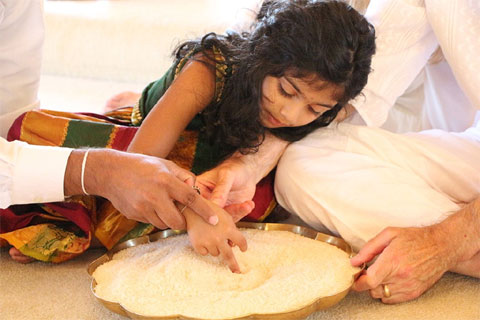
Vidyarambham, a cherished Hindu tradition in Kerala, Tamil Nadu, Karnataka, and Andhra Pradesh, marks the formal initiation of young children into the world of learning and arts. Observed on Vijayadashami (Dussehra), it falls on October 2, 2025, coinciding with the end of Navratri and the worship of Goddess Saraswati. Families, often accompanied by elders or priests, guide toddlers aged 3-5 to write their first letters on rice or sand, symbolizing the dawn of wisdom. Held at temples like Dakshina Mookambika in Paravur or Thunchan Parambu in Tirur, the ceremony blends devotion with joy, uniting communities in Kerala’s lush landscapes during a festival that emphasizes education’s sanctity.
Historical and Cultural Roots
Vidyarambham, derived from “Vidya” (knowledge) and “Arambham” (beginning), traces its origins to ancient Vedic traditions, where education was seen as a divine gift from Saraswati. In Kerala, it’s tied to the Thunchan Parambu Temple, honoring Thunchath Ezhuthachan, the father of Malayalam literature, who reformed the script in the 16th century. The ritual evolved from the gurukul system, where children were introduced to scriptures on an auspicious day. Historically, it was for 7-year-olds, but now targets preschoolers, reflecting modern early education. In Tamil Nadu and Karnataka, it’s called Akshara Abhyasam or Ezhuthiniruthu, emphasizing the first syllable “Om” or “Hari Shri Ganapataye Namah.”
Rituals: A Gentle Gateway to Learning
The ceremony begins with a ritual bath for the child, dressed in traditional attire like a white dhoti or sari. At the temple or home, parents or a guru holds the child’s hand to trace the first letters on a rice-filled tray or wet sand, invoking Ganesha for obstacle-free learning. Prayers to Saraswati follow, with offerings of flowers, fruits, and sweets. The child writes “Om” or the mantra “Hari Shri Ganapataye Namah,” symbolizing wisdom’s start. In Kerala, thousands gather at temples like Mookambika in Kollur, with priests guiding the rite. The muhurat for 2025 is October 2, during Aparahna (afternoon) or Vijay Muhurat, per Drik Panchang. Post-ritual, feasts and music mark the joyous entry into education.
Significance: Empowering Young Minds
Vidyarambham signifies life’s first step toward knowledge, aligning with Vijayadashami’s theme of triumph over ignorance. It instills discipline and curiosity, believed to bless the child with Saraswati’s grace for academic and artistic success. In Kerala, it’s a cultural milestone, with newspapers boosting circulation through special editions. The rite promotes gender equality, as both boys and girls participate, countering historical biases. In modern times, it adapts to include digital literacy, reflecting India’s push for education amid 1.4 billion people.
Modern Evolution and Community Impact
Urban families blend tradition with innovation, using apps for virtual ceremonies, while rural areas preserve authenticity. In 2025, amid post-pandemic recovery, it emphasizes holistic learning. Social media shares #Vidyarambham2025 moments, connecting diaspora communities. Challenges include commercialization, but its core—igniting young minds—endures, fostering India’s intellectual heritage.
A Spark of Wisdom
Vidyarambham isn’t just a ritual—it’s a promise of enlightenment. On October 2, 2025, as tiny fingers trace “Om,” it asks: Can ancient rites light modern paths? Kerala’s answer is yes, sowing seeds of knowledge for generations.
-By Manoj H