


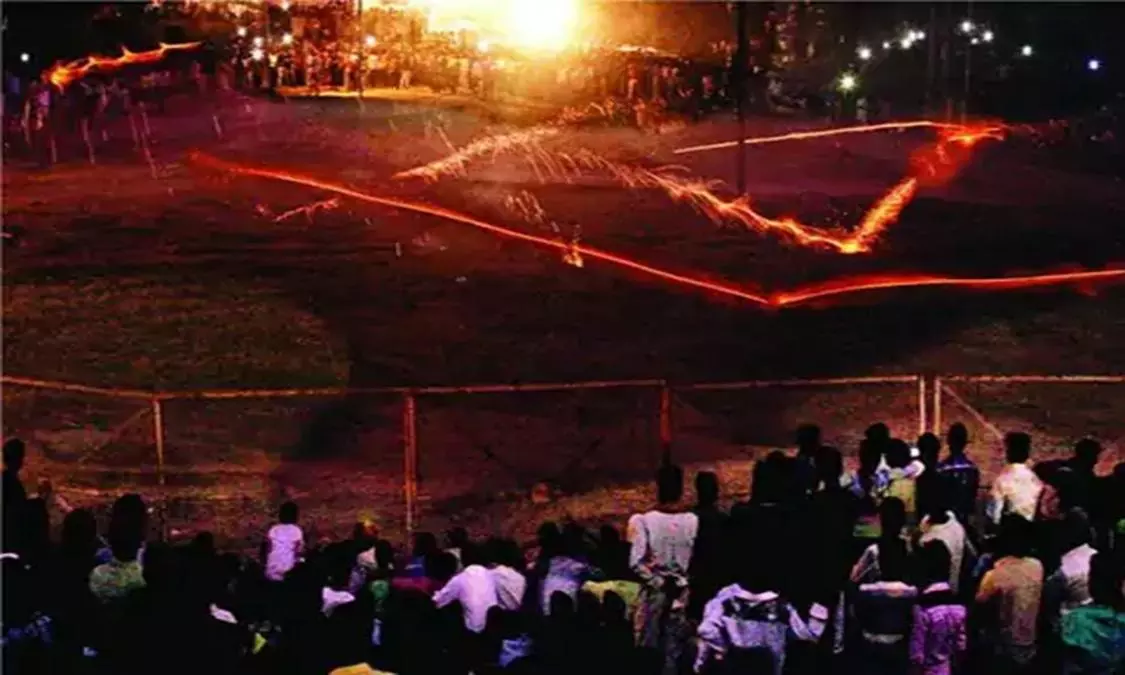
The skies above Gautampura turned amber once again this week as warriors armed with flaming missiles battled in a centuries-old tradition that transforms festivity into fierce spectacle. Just a day after Diwali, the annual Hingot War erupted near Indore, leaving 35 participants nursing burn injuries but the ancient spirit of valor burning brighter than ever. This celebration is not merely a festival; it is a fiery testament to courage, a dance with danger that has survived generations, and a cultural legacy that refuses to fade despite modern concerns.
A Battlefield Where Fruits Become Weapons
In the heart of Madhya Pradesh, approximately 55 kilometers from Indore city, the village of Gautampura transforms into a war zone every year on Dhok Padwa, the day following Diwali. Here, the Hingot War is not fought with swords or shields but with burning projectiles crafted from nature’s own arsenal. The hingot, a wild forest fruit resembling a small mango, becomes a weapon after an elaborate preparation process.
Warriors pluck these fruits from hingoria trees scattered across regions like Ujjain, Badnawar, and Dhar, then hollow them out by removing the pulp. The dried shells are then packed with a potent mixture of local combustible materials, including crushed charcoal from castor wood, corn ear, soda, gandrap, and kshar. After being stuffed with gunpowder, the shell is sealed with yellow mud and attached to a bamboo stick that serves as a propeller. The result: a rocket-like missile that flashes through the air like a meteor when ignited.
The preparation alone takes 8-10 days of drying, and with each hingot now costing Rs 18-20 due to the scarcity of hingoria trees, the tradition faces an uncertain economic future. Yet the warriors persist, traveling to distant forests to gather their ammunition, determined to keep this heritage alive.
Turra vs Kalangi: Warriors Without Winners
As evening descends on the battlefield near Devnarayan Temple, two rival armies take their positions approximately 200 feet apart. The Turra team, representing Gautampura village, faces off against the Kalangi team from neighboring Runji village. Dressed in traditional attire with turbans wrapped around their heads, the warriors carry iron shields in one hand and sling bags filled with hingots across their shoulders.
What sets this battle apart is its underlying philosophy: there are no winners or losers, only men proving their bravery. The war begins with an extraordinary gesture: opponents embrace each other before the combat commences, establishing that this is not about enmity but about honoring tradition and demonstrating courage. As deafening drums beat and clouds of smoke billow across the field, warriors light their bamboo sticks using slowly burning castor wood and hurl blazing shells toward their opponents.
The spectacle lasts approximately one to one-and-a-half hours, creating an atmosphere of raw adrenaline as fireballs streak through the darkening sky. Both sides exchange volleys of burning projectiles while defending themselves with shields, and the first team to exhaust their supply of hingots traditionally concedes the battle. Despite the intense competition, members of both teams remain ready to assist anyone injured, maintaining the spirit of camaraderie that underpins this dangerous tradition.
Echoes of Mughal Battles and Maratha Resistance
The origins of Hingot War remain shrouded in mystery, with no definitive historical documentation pinpointing its exact beginning. However, local folklore and village elders trace this tradition back over 200 years to the turbulent period between 1680 and 1707, during the Mughal-Dhangar Maratha Wars.
According to historians and community members, the practice emerged as a form of guerrilla warfare when Mughal cavalry forces attempted to raid and seize villages in the Gautampura region. The soldiers and inhabitants defending these areas, lacking sophisticated weapons, ingeniously weaponized the hingot fruit, stuffing it with gunpowder and hurling it at mounted Mughal soldiers to dismount them from their horses. This unconventional defense tactic proved effective in protecting their homeland from invaders.
The region around Gautampura has long been inhabited by the Gurjar community, known for their warrior spirit, bravery, and skilled horsemanship. Local folklore suggests that the Hingot War tradition evolved directly from the martial customs of these Gurjar warriors. When the actual conflicts ended, the local people preserved this warrior spirit by transforming it into an annual festival, a living memorial to their ancestors’ courage, and a means of ensuring future generations would not forget the art of hingot warfare.
For the people of Gautampura, hingot represents more than a weapon; it symbolizes swabhiman (self-respect) and the indomitable spirit that helped their forefathers resist foreign domination. By reenacting this battle each year, the community maintains a tangible connection to their history and honors the sacrifice of those who defended their land.
Dhok Padwa: The Day After Lights Become Flames
The timing of Hingot War holds deep cultural significance, observed annually on Dhok Padwa, the day immediately following Diwali. While Diwali illuminates homes with peaceful diyas and celebrates prosperity, Dhok Padwa in this region ignites a different kind of fire, one that tests physical courage rather than simply symbolizing spiritual illumination.
Dhok Padwa, also known as Balipratipada in other parts of India, traditionally commemorates the return of King Bali to Earth and celebrates marital harmony and prosperity. However, in Gautampura and Runji, this day takes on a distinct martial character. The festival begins with both villages gathering at the Devnarayan Temple for evening prayers, seeking divine blessings before the battle commences.
In the nearby town of Mhow, Dhok Padwa is celebrated with equal fervor but in a contrasting manner; people visit homes, touch the feet of elders to seek blessings, and strengthen family bonds through embraces and sweets. The juxtaposition of these celebrations, peaceful familial bonding in one area and fierce fire battles in another, illustrates the rich diversity of regional traditions within a small geographical area of Madhya Pradesh.
For residents of Gautampura and Runji, Dhok Padwa has become synonymous with the Hingot War, and many who have moved away, even to foreign countries, make it a point to return home for this one day. The festival serves as a powerful magnet, drawing people back to their roots and reinforcing community identity through shared participation in this dangerous yet sacred ritual.
Safety Measures Amid Ancient Danger
As the tradition has gained national attention and notoriety for injuries and occasional fatalities, the Madhya Pradesh district administration has implemented comprehensive safety protocols in recent years. The 2025 event saw an unprecedented deployment of resources: over 200 police personnel, 100 administrative staff, multiple fire brigade teams, and ambulances stationed at the venue.
High nets exceeding 10 feet and sturdy barricades now encircle the battlefield, creating a protective barrier between the warriors and the thousands of spectators who gather to witness this spectacle. CCTV cameras monitor the proceedings, allowing officials to respond quickly to any emergency. Medical teams remain on standby at the primary health center, equipped to handle casualties ranging from minor burns to more serious injuries.
Despite these precautions, the inherent danger cannot be eliminated. In this year’s battle, 35 participants sustained injuries, with five requiring hospitalization for severe conditions including a broken arm and a nose injury. Block Medical Officer Dr. Vandana Kesari confirmed that all injured individuals were out of danger after receiving treatment. The relatively controlled casualty count represents an improvement over previous years, when the festival has resulted in fatalities and dozens of serious injuries.
However, officials acknowledge that completely banning the festival would be nearly impossible given its deep embedding in the religious tradition and cultural identity of the area. Instead, the approach focuses on harm reduction while respecting the community’s determination to preserve this heritage, even at personal risk.
A Tradition at the Crossroads
Beyond safety concerns, the Hingot War faces existential threats from environmental and economic factors. The scarcity of hingoria trees has forced warriors to travel increasingly long distances to harvest the fruit, and the doubled cost of preparing each missile strains the resources of participants. Villagers express growing concerns that without active conservation efforts to protect and propagate hingoria trees, this tradition may become unsustainable within a generation.
Yet despite these challenges, the Hingot War endures as a powerful symbol of cultural continuity. It represents the triumph of local tradition over homogenizing modern influences, the preservation of historical memory through embodied practice, and the community’s collective decision to value heritage even when it demands sacrifice. For the warriors of Turra and Kalangi, stepping onto that battlefield each Dhok Padwa is not recklessness but an act of profound cultural devotion, a way of telling their ancestors that their courage has not been forgotten and will not be abandoned, no matter how dangerous the flames or how uncertain the future.
As night falls over Gautampura and the last hingot blazes across the darkening sky, the tradition that began as resistance against invaders continues as resistance against cultural erasure, a living flame that refuses to be extinguished.
By – Sonali