


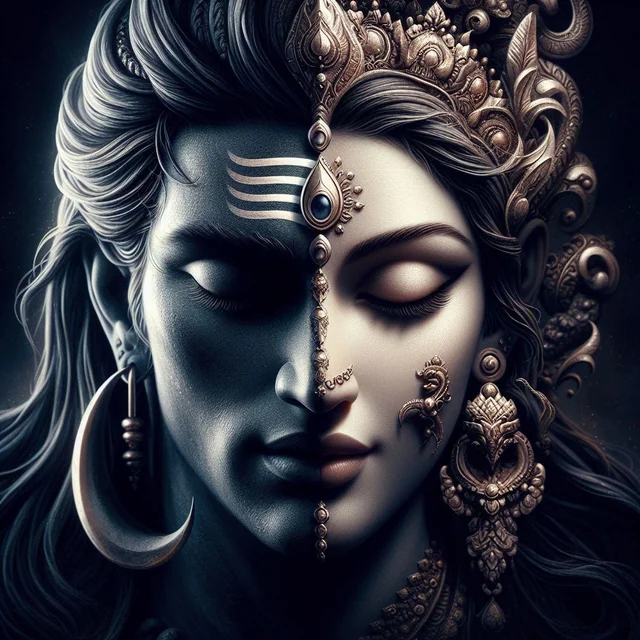
In the rush of modern romance, where Instagram likes measure love and swiping replaces courtship, relationships have become more complicated than ever. Yet, ancient Hindu philosophy whispers a timeless secret from thousands of years ago, a secret that could transform how we understand partnership, balance, and true equality. It’s the concept of Ardhanarishwar, a deity that teaches us something revolutionary: two complete individuals don’t complete each other; rather, they complement one another, creating something infinitely greater.
The Ancient Concept Unveiled
Ardhanarishwar, meaning “the Lord who is half-woman,” is depicted as half Shiva (masculine energy) and half Parvati (feminine energy), merged into a single divine form. But this isn’t about gender confusion or blurred lines, it’s about perfect equilibrium. The right half, representing Shiva, embodies strength, power, and destruction. The left half, symbolizing Parvati, channels compassion, creation, and nurturing. Together, they represent something neither could achieve alone: complete cosmic balance.
The mythology reveals an even deeper truth. According to sacred texts, Parvati sought to experience Shiva’s transcendent state. When she sat on his lap with complete acceptance and surrender, Shiva embraced her so fully that he made space within himself for her, shedding half of himself to include her entirely. This wasn’t a sacrifice; it was an ecstatic merger where both became something greater.
Complementing, Not Competing
Here’s where modern relationships get it wrong. We’ve been taught that equality means sameness, that men and women must compete on identical terms, in identical spaces, performing identical roles. But Ardhanarishwar teaches us something profoundly different: true equality isn’t about competition; it’s about complementarity.
Consider a tree and soil. The soil provides stability; the tree provides growth and creation. Neither is superior to the other. Remove the soil, and the tree dies. Remove the tree, and the soil lies barren. This is the essence of Shiva and Shakti’s relationship. In modern partnerships, this translates to understanding that different strengths aren’t inferior, they’re essential. When a partner brings emotional intelligence while another brings logical thinking, neither role diminishes the other. Each enhances the whole.
Beyond Gender: The Universal Truth
While Ardhanarishwar specifically balances masculine and feminine energies, its wisdom extends far beyond heterosexual partnerships. Every individual regardless of gender, harbors both energies within. The modern relationship crisis stems largely from our refusal to acknowledge this internal balance. Men fear appearing “soft” with emotions; women struggle to own their ambitions without guilt. But Ardhanarishwar whispers: both are divine.
In healthy modern relationships, partners create space for each other’s wholeness. A woman pursuing a demanding career isn’t neglecting her feminine nurturing quality; she’s expressing her complete self. A man engaging deeply in emotional conversations isn’t abandoning his masculine strength; he’s honoring his full humanity.
The Secret to Lasting Partnership
Modern psychology is only now catching up to what Hindu philosophy knew centuries ago. Therapists increasingly recognize that the strongest relationships aren’t built on perfect compatibility, they’re built on mutual respect, acceptance, and the willingness to make space for each other’s growth.
Ardhanarishwar demonstrates this through its iconography. Shiva holds his rosary, symbol of spiritual asceticism. Parvati mirrors in her hand, representing the material world’s beauty. Rather than one dismissing the other, both exist in honored harmony. Similarly, modern couples thrive when one partner’s ambition isn’t seen as a threat to the other’s contentment, but as a separate yet integrated aspect of their shared journey.
The concept also challenges the false notion of “finding your other half.” Instead, Ardhanarishwar suggests arriving as whole individuals who choose to merge, creating something unprecedented. This reframes modern dating culture’s desperation, the searching, the incompleteness, the dependency. True partnership isn’t about desperation; it’s about two complete people choosing to dance together.
Equality Redefined for Today’s World
Gender equality in modern India has become a political slogan, but Ardhanarishwar offers something deeper: true equality through celebrating difference while maintaining dignity. This means a wife’s role in household decision-making carries equal weight to her husband’s professional choices. It means a man’s emotional expression deserves the same respect as a woman’s professional ambition. It means both partners’ dreams matter equally.
The Manu Smriti, ancient Hindu texts governing dharma (righteousness), explicitly stated that family welfare comes only through “mutual intimacy, cooperation, and mutual satisfaction between husband and wife.” This isn’t ancient patriarchy, it’s ancient wisdom recognizing that neither spouse can flourish without the other’s genuine respect and support.
Rekindling the Divine in Relationships
Modern relationships suffer because we’ve abandoned this holistic understanding of partnership. We’ve reduced love to chemistry, reduced commitment to convenience, and reduced partnership to transaction. Ardhanarishwar reminds us that when two people genuinely merge, not losing themselves but integrating their energies, something sacred emerges. It’s not mystical; it’s practical. When you stop competing with your partner and start complementing them, conflict transforms into collaboration. Insecurity transforms into interdependence. Loneliness, even in togetherness, transforms into profound connection.
Becoming Whole Together
In a world obsessed with finding the “perfect match,” Ardhanarishwar teaches that perfection isn’t about finding someone identical to you. It’s about finding someone whose differences dance beautifully with yours, someone with whom you can create a balance that neither could achieve alone. Modern relationships desperately need this ancient wisdom now more than ever.
The next time conflict arises, instead of asking “Who’s right?” ask “How do our differences create something greater?” When insecurity strikes, remember: you’re not half a person seeking your completion. You’re a whole being choosing to merge energies with another whole being. That’s when the real magic, the Ardhanarishwar within modern relationships, awakens.
By – Sonali