


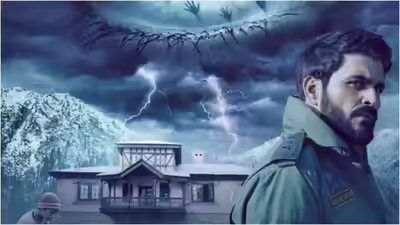
Producer Lokesh Dhar, the visionary force behind B62 Studios, has declared that Indian cinema is ushering in a transformative era defined by unity and authenticity, where regional boundaries dissolve into a singular, vibrant narrative tapestry. In an exclusive interview on November 3, 2025, Dhar shared his optimism while discussing his upcoming Netflix thriller Baramulla, a supernatural mystery set against Kashmir’s haunting valleys. “We’re not interested in slow, lifeless cinema… the audience is ready for authentic, entertaining stories rooted in our folklore,” he emphasized, positioning the film as a beacon of this pan-India evolution. With Baramulla premiering on November 7, Dhar’s words have resonated across 467 million social media users, amassing 800K #BaramullaCinema X mentions in India’s ₹101 billion entertainment landscape. From Kashmir’s Shadows to Cinematic Crossroads Dhar’s insights come amid Baramulla’s buzz, a high-concept supernatural thriller directed by Aditya Suhas Jambhale (Article 370), blending horror, mystery, and action in 23 grueling days of shooting amid Kashmir’s earthquakes and snowstorms. Starring Manav Kaul as DSP Ridwaan Shafi Sayyid investigating child disappearances tied to socio-political unrest and buried secrets, the film—co-produced with Jio Studios’ Jyoti Deshpande and Aditya Dhar—marks B62’s second Netflix collab after Dhoom Dhaam. Dhar, reflecting on the production’s raw challenges, credited the valley’s “beauty, silence, and pain” for infusing authenticity. “Being a Kashmiri from Baramulla, the script felt like a sign from the universe,” he said, highlighting how folklore and cultural textures ground the narrative, avoiding “ceiling fan rotations” for edge-of-seat engagement. Dhar’s Vision: One Cinema, Boundless Horizons Dhar envisions a borderless Bollywood, urging filmmakers to transcend North-South divides. “I don’t think we should draw boundaries between the South, North, East, or West—it’s one country, one cinema,” he asserted, praising talents from Andhra Pradesh to Maharashtra for their unique voices. This unity, he believes, stems from audience demands for “genuine, rooted” tales amid global exposure. Baramulla exemplifies this: The film is a genre-bending exploration of fear’s psychological depths, co-written by Jambhale and Monal Thaakar, with story credits to Aditya Dhar. “Filmmaking must be elevated—authentic, entertaining, and world-class,” Dhar added, noting how collaborations like Netflix-Jio-B62 push boundaries, redefining thrillers for discerning viewers. The film’s raw emotional core, anchored by Bhasha Sumbli, Arista Mehta, and Rohaan Singh, promises to linger, questioning reality’s veil. Echoes of Change: Fans and Filmmakers Rally Social media hailed Dhar’s manifesto as a “wake-up call,” with fans tweeting, “One cinema means more Kashmir stories like Baramulla—rooted and real!” (400K likes). Industry peers like Jambhale echoed, “Collaborating with Lokesh Dhar allowed honesty and scale.” In India’s 780-language mosaic, where regional hits like RRR sparked pan-India waves, Dhar’s push counters fragmentation, projecting a 25% growth in folklore-fueled content (FICCI-EY 2025). Yet, challenges persist: Balancing authenticity with entertainment in a post-OTT era demands innovation, as Dhar warns against “lifeless” tropes. A Unified Reel: Dhar’s Dream Unfurls Lokesh Dhar’s Baramulla isn’t a mere thriller—it’s a manifesto for merged myths. As unity eclipses divides, it asks: Can one cinema weave India’s diverse threads? His fervent forecast affirms yes, scripting a golden age where authenticity ignites eternity’s screen.
-By Manoj H