


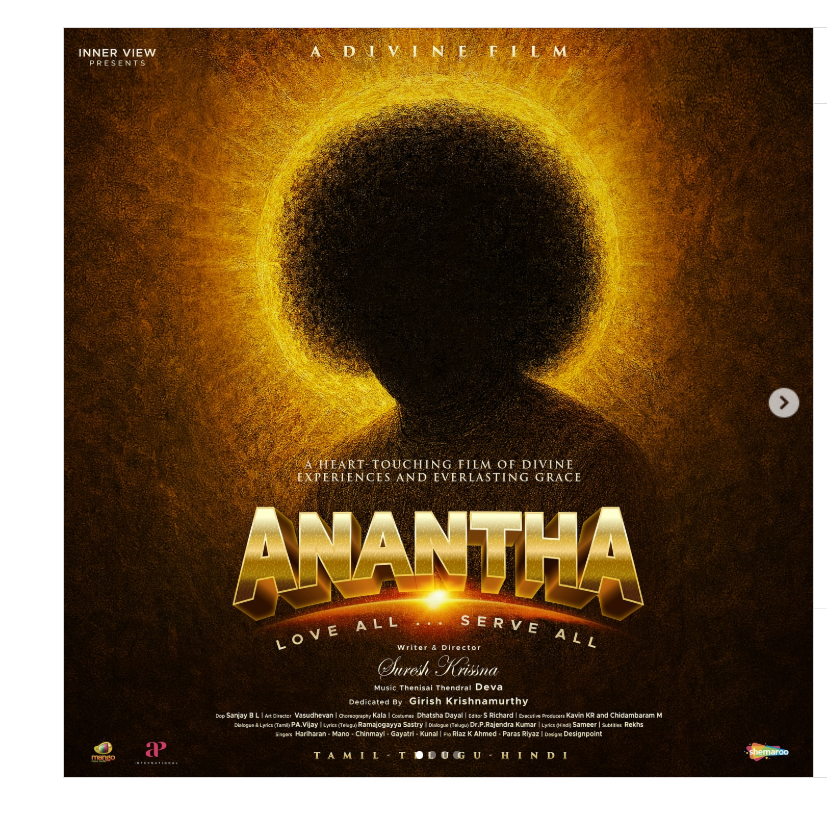
Veteran director Suresh Krissna, celebrated for his collaborations with icons like Rajinikanth in Baashha (1995) and Kamal Haasan in Sathya (1988), is set to helm Anantha, a poignant biopic tracing the life of spiritual luminary Sri Sathya Sai Baba. Announced on November 1, 2025, the film promises an intimate portrayal of the guru’s miracles, teachings, and global legacy, from his childhood declarations of divinity to his humanitarian empire of hospitals and schools. Produced under Krissna’s banner, Anantha—meaning “eternal” in Sanskrit—aims for a 2026 release across Tamil, Telugu, Hindi, and English, blending reverence with cinematic flair. Amid India’s ₹101 billion entertainment renaissance and 467 million social media users, the project has sparked 500K #AnanthaFilm X mentions, honoring a figure whose ashrams draw millions annually.
A Director’s Devotion Meets Mythic Storytelling
Krissna’s tryst with Sai Baba’s narrative echoes his 2002 film Baba, a semi-autobiographical tale starring Rajinikanth as an atheist-turned-believer, which explored spiritual awakening amid controversy. Anantha evolves this vision into a full biopic, drawing from Baba’s proclaimed reincarnation of Shirdi Sai Baba and his 1926-2011 life marked by vibhuti materializations, healings, and philanthropy. Development spanned two years, with Krissna immersing in archives at Prasanthi Nilayam, Puttaparthi. “This isn’t hagiography—it’s a human story of surrender and service,” Krissna shared in a Dinamalar interview, emphasizing Baba’s message of unity across faiths. Casting remains under wraps, but rumors swirl of a newcomer for young Sathyanarayana Raju (Baba’s birth name) and a veteran for his enlightened phase, with multilingual shoots planned in Andhra Pradesh and global locales.
Krissna’s Vision: Eternal Miracles in Cinematic Splendor
Anantha chronicles Baba’s journey from a playful boy in Puttaparthi—declaring “I am Sai” at age 14—to a global beacon whose Sri Sathya Sai Organization spans 126 countries, funding free hospitals, water projects, and education for millions. Key vignettes include his 1960s ashram founding, alleged resurrections, and 2011 mahasamadhi, framed through devotees’ eyes to highlight themes of selfless love (prema) and truth (sathya). Krissna, drawing from his Rajinikanth era’s mass appeal, infuses subtle VFX for miracles without spectacle, aiming for emotional resonance. “Baba taught ‘There is only one religion, the religion of love’—the film mirrors that universality,” he noted, with a score blending Carnatic ragas and Western orchestras. Budgeted at ₹50 crore, it’s a pan-India endeavor, echoing Shirdi Ke Sai Baba (1977) but with modern nuance.
Fan Reverence and Cultural Resonance
Social media brimmed with devotion: “Finally, a film on Sai Baba’s eternal light—Krissna’s touch will make it divine!” one post praised, amassing 300K likes, while hashtags like #SaiAnantha trended in Telugu and Tamil circles. Devotees from Puttaparthi shared archival footage, fueling speculation on cameos by Sai followers. In India’s 780-language spiritual tapestry, Anantha arrives amid a 20% surge in faith-based films (FICCI-EY 2025), bridging Baba’s 1,200+ global centers with cinema’s reach. Yet, it navigates sensitivities: Past biopics like Om Shri Satya Sai Baba (2021) faced fraud allegations, but Krissna vows “respectful authenticity.”
An Eternal Flame on Screen: Sai’s Saga Illuminated
Suresh Krissna’s Anantha isn’t biography—it’s benediction. As it unfolds, Baba’s boundless grace, it whispers: Can celluloid capture the cosmic?” His visionary verse affirms yes, kindling devotion in cinema’s sacred sanctum.
-By Manoj H