


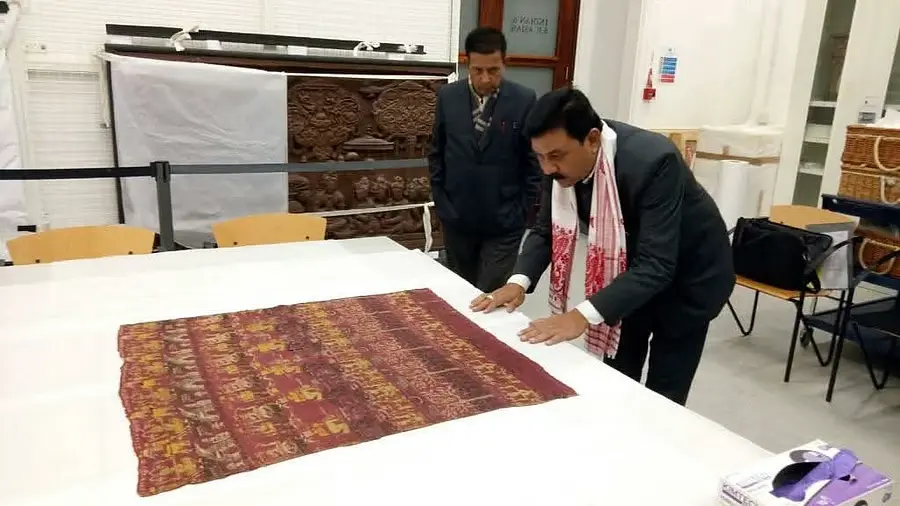
In a momentous agreement signed just days ago, Assam Chief Minister Himanta Biswa Sarma inked a historic Letter of Intent with the British Museum in London to bring back one of India’s most cherished cultural treasures: the Vrindavan Vastra. This magnificent 400-year-old silk textile, intricately woven under the spiritual guidance of saint-reformer Srimanta Sankardeva, is set to return to its homeland for an 18-month public exhibition beginning in 2027, marking what many are calling the “homecoming of an ancestor.”
Divine Stories Woven in Silk: What Makes Vrindavan Vastra Extraordinary
The Vrindavan Vastra is far more than a textile; it is a sacred narrative stitched into silk threads. Created in the 16th century, this masterpiece depicts vivid episodes from Lord Krishna’s life, particularly his childhood years and divine pastimes in Vrindavan. Measuring an impressive 937 centimeters in length and 231 centimeters in width, the textile originally consisted of 15 separate silk panels that were later meticulously stitched together to form one cohesive drape.
What makes this textile truly exceptional is its artistic brilliance combined with spiritual depth. The Vastra’s designs feature vibrant motifs woven using colored threads: red, white, black, yellow, and green depicting Krishna’s legendary feats and miraculous deeds. The weaving is so intricate that it was created using the complex “lampas technique,” a method requiring two weavers to work simultaneously, each controlling separate sets of warps and wefts. This level of technical mastery was led by master weaver Mathuradas Burha Aata and his 12 assistant weavers, all disciples of Srimanta Sankardeva’s spiritual lineage.
From Royal Commission to Sacred Symbol: The Historical Journey
The Vrindavan Vastra was commissioned by Koch king Nara Narayan, who ruled over parts of present-day Assam and West Bengal. The request emerged from Nara Narayan’s deep devotion and his shelter of Sankardeva, the Vaishnavite saint who had been targeted by the Ahom kingdom at the instigation of Brahmin priests. This textile became a revolutionary medium for depicting sacred stories, especially considering that Neo-Vaishnavism under Sankardeva discouraged idol worship yet the Vastra beautifully bridged this spiritual principle through its woven narratives.
Interestingly, the textile includes woven portions of poetry penned by Srimanta Sankardeva himself, making it not just a visual masterpiece but also a literary artifact. The Vastra also features a remarkable blend of artistic traditions, including Chinese damask and brocade with dragon motifs in its upper sections, likely later additions that reflect the textile’s cultural journey across regions.
An Involuntary Journey Across Continents
The Vrindavan Vastra’s path away from Assam is a sobering chapter in India’s cultural heritage story. The textile traveled to Tibet, where it was repurposed in a monastery at Gobshi, eventually acquiring a reputation for mystical properties among Tibetan communities. During the 1904 Younghusband expedition to Tibet, British journalist Perceval Landon acquired the textile and brought it to London, where it was eventually accessioned into the British Museum’s collection as “As1905,0118.4.” For decades, the British Museum even miscatalogued it as Tibetan silk, obscuring its true Assamese origin and delaying recognition of its significance in Indian cultural history.
2027: The Long-Awaited Homecoming
To accommodate this precious returning artifact, the Assam government is constructing a new climate-controlled museum in Guwahati, built in partnership with the JSW Group, ensuring the Vastra receives conservation standards befitting its historical importance. The 18-month exhibition will provide unprecedented access for Indian scholars, art enthusiasts, and the general public to witness this testament to Assamese weaving excellence and Vaishnavite Bhakti tradition.
Chief Minister Sarma’s emotional words at the signing captured the sentiment perfectly: “Even for a limited period, it feels like the homecoming of an ancestor.” The Vrindavan Vastra represents more than recovered threads; it embodies Assam’s cultural identity, medieval artistic mastery, and the enduring power of devotional art to transcend centuries and continents.
By – Sonali