


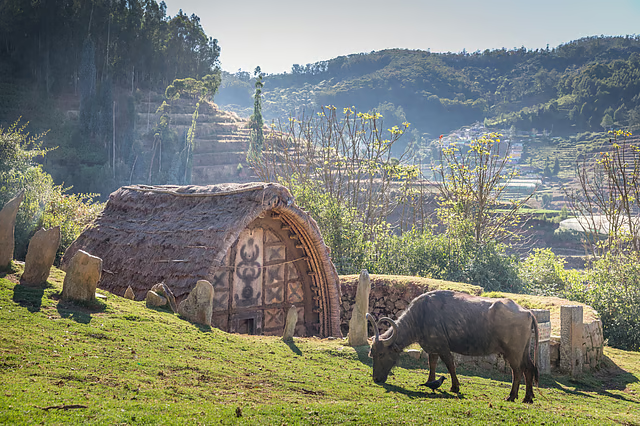
Nestled among the rolling emerald valleys of the Nilgiri Hills in Tamil Nadu lies a remarkable architectural legacy, the iconic Toda huts. These distinctive barrel-shaped dwellings represent far more than mere structures; they embody centuries of indigenous knowledge, environmental harmony, and a pastoral community’s profound adaptation to mountain living. As the 21st century pushes relentlessly toward urbanization, a quiet but powerful movement is underway to preserve these architectural treasures before they disappear entirely from India’s cultural landscape.
The Toda people, believed to be among the region’s most ancient inhabitants, have called the Upper Nilgiris home for generations. Living primarily as pastoral communities, the Todas traditionally organized themselves into small settlements called munds, each typically comprising three to seven closely grouped dwellings alongside sacred dairy temples and buffalo pens known as hundis. These hamlets were never enclosed by gates or fences; instead, they naturally blended into the undulating terrain, with houses deliberately staggered across slopes to maximize visibility and adapt to the challenging landscape.
The Ingenious Design: Form Follows Function
What makes Toda huts extraordinary is their sophisticated design philosophy. Each dwelling, locally called an arsh or dogle, rises approximately 10 feet high, stretches 18 feet in length, and measures 9 feet wide. The structure’s distinctive barrel-vault or pent shape immediately catches the eye, appearing like a semi-cylindrical tunnel emerging from the hillside. This iconic form isn’t purely aesthetic; it’s a masterclass in climate adaptation and resource efficiency.
The construction process reveals traditional engineering brilliance. Sturdy bamboo poles form the skeletal framework, with the thickest pole positioned centrally for maximum structural support. Split bamboo canes and rattan vines, gathered locally from the Nilgiri Biosphere, are then carefully layered horizontally across this frame, creating a latticed web. Finally, dried grass sourced from the region is stacked densely as thatch, creating a weatherproof exterior that actually keeps interiors remarkably warm even during the region’s bitterly cold winters. The front and back facades are typically constructed from dressed granite stones, adding durability and decorative value.
The Entrance: Protection Through Constraint
One of the most distinctive features is the entrance, deliberately minimal at approximately 3 feet in both height and width. Rather than appearing as an architectural limitation, this deliberately small doorway serves multiple purposes: it prevents harsh mountain winds from infiltrating the interior, keeps wild animals at bay, and maintains interior warmth during extreme weather. Visitors must literally crawl to enter these spaces, an experience that feels like entering a protective cocoon.
The hut’s dark, windowless interior isn’t a drawback but a sophisticated design choice. A single raised earthen platform (45-60 cm high) positioned inside serves as both a sleeping and sitting area, optimizing spatial efficiency. The cooking area occupies the opposite side, with smoke naturally escaping through the thatch roof rather than through a chimney. Many traditional huts contain a symbolic small pit in the center, dividing the interior into sacred and secular zones.
Sacred Symbols and Tribal Artistry
The exterior front panel becomes a canvas for traditional Toda art. Decorative rock murals featuring crescent moons, sacred buffalo motifs, flowers, and geometric patterns adorn the stone façade, telling stories of a community for whom buffalo represent not mere livestock but spiritual and cultural anchors. These embellished huts showcase intricate tribal symbolism passed down through generations, with the buffalo serving as the community’s economic and religious centerpiece.
A Cultural Renaissance
By the 1990s, traditional Toda huts faced extinction. Young Todas were abandoning these dwellings for modern concrete structures, and only a handful of traditional houses remained in permanent hamlets by 1995. However, a transformative shift occurred when a local administrator agreed to fund the reconstruction of a traditional house for an elderly villager. The construction proved so impressive that the community’s enthusiasm reignited—nine more houses rose within that year.
Between 1995 and 2005, forty new traditional huts were constructed, marking a dramatic reversal of cultural erosion. Today, over 35 traditional houses continue this heritage movement, with new initiatives like Toda 2.0 combining traditional architectural elements with modern amenities while preserving cultural authenticity.
The Toda huts remain architectural ambassadors, reminding us that ancient wisdom offers sustainable solutions for contemporary environmental challenges. Standing against the Nilgiris’ misty backdrop, these humble dwellings prove that true innovation often emerges from deep harmony with nature, a lesson our modern world desperately needs to remember.
By – Sonali