


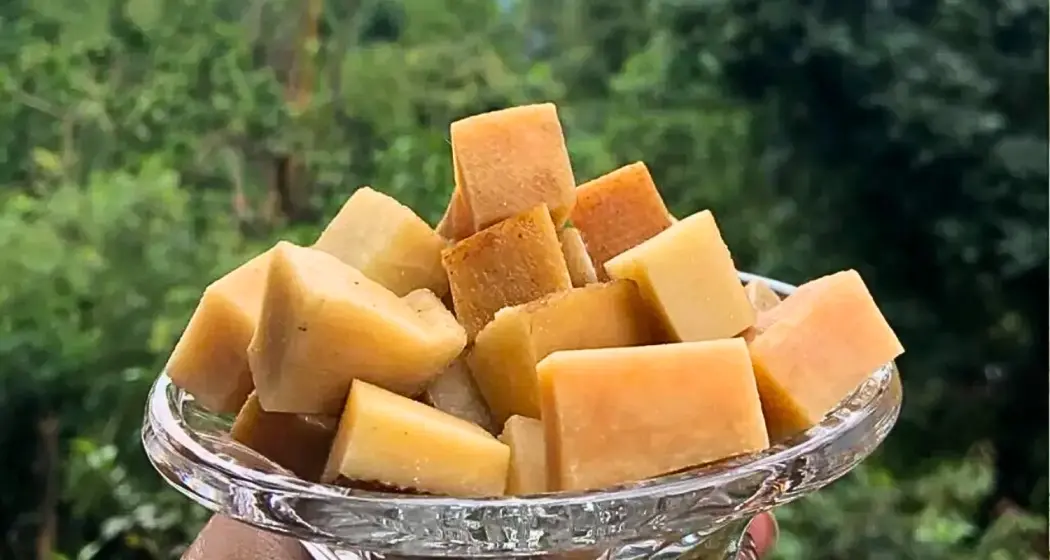
Yak Churpi is a traditional cheese made from the milk of the native yaks of Arunachal Pradesh, especially from the high-altitude districts such as West Kameng and Tawang.
It’s not your everyday soft cheese: churpi often comes in a “hard-cheese” version that is dry, dense, and can last for a very long time, a practical requirement in remote Himalayan regions where fresh produce and refrigeration are scarce.
Traditional Roots: How It’s Made
The process of making yak churpi is rooted in centuries-old methods developed by the tribal communities, mainly the Brokpa and Monpa, who rely on yaks for their livelihood. Yak milk is collected during milking seasons when yaks graze on highland pastures.
To make churpi, the fresh milk is placed in a large cylindrical wooden churn (often made from local Thuja wood) called a Shoptu. The milk is vigorously churned for 2–3 hours using a wooden stirrer (“Kelu”). During this process, butter separates out. The remaining milk is again churned until it curdles and cheese solids form.
Once the curd forms, it is separated traditionally using a cotton cloth or bamboo sieve and then shaped into blocks or rounds. These are then allowed to dry, typically in the sun or near the hearth, until they harden. The drying process reduces moisture drastically, transforming the cheese into a very rigid, durable product.
Over time, with careful storage (sometimes even in yak skin), churpi can remain usable for years, a functional advantage in remote mountainous regions where winters are long and fresh food hard to come by.
Nutritional Value & Purpose in High-Altitude Life
Yak milk, the base for churpi, is richer than standard cow’s milk. It offers higher levels of protein and essential nutrients, making churpi a dense source of nourishment in an environment where fresh vegetables are often scarce due to cold, altitude, or inhospitable terrain.
For tribal herders of Arunachal, churpi serves multiple dietary needs: it can be eaten as is (especially in its hard, chewable form) or incorporated into curries, vegetarian or non-vegetarian, and eaten with rice.
In high-altitude, cold, and often hypoxic (low-oxygen) conditions, such a protein-rich, durable, and energy-dense food becomes indispensable. For generations, churpi has helped Himalayan communities survive harsh climates and food scarcity.
Cultural Significance Among Tribal Communities
For the Monpa, Brokpa, and other tribes of the Eastern Himalayas, yak churpi is more than just food; it’s a part of their identity and traditional lifestyle. Its production follows ancestral knowledge, passed down through generations.
Churpi, in its different forms—soft for cooking and hard for chewing—features in daily meals and special occasions and sustains people during long winters and tough travel. In many Himalayan areas (not just Arunachal but also neighboring regions), churpi is known as a “mountain cheese,” symbolic of self-reliance and adaptation to extreme environments.
Moreover, because churpi can be stored for long periods, tribal families migrating seasonally with their yaks find it extremely practical: it travels well, preserves over months, and offers reliable nutrition even in remote pastures.
Challenges & The Changing Times
However, the traditional ways of producing churpi face challenges. Yak herding is demanding; the yaks graze on fragile high-altitude pastures, and herders practise seasonal migrations to sustain the herd and the ecology. This way of life has come under pressure due to climate change, shifting weather patterns, modernization, and economic changes.
Additionally, as younger generations migrate to towns or newer occupations, there is a risk that the traditional knowledge and craft of churpi-making might get lost or diluted. Maintaining the artisanal process: churning, curing, and drying demand labor, time, and commitment, which may not appeal to everyone.
At the same time, there are voices and efforts within tribal communities and among researchers to preserve and possibly adapt churpi production in a sustainable way. Experts note that yak milk and its products (cheese, butter, and other dairy items) represent a valuable heritage and resource, not only nutritionally but also economically.
Why Yak Churpi Matters—For Today and Tomorrow
In a rapidly changing world where global demand is rising for “authentic,” “traditional,” and “heritage” foods—foods with a story, a tradition, and ecological roots—like yak churpi, they stand out. It embodies the resilience of mountain communities, their adaptation to extreme environments, and their harmony with nature.
Churpi also represents a sustainable model of food production based on local resources (yak milk) and traditional craftsmanship (wooden churners, natural drying) and designed for longevity (hard, durable cheese).
As more people within India and beyond begin to explore Himalayan cuisine, there is potential for churpi to reach a wider audience. But balancing that with respect for tradition, ecological sustainability, and fair benefit to yak-herding communities will be important.
In the high Himalayas of Arunachal, where life and terrain demand resourcefulness, yak churpi remains a universal constant, nourishing bodies, preserving culture, and symbolising the timeless bond between people, animals, and mountains.
By – Sonali