


The greatest films often owe their power not to their heroes, but to the extraordinary antagonists who steal every scene they grace. From the shadowy corners of Bollywood to the sprawling universes of Hollywood, cinema has gifted us villains so compelling, so multifaceted, and so mesmerizing that audiences leave theaters talking more about the antagonist than the protagonist. These are not mere obstacles for heroes to overcome; they are fully realized characters with depth, philosophy, and undeniable screen presence.
BOLLYWOOD’S UNFORGETTABLE TYRANTS
Gabbar Singh: The Villain Who Became an Icon
When Amjad Khan unleashed Gabbar Singh in Sholay (1975), he didn’t just create a villain; he redefined what it meant to be evil on the Indian screen. While Amitabh Bachchan and Dharmendra gave stunning performances, the film belonged entirely to Gabbar. His unpredictable nature, maniacal laughter, and terrifying presence transformed him into a cultural phenomenon that has endured for nearly five decades. The famous line “Kitne aadmi the?” became more iconic than any dialogue delivered by the heroes. Gabbar wasn’t simply a dacoit; he was a force of nature, sometimes jovial and playful, the next moment brutally lethal. His character proved that villainy could be theatrical, poetic, and absolutely compelling.
Alauddin Khilji: When the Antagonist Becomes the Spectacle
Ranveer Singh’s portrayal of Alauddin Khilji in Padmaavat (2018) transcended the film itself and became the reason audiences revisited the cinema. While Shahid Kapoor’s noble Ratan Singh and Deepika Padukone’s dignified Padmavati delivered respectable performances, they faded into obscurity against Khilji’s wild, untamed energy. Khilji danced like a man possessed, ate without restraint, and pursued Padmavati not out of love but out of a hunger for conquest. His obsession was primal, chaotic, and disturbingly captivating. He was loud, dangerous, and hypnotic, a villain whose every gesture commanded attention. Several audiences reportedly watched the film multiple times solely for Singh’s electrifying performance, a testament to how completely he dominated the narrative.
Kancha Cheena: The Sophisticated Kingpin
Danny Denzongpa’s portrayal of Kancha Cheena in Agneepath (1990) established the template for the refined, elegant villain in Hindi cinema. Unlike the theatrical madness of Gabbar, Kancha embodied a dangerous sophistication- suave, panache, and utterly menacing as a drug lord. His character was stylish and controlled, a stark contrast to Amitabh Bachchan’s rage-driven revenge narrative. Even after three and a half decades, Denzongpa’s interpretation of the role continues to set the standard for villains who captivate audiences with elegance rather than explosiveness. He proved that villainy didn’t require histrionics; it required presence and intelligence.
Mogambo: The Grandeur of Global Ambition
Amrish Puri’s Mogambo in Mr. India (1987) was quintessentially Indian villainy at its most grandiose. With his maniacal cackle, absurd world-dominating inventions, and aggressive expressions, Mogambo was not just a villain; he was a force that dominated every frame. His character became the blueprint for countless Bollywood antagonists that followed, establishing how a villain could command respect through sheer presence and ambition. Puri’s performance was so iconic that it transcended the film, becoming a cultural reference point for generations of moviegoers. Mogambo wasn’t trying to win audiences; he was conquering them.
HOLLYWOOD’S MASTERFUL MANIPULATORS
The Joker: Chaos as Philosophy
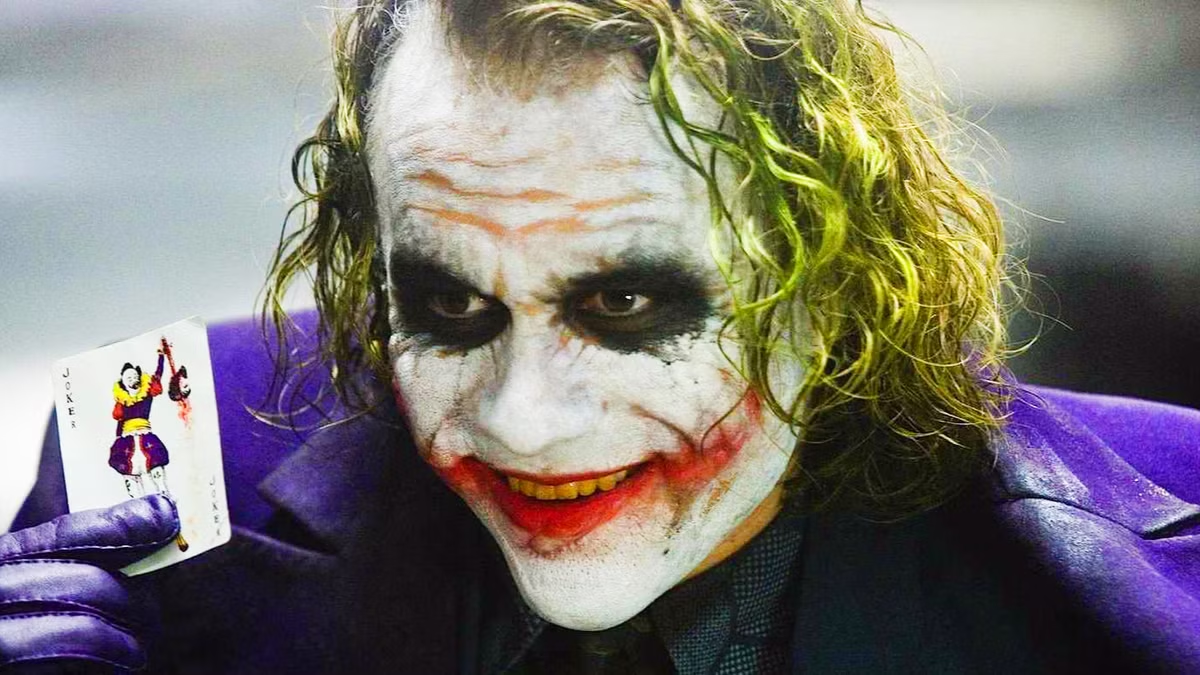
Heath Ledger’s Joker in The Dark Knight (2008) didn’t just steal the spotlight; he fundamentally altered our understanding of what a cinematic villain could be. His chaotic energy, unpredictable nature, and philosophical musings on the nature of chaos versus order elevated him from a simple comic book villain to a truly formidable antagonist. The Joker dominated every scene, with his lack of a clear origin story making him feel less like a man and more like a force of nature. Ledger’s portrayal was so commanding, so terrifying, and so intellectually provocative that Christian Bale’s Batman sometimes felt like a supporting character in his own story. The Joker wasn’t playing a role; he was the story.
Thanos: The Tragic Titan with Conviction
Josh Brolin’s Thanos in Avengers: Infinity War is the rare villain who functions almost as the film’s protagonist. His tragic backstory—an outsider with no home, a man pursuing a vision that no one else comprehends or agrees with—generates genuine sympathy even as he commits atrocities. What makes Thanos extraordinary is that he’s not entirely wrong; his conviction that half the universe must die so the other half may thrive is presented with such philosophical weight that audiences find themselves contemplating the morality of his mission. The scene where he sacrifices Gamora, his adopted daughter, for the Soul Stone, and later confronts her ghost in a hallucinogenic moment asking, “What did it cost?” reveals the tragic humanity beneath the cosmic tyrant. Thanos proved that a villain could be both absolutely monstrous and deeply sympathetic, a rare and powerful combination that audiences found absolutely mesmerizing.
Darth Vader: The Redemption Arc That Changed Cinema
Darth Vader is the archetypal cinematic villain, a figure so imposing, so visually distinctive, and so sonically iconic that he has become embedded in our cultural consciousness. His heavy breathing, his black suit, and James Earl Jones’ commanding voice create an immediate atmosphere of dread. Yet what truly distinguishes Vader is his tragic backstory and his eventual redemption, which add layers of complexity to what could have been a one-dimensional tyrant. His character journey spans across films, revealing how a man of noble intentions was seduced into darkness. By the saga’s end, Vader becomes not just a villain to overcome, but a character whose fall and redemption generate profound emotional resonance. He remains cinema’s greatest exploration of how corruption and power can consume even those destined for greatness.
Erik Killmonger: The Antagonist With a Justifiable Cause
Michael B. Jordan’s Erik Killmonger in Black Panther (2018) presented a villain whose rage, while fierce and destructive, is rooted in legitimate grievance and systematic oppression. As an antagonist determined to arm all Black individuals globally to fight systemic oppression, Killmonger’s fury and impulsiveness are far more coherent than T’Challa’s utopian promises of Wakanda’s isolationism. Jordan’s portrayal reveals the limitations of the Wakandan ideal and forces audiences to grapple with uncomfortable truths about colonialism, racial oppression, and the costs of isolationism. Killmonger isn’t simply evil; he’s a vessel for righteous anger navigating a world built to suppress him. His character generates complex feelings of attraction and aversion; we’re drawn to his passion even as we recoil from his methods. This moral ambiguity makes him infinitely more interesting than T’Challa’s straightforward heroism, proving that the best villains are those who challenge our assumptions about right and wrong.
THE VILLAIN’S Triumph
These eight antagonists share a common thread: they possess something their heroes often lack—a clear philosophy, unwavering conviction, and an ability to captivate audiences through sheer force of personality and intellect. Whether through theatrical grandeur, psychological depth, philosophical conviction, or moral complexity, these villains have transcended their roles as mere obstacles and become the true protagonists of their stories. In cinema, the villain who steals the show often does so because they possess something increasingly rare in storytelling: an unapologetic commitment to their vision, a willingness to sacrifice everything for their beliefs, and a charisma that makes audiences lean forward in their seats even as they root against them. These are the characters that linger in our minds long after the credits roll, proof that sometimes, the best heroes are actually the most fascinating villains.
By – Sonali