


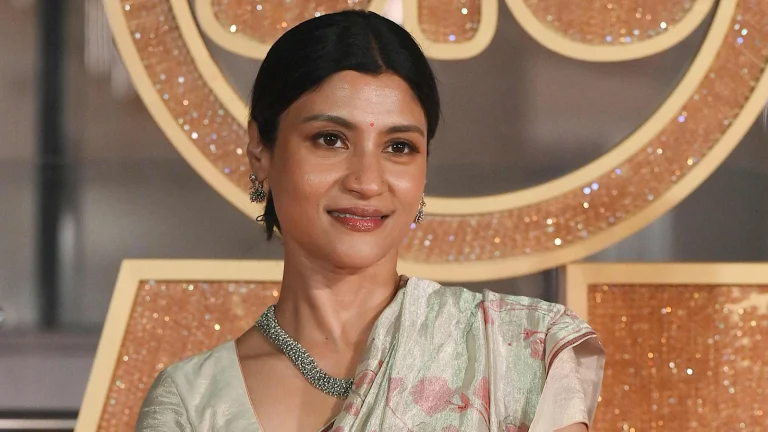
Veteran actor and filmmaker Konkona Sensharma has weighed in on a fresh debate in Bollywood – the contrasting narratives around on-screen romances involving female actors with younger male counterparts. Her comments come amid renewed industry and audience discussions about ageism and gender bias in cinema casting and storytelling.
Sensharma, known for her nuanced performances and thoughtful insights on cinema, recently addressed why such pairings are often labeled “bold” when an older woman romances a younger man, while similar pairings involving older male leads and younger actresses are widely accepted as “cinema magic.”
Audience Perception at the Core, Says Sensharma
The conversation ignited on a recent episode of a celebrity chat show hosted by Kajol and Twinkle Khanna, where actors Salman Khan and Aamir Khan were questioned about this double standard. The panel highlighted that older male actors frequently star opposite much younger female leads, often without controversy, while the reverse tends to draw attention or criticism.
Responding to the debate, Sensharma said that the way such pairings are perceived ultimately lies with the audience: “It’s the audience’s prerogative and their right. Somebody can see it as bold, somebody else might not.” She added that personally she doesn’t view the concept as inherently bold because age-different relationships are common in real life, including among public figures, and are increasingly normalised.
Critiquing Industry Norms and Narrative Stereotypes
Sensharma also highlighted a broader issue that she believes fuels the discomfort around reversed age roles in cinema: the tendency to fit women into restrictive boxes. Discussing the complexity of female identities on screen, she referenced the many roles and archetypes represented in culture, saying there’s no “one described way” a woman should be. This, she asserted, limits both storytelling and audience imagination when a woman takes the lead in unconventional romantic dynamics.
Her comments reflect ongoing conversations about ageism and gender bias in Bollywood, where female actors often face limited opportunities and stereotypes compared with their male counterparts. Industry commentators have pointed out that older male actors dating much younger actresses in films has long been normalized, while similar instances involving women are still seen as breaking social taboos.
On Her Own Film Choices and Age Gap Roles
Sensharma pointed out that each instance of age gap in her films served specific narrative purposes rather than being used as a gimmick. In Metro… In Dino (2025), where she stars opposite Pankaj Tripathi and also shares screen space in a younger romantic subplot with actor Rohan Gurbaxani, the storytelling choices were intentional and character-driven. She noted the age gap plot in the film was handled with humour and nuance, exploring character dilemmas rather than simply courting controversy.
She also referenced her earlier work in Dolly Kitty Aur Chamakate Sitare to explain how relationship arcs in films can depict emotional states and life moments without being defined solely by age perceptions. According to Sensharma, such portrayals are less about being “bold” and more about reflecting complex human experiences.
Industry Shifts and Broader Debate
Sensharma’s remarks coincide with broader industry introspection on age appropriateness in romance narratives. A section of actors and filmmakers have encouraged casting more age-balanced stories, suggesting that older male leads paired with much younger heroines is a tradition increasingly questioned by audiences and critics alike.
While some performers argue that changing audience tastes are slowly influencing these norms, others feel that entrenched star power dynamics still shape casting choices. Regardless, Sensharma’s comments add a prominent voice to an important conversation around gender, age, and representation in mainstream Indian cinema.
Looking Ahead
As Hindi film content diversifies across cinema and digital platforms, discussions about age, gender bias, and narrative fairness are gaining traction. Sensharma’s perspective underscores the need for audiences and creators to move beyond binary labels such as “bold” or “normal” and consider the artistic and social context of storytelling in a rapidly evolving industry.
By – Sonali