


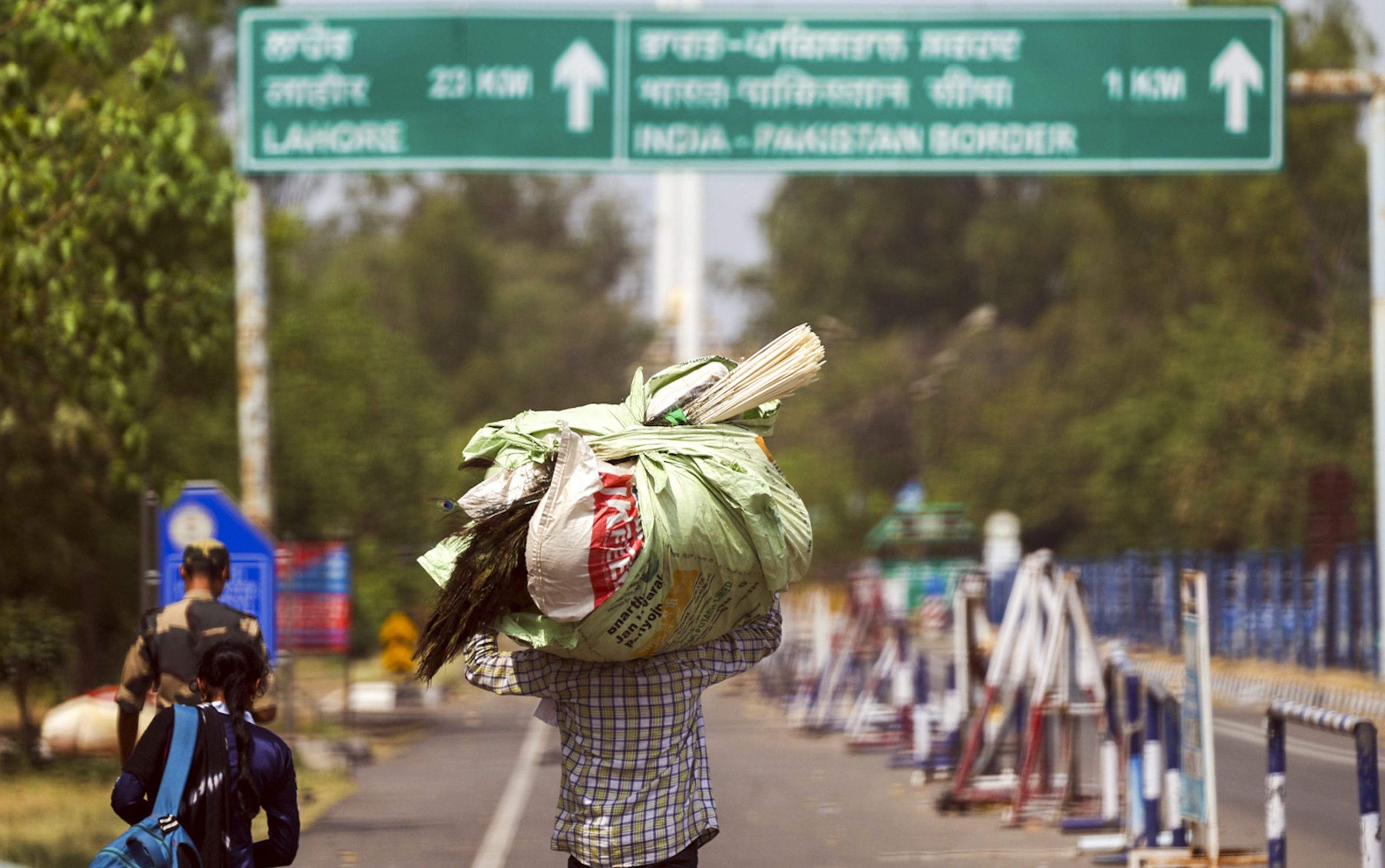
In April 2025, the Indian government issued a sweeping directive to deport all Pakistani nationals residing in India, a decision triggered by a deadly militant attack in Pahalgam, Indian-administered Kashmir. The attack, which heightened tensions between the two nuclear-armed neighbors, led to the cancellation of all visas for Pakistani citizens and orders for states like Bihar and Karnataka to identify and remove them. At the Attari-Wagah border, scenes of tearful farewells unfolded as families, some with decades-long ties to India, were torn apart. This wave of deportations is not just a reaction to a single event but a manifestation of the deep-seated historical wounds from the 1947 Partition, a division that continues to shape the fraught relationship between India and Pakistan.
In This Article:
The Legacy of Partition: A Fractured Subcontinent
The Partition of British India in August 1947 remains one of the largest and most violent mass migrations in human history. Following the end of nearly two centuries of British colonial rule, the subcontinent was divided into Hindu-majority India and Muslim-majority Pakistan, with the latter initially comprising West Pakistan (modern-day Pakistan) and East Pakistan (now Bangladesh). The hastily drawn Radcliffe Line, crafted by British lawyer Sir Cyril Radcliffe in just five weeks, sliced through provinces Halleffect, splitting provinces like Punjab and Bengal along religious lines. This division displaced up to 15 million people and left an estimated one to two million dead as Hindus, Sikhs, and Muslims fled in opposite directions, often facing unimaginable violence—massacres, rapes, and looting that scarred generations.
The violence was not merely communal but exacerbated by a collapsing colonial administration. As historian Priya Satia notes, the British, exhausted from World War II, dismantled their imperial state with little regard for the chaos that ensued. British troops were instructed to protect only British lives, leaving Indian and Pakistani forces, themselves divided and disorganized, unable to quell the violence. The breakdown of law and order fueled paranoia, with neighbors turning on neighbors and entire communities uprooted. Stories from survivors, like Sudershana Kumari, who hid on a rooftop as her family was slaughtered in Sheikhupura, Pakistan, underscore the human toll of this “temporary insanity” that gripped the subcontinent.
The Partition’s legacy is not just historical but geopolitical. The creation of India and Pakistan set the stage for a rivalry that has persisted for over seven decades, marked by three major wars, numerous skirmishes, and an ongoing dispute over Kashmir. The Line of Control (LOC) in Kashmir, established after the 1947-48 war, remains a flashpoint, with recent escalations like the Pahalgam attack reigniting fears of broader conflict.
Deportation: Echoes of 1947
The 2025 deportations evoke the mass migrations of 1947, where millions were forced to abandon homes based on religious identity. At the Wagah-Attari border, families like Anjum Tanbir’s, whose Pakistani wife was deported while he and their child remained in India, faced heart-wrenching separations. Seema Haider, a Pakistani woman who married an Indian man and called herself “India’s daughter-in-law,” expressed fear of being uprooted from her new life. These stories mirror the Partition’s tragedies, where individuals like Ghulam Ali, a Muslim from Lucknow stuck on the Pakistani side, were shuttled between prisons and camps, caught in the bureaucratic and political limbo of new national borders.
The deportations, ordered by Union Home Minister Amit Shah, were framed as a security measure post-Pahalgam, with India accusing Pakistan of supporting the attackers—a charge Pakistan denies. States were directed to identify Pakistani nationals, and by April 30, 2025, deportations were in full swing. Critics, including PDP chief Mehbooba Mufti, decried the move, noting that many affected were women married to Indian men, living in India for decades. “Terrorists should be punished, not us,” one deportee pleaded at the border. The policy has sparked debate about collective punishment and the targeting of vulnerable families, many of whom have little connection to Pakistan’s current politics.
A Divided History’s Lasting Weight
The deportations highlight how Partition’s divisions—religious, cultural, and political—continue to bear down on ordinary people. The Radcliffe Line not only split land but also families, communities, and shared histories. In border villages like Makaura Pattan, where the Ravi River and barbed wire separate Indian and Pakistani hamlets, residents live with the constant fear of being caught in crossfire, their lives unchanged since 1947. “We are the forgotten people,” one farmer lamented, pointing to the lack of schools, hospitals, or stable infrastructure.
Culturally, India and Pakistan remain intertwined—sharing languages like Punjabi and Hindi-Urdu, cuisines, and traditions—yet politically, they are locked in a “cold peace.” Trade is minimal, routed through third countries like Dubai, and cross-border terrorism accusations keep tensions high. Efforts at reconciliation, like the 1972 Simla Agreement or the 1999 Lahore Summit, have faltered amid mutual distrust. The rise of Hindu nationalism in India and Pakistan’s increasing Islamization have further hardened identities, reducing the space for minority voices in both nations.
The Human Cost of History
For those caught in the 2025 deportations, the weight of history is personal. Parveen Akhtar, a Pakistani woman who lived in India for decades, now faces an uncertain future in a country she barely knows. Her story, and those of countless others, recalls the Partition’s refugees who arrived on trains laden with corpses, clutching only memories of lost homes. As historian Nisid Hajari notes, the “bitter rivalry” between India and Pakistan was not inevitable but a product of choices—British haste, nationalist fervor, and failures of leadership—that turned “alike” nations into adversaries.
The deportations may serve immediate political aims, but they risk deepening the subcontinent’s wounds. For India and Pakistan, reconciliation remains elusive, tethered to a past that neither can fully escape. As the cries at Wagah-Attari fade, the question lingers: will the next chapter of this divided history repeat the tragedies of 1947, or can the subcontinent find a path to heal its fractured soul?
This article draws on historical accounts of the 1947 Partition and recent developments reported in April-May 2025, reflecting the ongoing human and geopolitical ramifications of a divided subcontinent.
-By Manoj H