


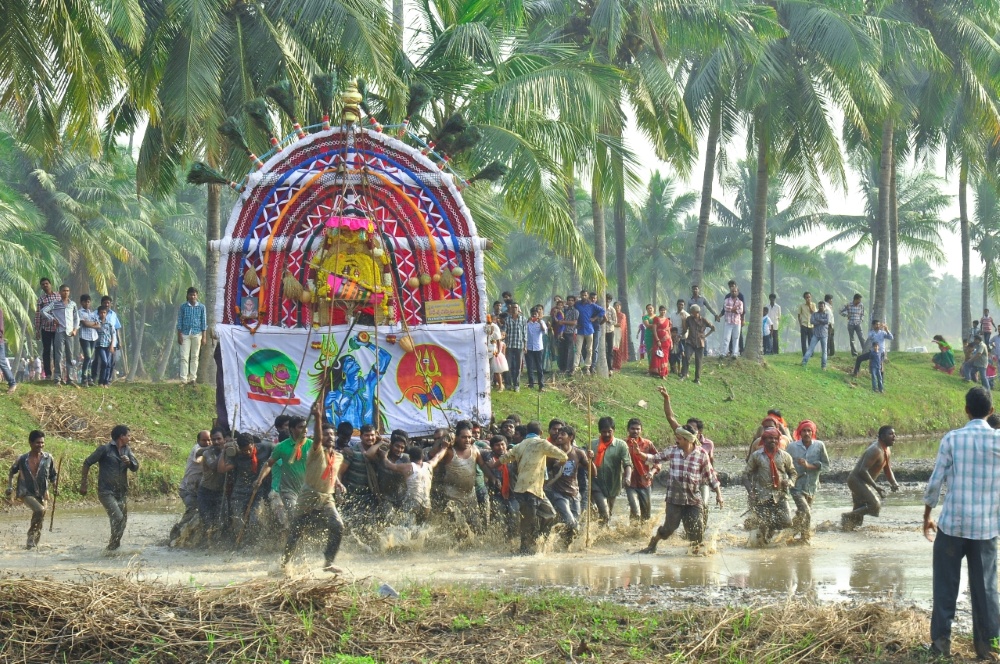
Andhra Pradesh Chief Minister N. Chandrababu Naidu has said the state Cabinet has decided to organise Jaganna Thota Prabhala Teertham as a state festival, extending formal administrative support to a Kanuma-day tradition that has been sustained for generations in the Konaseema region.
Naidu said the festival draws around five lakh devotees annually, and that state recognition would help preserve heritage while strengthening cultural tourism and improving logistical support for a gathering of this scale.
When it happens and where it unfolds
Prabhala Teertham is observed during the Sankranti season, with the main congregation associated with Kanuma in the Konaseema belt.
The focal point, often referred to as Jaganna Thota/Jaggannathota, is widely described in festival narratives as a small hamlet and congregation ground near Mosalapalli village in Ambajipeta mandal (Dr B.R. Ambedkar Konaseema district).
A sacred grove, not a single large temple complex
A defining feature of the festival is that the main congregation point is remembered more as an open-air sacred ground—a coconut grove—than as a conventional pilgrimage centre dominated by one monumental temple structure.
At the same time, the ritual life of the festival is strongly temple-linked: the event is popularly described as a convergence of Prabhalu and idols connected to 11 Shiva temples/kshetras from surrounding villages.
What “Prabhala Teertham” signifies
In regional usage, “theertham” can denote sacred water as well as a sacred gathering/fair. The term “prabha/prabhalu” is commonly used for the towering, decorated carriers—often bamboo-framed structures adorned with cloth, paper, lights, and other elements—associated with the procession tradition.
As described in public coverage, Prabhalu are decorative replicas of religious idols, mostly of Shiva, and they form the festival’s visual centerpiece.
The Ekadasa Rudras belief: faith and folklore
Devotees and local accounts often connect the festival to the idea of Ekadasa Rudras—eleven forms of Shiva—framing the annual convergence as a symbolic assembly for balance, welfare and prosperity.
For publishability, this should be presented as belief/tradition, not as verifiable historical chronology. Public descriptions frequently refer to the tradition as around 450 years old.
The festival is also commonly contextualised through Shaiva mythology, including the narrative around Daksha’s yagna and Veerabhadra—invoked as symbolic of Rudra’s corrective force and the restoration of cosmic order.
The eleven participating villages
The festival is widely associated with participation from eleven villages/kshetras, commonly listed as: Vyagreswaram, K. Pedapudi, Irusumanda, Vakkalanka, Nedunuru, Mukkamala, Mosalapalli, Palagummi, Gangalakurru Agraharam, Gangalakurru, and Pulletikurru.
Preparations typically begin days in advance, as teams assemble and decorate the Prabhalu and plan the movement routes.
A procession shaped by Konaseema’s landscape
Unlike many temple processions that remain largely on roads, Prabhala Teertham is often described as moving along bunds, canal edges and agricultural stretches, turning the countryside itself into a ritual corridor.
One of the most watched moments is the dramatic movement involving Prabhalu linked to Gangalakurru and Gangalakurru Agraharam, where large crowds gather to witness the crossing point—an element that contributes to the festival’s scale and spectacle.
Recognition beyond Konaseema
Prabhala Teertham has also received national visibility through cultural showcases. In January 2023, Andhra Pradesh’s tableau at the Republic Day parade featured Prabhala Theertham, bringing wider attention to the Konaseema tradition.
Media reports and festival-linked materials also note that Prime Minister Narendra Modi conveyed greetings in 2020, acknowledging the tradition and extending wishes to devotees.
What “state festival” status can change
State-level recognition typically means more predictable coordination—crowd management, sanitation, emergency services, traffic planning and inter-departmental support—which becomes essential when a festival draws lakhs of visitors. Naidu has said the government will provide necessary support for arrangements.
By: Charu