


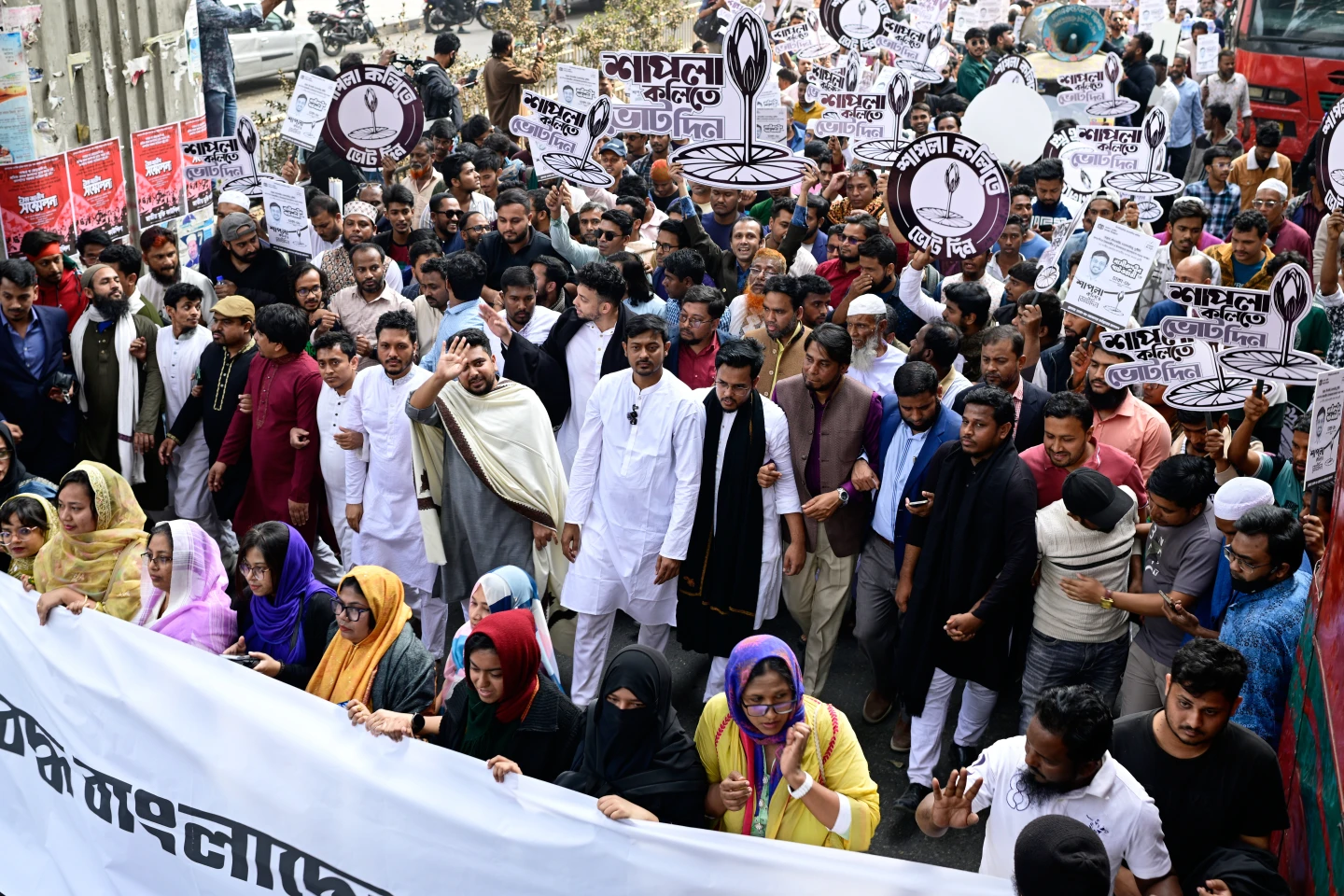
Dhaka, Jan 22 (AP): Campaigning kicked off on Thursday for Bangladesh’s first national elections since the 2024 uprising that led to the ouster of longtime Prime Minister Sheikh Hasina. The elections, scheduled for February 12, are being held under an interim government and are seen as the most consequential in the country’s history, with voters also set to decide on proposed political reforms.
Political rallies were held across Dhaka and other major cities, with major parties vying for influence in a political landscape reshaped by Hasina’s departure. The interim government, led by Nobel laureate Muhammad Yunus, has promised a free and fair election, though questions persist after Hasina’s Awami League party was banned. Historically, the Awami League and the Bangladesh Nationalist Party (BNP) have dominated Bangladeshi politics.
The law and order situation remains a concern, but the interim administration has assured citizens that voting will be peaceful. Yunus assumed office on August 8, 2024, three days after Hasina left for India, following a violent crackdown that claimed hundreds of lives during the uprising.
With the Awami League barred, a 10-party alliance led by Jamaat-e-Islami, an Islamist party, is campaigning to expand its influence. The alliance also includes the National Citizen Party (NCP), formed by student leaders of the uprising. Jamaat-e-Islami has faced criticism from secular groups for positions seen as challenging Bangladesh’s secular framework.
Tarique Rahman, BNP chairman and son of former Prime Minister Khaleda Zia, is widely viewed as a frontrunner for the prime ministership. Rahman, who returned to Bangladesh last month after 17 years in exile in the UK, is launching his campaign in Sylhet and will tour several districts in the coming days. Meanwhile, Jamaat-e-Islami and NCP plan to begin their campaigns in Dhaka.
The elections will also include a referendum on a national charter, aimed at institutionalising reforms introduced after the July 2024 uprising. The charter, signed by 25 of 52 registered parties, proposes term limits for legislators, strengthened checks on executive power, and anti-corruption measures. While the charter is currently nonbinding, the referendum seeks to make it a part of the constitution.
The interim government asserts that the charter would prevent future authoritarian administrations by giving the presidency more authority to balance the historically powerful prime ministerial office. Opposition parties, including the Awami League, have voiced concerns over the charter and several other parties refused to sign it.
The February election will not only determine Bangladesh’s next government but could also reshape the country’s political framework for decades to come.
Category: Breaking News
SEO Tags: #swadesi, #News, Campaigning starts for Bangladesh’s first national election after Hasina’s ouster