


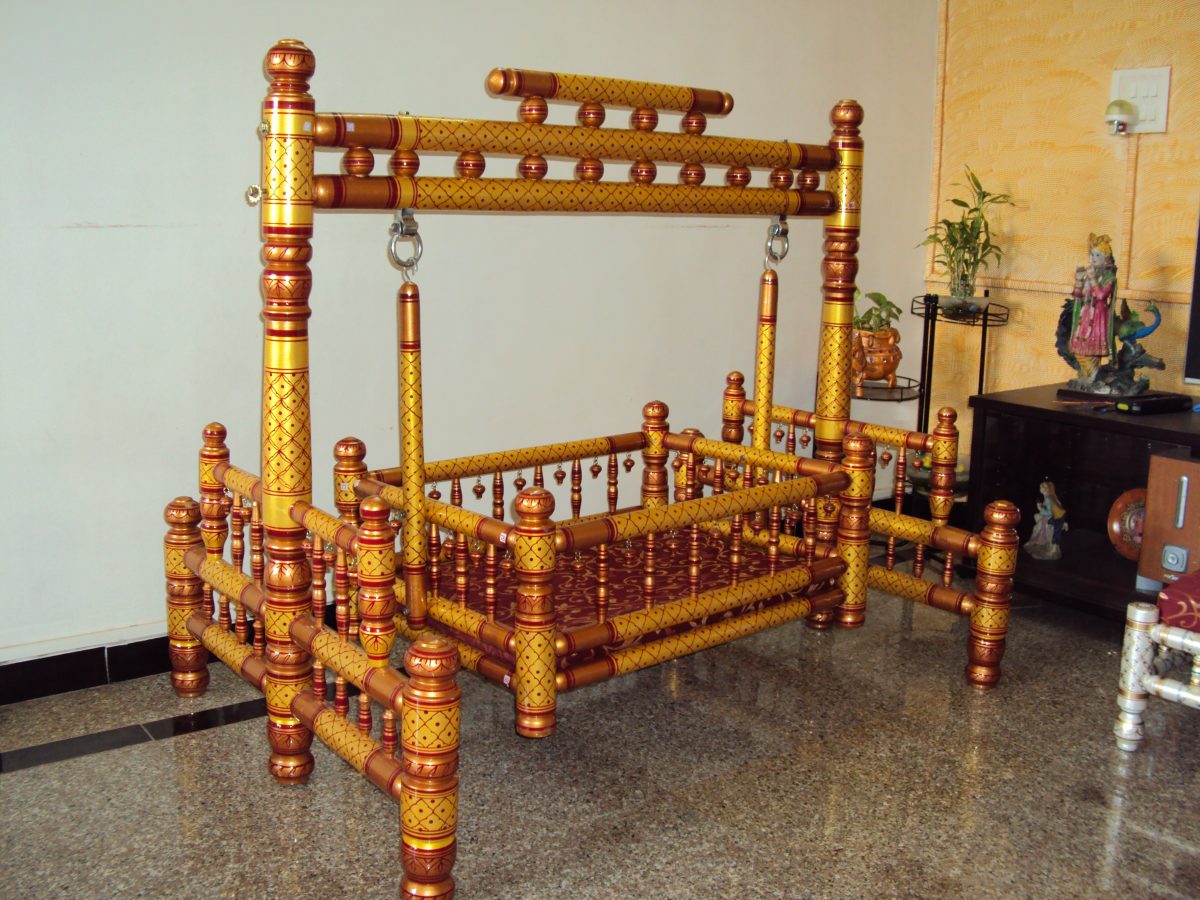
From wedding rituals to contemporary living rooms, Sankheda furniture—lacquered, hand-painted woodwork from Sankheda town in Gujarat’s Chhota Udaipur region—continues to hold its ground as both cultural heirloom and design statement. The craft’s identity remains unmistakable: turned teak forms, glossy lacquer, and bold motifs that read like folk geometry on wood.
Where it comes from
Sankheda is located near Vadodara; craft documentation places it roughly 45–55 km from the city and identifies it as the core production geography for this furniture tradition.
Heritage craft with a modern pulse
Teak, lathe, lacquer—and a signature shine
Sankheda pieces are typically made from seasoned teak, shaped on a lathe, then finished with lac (a natural resin) and hand-painted motifs. Traditional finishing methods include polishing techniques that use agate/akik stone and local materials like kevda leaf to enhance the surface.
The Sankheda palette: maroon-gold, now expanded
The classic identity is still anchored in maroon and gold, but contemporary market demand has pushed colour innovation—black, burgundy, green, blue, ivory, and metallic tones now appear alongside the traditional scheme.
GI protection: authenticity backed by law
Sankheda furniture is protected under India’s Geographical Indications framework, a safeguard that helps preserve provenance and authenticity in wider markets.
Artisans and local economy: a community craft, not a factory line
This is a community-led tradition, practised by Kharadi-Suthar artisans, with documentation noting around 80–100 families associated with the craft in and around Sankheda.
A craft with collective identity
Formal cultural-heritage documentation describes how Sankheda’s woodworking and painting skills create a strong sense of community identity and continuity, with specialised roles across turning, painting, and finishing.
Beyond India: exports and heritage buyers
Sankheda furniture has moved far beyond local demand—craft documentation highlights overseas traction in markets including the United States, the United Kingdom, Russia and Australia, while other summaries also note exports to Europe and West Asia.
Why the diaspora connects instantly
Heritage records identify the Gujarati community in India and globally as the primary users of Sankheda furniture—one reason the craft often finds steady demand among buyers looking for culturally rooted, statement décor.
Adaptation without dilution: how the craft is evolving
Mechanisation where it helps, handwork where it matters
Sankheda has modernised selectively—electrically operated lathes were introduced to increase output, but the defining value still lies in hand painting, motif work and surface finishing.
Synthetic colours, newer finishes—and the debate on “original shine”
Craft research notes increased use of synthetic colours and coatings such as melamine in some product lines, even as traditional lacquer-based pieces remain the benchmark for collectors and connoisseurs.
Cultural significance: why Sankheda is more than furniture
Sankheda is woven into Gujarati life—wedding gifting traditions, ceremonial use, and heirloom items like the ghodiyu (child’s cradle) appear repeatedly in craft documentation and cultural records.
The road ahead
As heritage-led interiors and boutique hospitality look for distinctive handcrafted pieces, Sankheda’s advantage remains clear: it offers functional furniture with a recognisable visual language, backed by living artisan communities and GI-linked provenance.
By – Sonali