


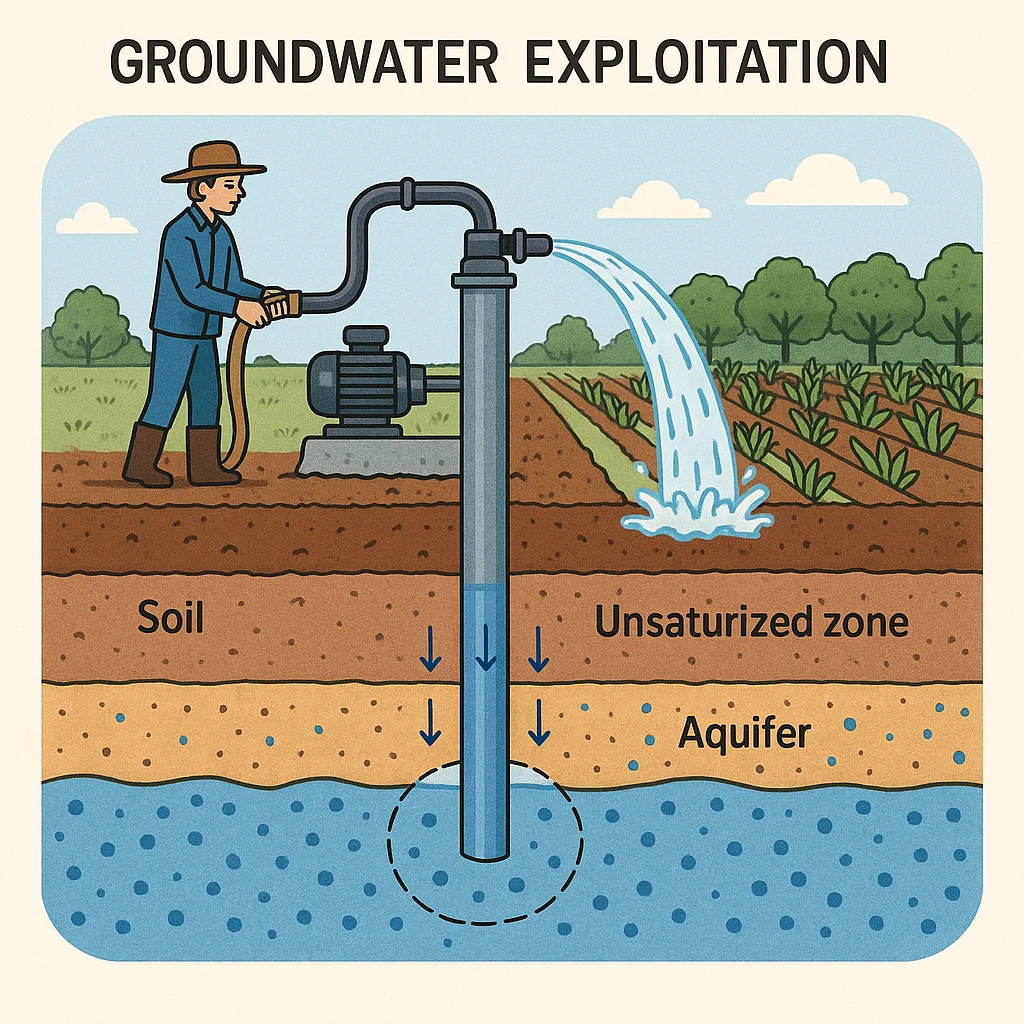
In the semi-arid Upper Arkavathy watershed of Bengaluru Rural district, groundwater is the lifeblood of rural communities, sustaining both agriculture and drinking water needs. However, a recent study by Water, Environment, Land and Livelihoods (WELL) Labs and Ashoka Trust for Research in Ecology and the Environment (ATREE) has raised alarms about rampant groundwater exploitation, which poses a severe threat to rural drinking water systems. Published on May 3, 2025, in The Hindu, the study highlights how over-abstraction, driven by free electricity for irrigation borewells, is depleting aquifers, straining local budgets, and jeopardizing the sustainability of rural water supplies. This article delves into the findings, causes, impacts, and proposed solutions to address this escalating crisis in the Upper Arkavathy watershed.
In This Article:
The Upper Arkavathy Watershed: A Fragile Ecosystem
The Upper Arkavathy watershed, encompassing areas like the Aralumallige sub-watershed (20 sq. km) in Bengaluru Rural, is a semi-arid region with an average annual rainfall of 800 mm. Groundwater is the sole source of irrigation and drinking water, as surface water bodies, such as the Arkavathy River and its cascading tanks, have largely dried up or become polluted over decades. The region’s hard-rock aquifers, typical of South India, have low water-holding capacity and recharge quickly but deplete rapidly during dry spells, making sustainable management critical. The study focused on Doddathumakuru and Aralumallige gram panchayats, revealing systemic issues threatening water security.
The Root Cause: Free Electricity and Over-Abstraction
The primary driver of groundwater depletion, according to the WELL Labs and ATREE study, is the free electricity provided to farmers for irrigation borewells. This policy, intended to support agriculture, has led to unchecked over-abstraction, as farmers drill deeper borewells and pump water without cost constraints. A 2018 ATREE study in the Arkavathy sub-basin noted farmers switching to water-intensive crops like eucalyptus and vegetables, further exacerbating depletion. The Central Ground Water Board (CGWB) classifies all blocks in Bengaluru Rural as “overexploited,” with 100% extraction rates reported in 2024, leaving no buffer for future needs.
The free electricity policy also imposes a financial burden, termed an “electricity debt,” on gram panchayats. The study found that high pumping costs consume significant portions of local budgets, sometimes rivaling expenditures on schools or healthcare. Veena Srinivasan of WELL Labs told The Hindu, “Sometimes, the entire town’s budget for water is going in the electricity bill,” diverting funds from critical infrastructure like wastewater treatment.
Impacts on Rural Drinking Water Systems
Groundwater depletion directly threatens rural drinking water systems. As aquifers dry up, panchayats must drill new borewells or deepen existing ones, incurring substantial costs. The study highlights that pumping costs are a bigger burden than drilling, as deeper water tables require more energy. In Doddathumakuru and Aralumallige, these expenses compete with other development priorities, straining local governance. Households also face increased costs, as they rely on private tankers or bottled water when public systems fail.
The broader ecological and social impacts are stark. Fallow agricultural fields have emerged as farmers sell water to urban areas, a trend noted by environmentalist Leo F. Saldanha in a 2019 Down To Earth report. Industrial belts in Doddaballapura, part of the Arkavathy basin, add pressure by polluting groundwater with untreated effluents, further reducing potable water availability. The WWF’s wetland restoration project in the region underscores how surface water bodies, once vital for irrigation, have been defunct for decades, leaving groundwater as the only recourse.
A Looming Crisis: Long-Term Sustainability at Risk
Bengaluru Rural’s groundwater crisis is part of a larger regional challenge. A 2025 Hindustan Times report noted that Bengaluru’s urban and rural districts extract 100% of available groundwater, with over 6,000 of 14,000 borewells drying up. The city’s reliance on the Cauvery River (1,450 MLD) and borewells (650 MLD) falls short of its 2,600 MLD demand, with rural areas bearing the brunt of the deficit. The Upper Arkavathy’s low aquifer capacity, as explained by IIT Gandhinagar’s Prof. Vimal Mishra, makes it particularly vulnerable to prolonged dry spells, unlike North India’s high-capacity aquifers.
Without intervention, the study warns of severe consequences. A 2018 Down To Earth report predicted that 40% of India’s population could lack drinking water access by 2030, with Bengaluru among 21 cities at risk of groundwater depletion. Rural communities, lacking the infrastructure of urban centers, face heightened vulnerability, with women and marginalized groups often spending hours fetching water.
Proposed Solutions: A Paradigm Shift
The WELL Labs and ATREE study calls for a “fundamentally different approach to planning.” Key recommendations include:
- Incentivizing Diversified Incomes: Encourage farmers to adopt less water-intensive crops or non-agricultural livelihoods to reduce groundwater abstraction while boosting incomes.
- Regulating Electricity Use: Reform the free electricity policy to promote efficient water use, possibly through metered systems or subsidies for sustainable practices.
- Watershed Management: Revitalize tanks and wetlands, as proposed by WWF’s restoration project covering 350 hectares, to enhance groundwater recharge.
- Rainwater Harvesting: Enforce and expand rainwater harvesting, as suggested in a 2020 The Hindu article, to recharge aquifers and reduce reliance on borewells.
- Strengthening Governance: Empower the Karnataka Groundwater Authority, established in 2011, to regulate extraction effectively, addressing its current inefficiencies.
Groundwater exploitation in the Upper Arkavathy watershed is a ticking time bomb for Bengaluru Rural’s drinking water systems. Driven by free electricity and water-intensive agriculture, over-abstraction threatens not only water security but also the financial and social fabric of rural communities. The WELL Labs and ATREE study underscores the urgency of rethinking water management, from policy reforms to community-driven conservation. As the Nilgiris’ Vegetable Show celebrates agricultural abundance, the Upper Arkavathy’s plight serves as a sobering reminder of the need for sustainable practices to ensure water for all. Without swift action, the region risks a future where drinking water becomes a luxury, not a right.
-Manoj H
Also Read – Delhi’s New Law to Regulate Private School Fees: A Step Toward Affordable Education?