


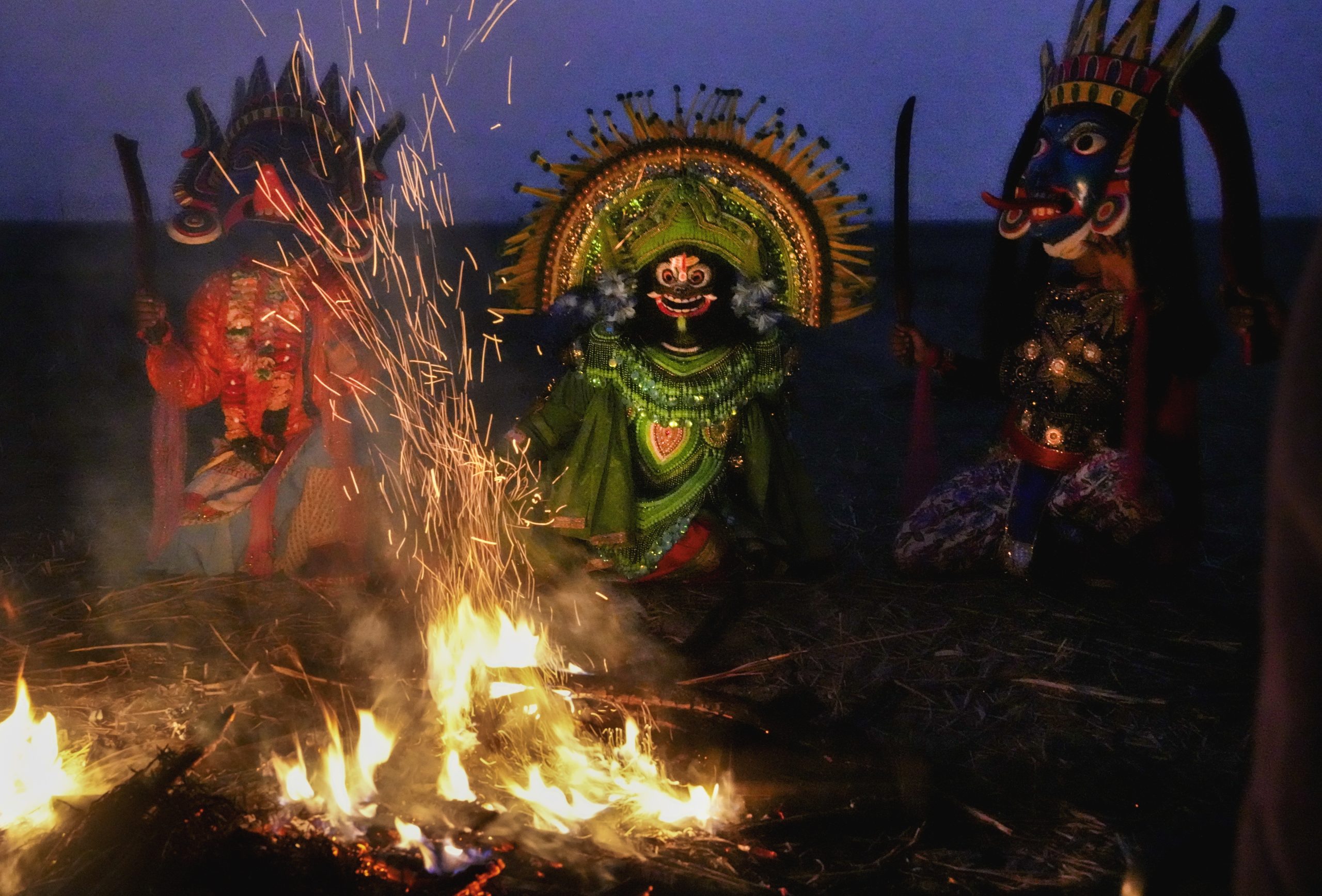
In the villages of Kushmandi block in Dakshin Dinajpur, a striking wooden face still holds the power to frighten away “evil forces,” invoke village deities, and turn a courtyard into a living stage. Known locally as Mukha Khel—the “game of masks”—the Gomira (Gamira) masks are not just folk art. They are ritual objects, performance tools, and a community’s identity carved into wood.
Cultural roots: masks that protect, not just perform
Gomira masks are inseparable from the Gomira dance, a ritual folk tradition in the Dinajpur region. These performances are typically organised between the Bengali months of Baisakh–Jyestha–Asharh (roughly mid-April to mid-July). There are no fixed dates—each village schedules its own event, often linked to agricultural cycles and local worship.
Unlike scripted theatre, the emphasis is on invocation and community protection: the masked dancer embodies forces—divine, animal, mythic—meant to usher in good and ward off harm.
From sacred wood to living iconography
The craft is labour-intensive and highly skilled. GI documentation notes that masks are made from locally available woods such as neem, gamar/gamari, mango, pakur, kadam and teak, shaped from seasoned logs using hand tools, then finished and painted.
Characters span a wide symbolic range—goddesses, guardians, demons, animals and epic figures—each mask designed not merely as decoration, but as a recognisable “presence” in the ritual landscape.
GI recognition—and the cooperative backbone
The craft’s distinctiveness is formally recognised: “Wooden Mask of Kushmandi” is listed as a registered GI from West Bengal.
Production is strongly associated with artisan clusters around Mahishbathan and nearby villages, supported by local collective structures. GI documentation names Mahisbathan Gramin Hasta Silpa Samabay Samiti Limited as the producer organisation linked to the craft.
A West Bengal craft-hub note also describes the cooperative model and nearby village clusters involved in mask-making.
The modern squeeze: livelihood uncertainty, youth exit
Even as interest in folk art rises, the ecosystem remains fragile. Mask-making is time-heavy, orders can be irregular, and many families still rely on seasonal agriculture to stabilise income. With younger generations chasing steadier work, the pipeline of master artisans becomes harder to sustain.
The path ahead: tourism, but with the soul intact
The smartest preservation model is not “souvenir-isation,” but context-led cultural tourism—where visitors learn why the masks exist, how they are made, and what they mean in ritual life. Festivals and exhibitions can help, but only if they keep the tradition’s sacred centre intact.
Bottom line: In Kushmandi, these masks are still living heritage—faces that carry fear, faith, and folklore in equal measure. Keeping them alive means protecting both the craft economy and the ritual dignity that gives the masks their power.
By – Sonali