


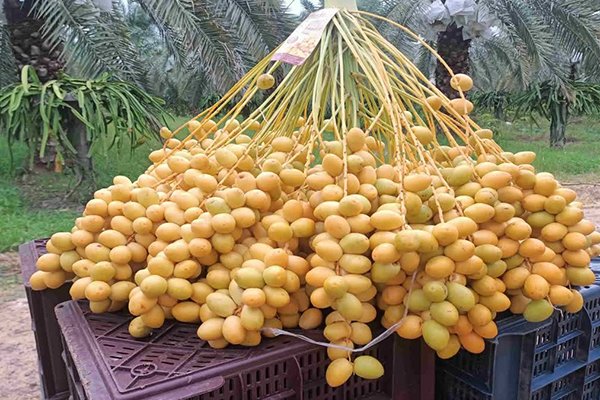
Across the salt-white stretches of the Kutch landscape—where heat, salinity, and water stress shape every harvest—one fruit has turned regional resilience into a signature taste: Kachchhi Kharek. Known locally for its crisp bite and natural sweetness, this indigenous Kutch date has moved from seasonal markets to a stronger national and international identity, powered by GI registration and rising demand for natural, nutrient-rich foods.
What exactly is “Kachchhi Kharek”?
Unlike the fully ripened dark-brown dates common in global markets, dates in Kutch are harvested at the khalal stage—when the fruit is mature, sucrose-rich, and yellow/red yet still crisp. This is a defining feature of Kutch’s date economy and a key reason Kachchhi Kharek has a distinct consumer following.
(For longer storage and wider distribution, part of the crop may also be dehydrated—sun/solar drying and controlled dehydration are commonly used value-add routes for dates harvested early.)
Why Kutch’s dates taste different
Growers and researchers link Kachchhi Kharek’s character to Kutch’s extreme agro-climate. Date palms here are noted for salinity tolerance and adaptation to drought/heat, conditions that shape fruit development and post-harvest decisions (including the need to harvest before moisture-heavy weather damages the crop).
GI tag: the biggest credibility boost
Kachchhi Kharek isn’t just “famous”—it is officially protected. Reporting notes a GI certificate was granted after an application filed by a Kutch farmer producer organisation, and the GI registry lists Kachchhi Kharek as registered. This helps differentiate authentic Kutch produce from generic “kharek” sold elsewhere.
Production strength: Kutch is the nucleus
Kutch isn’t a marginal contributor—it is the core of Gujarat’s date-palm footprint. Government figures cited in reporting place 19,251 hectares under date palm in Kutch—about 94% of Gujarat’s total date-palm area. The GI journal also notes Kachchh accounts for more than 85% of India’s date-palm cultivation.
Demand, imports, and the “Made-in-India” opportunity
India remains a massive consumer market for dates. Trade data show India imported ~490.6 million kg of dates (fresh or dried) worth ~$267.2M in 2023, largely from UAE, Iraq, and Iran—a reality that strengthens the case for domestic branding and value-add from Indian date regions like Kutch.
Challenges on the horizon
The biggest risk isn’t demand—it’s weather volatility. Recent reporting flags a sharp shift in Kutch rainfall patterns, with rain arriving earlier and causing 30–40% crop losses in some years by damaging fruit close to harvest. Long-term solutions increasingly point toward climate-resilient varieties, better harvest planning, and stronger post-harvest infrastructure.
A sweet future rooted in desert grit
From Kutch farms to festive gifting and premium dry-fruit counters, Kachchhi Kharek reflects what the desert does best: turning constraint into character. With GI protection, stronger branding, and smarter post-harvest handling, this Kutch original is positioned to hold its own—at home and wherever Indian diaspora demand keeps tradition alive.
By – Sonali