


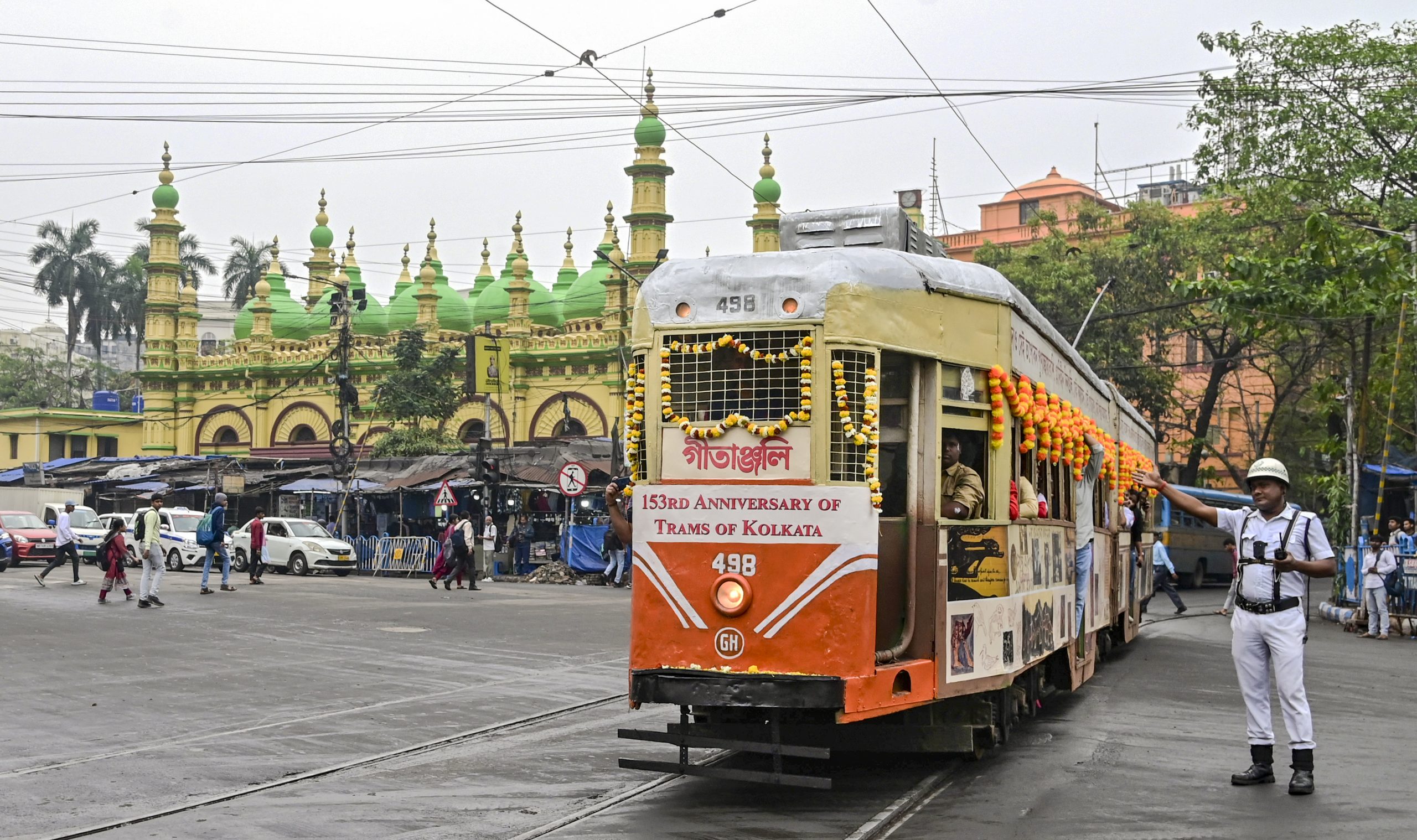
Kolkata’s tram service—once a backbone of daily commuting—now survives as both a working transit mode and a living symbol of heritage. The city’s trams trace their origins to February 24, 1873, making Kolkata home to India’s only operational tram system today and one of the world’s oldest running public transport legacies.
Yet, after decades of shrinkage, the network is down to a skeletal footprint, even as the debate intensifies: modernise and integrate, or reduce trams to a heritage-only token.
Historic Origins and Early Development
Kolkata’s tram story began with horse-drawn tramcars running between Sealdah and Armenian Ghat on February 24, 1873 (the service was later discontinued the same year before restarting in the 1880s).
A major expansion followed after the Calcutta Tramways Company (CTC) took shape in 1880, formalising the system’s growth.
By 1902, Kolkata became the first city in Asia to introduce electric trams, a landmark moment in the region’s urban transport history.
From Lifeline to Lean Network
At its peak, Kolkata’s trams had extensive reach and scale—Reuters notes the network once had more than 340 tram cars.
But over the decades, multiple pressures—metro expansion, road projects, maintenance constraints, and policy shifts—have steadily pushed trams out of the city’s transport mainstream.
Current Operations: Two Routes, Irregular Service
Today, the system is operated by the West Bengal Transport Corporation (WBTC).
Tram operations are now largely confined to two truncated routes—Shyambazar–Dharmatala (Esplanade area) and Gariahat–Dharmatala (Esplanade area)—and services are reported to run irregularly.
The currently operational track length is commonly cited at around 14 km.
Daily ridership is often reported at around 15,000 passengers, though this can vary with frequency and service disruptions.
Modernisation Plans and the Threat of Closure
In recent years, the tram system’s future has become increasingly uncertain. The West Bengal government has signalled plans to discontinue tram services across most routes, retaining only a short heritage stretch (often described as Maidan–Esplanade) for symbolic/tourism value.
Authorities argue trams are slow and occupy scarce road space in an already congested city. But the proposals have triggered protests and legal interventions—most notably, court scrutiny around tram tracks being removed or covered during roadworks.
Environmental and Cultural Importance
Even with operational challenges, trams remain one of the cleanest urban mobility options at the point of use—an electrified system that can reduce dependence on high-emission road transport when run at meaningful scale.
Culturally, Kolkata’s trams are more than vehicles: they are memory on wheels—immortalised in the city’s films, photography, and everyday nostalgia.
Public Sentiment and Preservation Efforts
Citizen groups such as the Calcutta Tram Users Association (CTUA) have campaigned for revival and fought legal battles to prevent dismantling.
Experts and advocates argue the choice doesn’t have to be “heritage vs shutdown.” Some propose modernising trams and integrating them as feeder services to the expanding metro network, similar to models seen in European cities.
Between Heritage and Modernisation
Kolkata’s tram service stands at a crossroads. Practical concerns and urban growth have accelerated its decline, but its historical, cultural, and environmental value remains hard to replace.
Whether it survives as a functional mass transit mode—or is reduced to a short heritage ride—Kolkata’s tram will remain a defining symbol of the city’s past and its choices for the future.
By – Sonali