


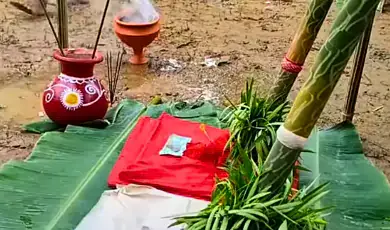
When July’s second fortnight arrives, Agartala will seal its gates and plunge into profound stillness as Ker Puja approaches, an age-old, boundary-setting festival that will suspend normal life for about thirty hours. Celebrated typically in July or August, Ker Puja is a deeply rooted Hindu-tribal festival honouring Ker, the guardian deity of Vastu Devata. Held within a strictly demarcated boundary, the festival combines age-old tantric rituals with communal devotion and Raj-era protocols.
In This Article:
What is “Ker” & Why It Matters
The term “Ker” in the tribal Kokborok language translates to a “specified boundary” or an area of austerity. During the festival, entrances to Agartala and designated regions, such as Old Agartala (Puran Habeli) and the Ujjayanta Palace grounds, are officially sealed for approximately two-and-a-half days. The shutdown aims to protect inhabitants from external threats, diseases, and calamities, mirroring the ancient purpose of securing collective welfare.
Timeline & Ritual Sequence
- Initiation: The festival traditionally begins 15 days after the conclusion of Kharchi Puja, aligning with tribal lunar customs.
- Declaration of Sacred Zone: Midnight marks the enforcement of the designated Ker boundary. Notices are issued banning births, deaths, excursions, lighting fires, dancing, singing, and other disturbances within the area.
- Rituals in Silence: The head priest, known as the Chantai, presides over silent ceremonies, with the firing of cannons or guns signalling ritual commencement.
- Offerings & Sacrifices: Devotees offer eggs, pigeons, goats, buffaloes, homemade liquor, and more to invoke divine protection.
- Public Participation: Pregnant women, the elderly, and the infirm are sheltered outside the designated zone to ensure their safety.
Royal Legacy & State Patronage
Centuries-Old Origins: Ker Puja is believed to have begun during the Manikya dynasty in the 15th century and continued under successive monarchs.
Modern State Support: Following the integration with the Indian Union in 1949, Tripura’s regent queen Kanchan Prabha Devi ensured that state sponsorship of pujas remains, as part of agreements with the Tripura government.
Shrinking Sacred Boundaries: Though the festival’s core rituals are intact, their spatial scale has moderated. Ceremonies now follow the original royal format but within reduced zones around the palace and designated hill outposts.
Strict Conduct: Punishment & Fine
Ker Puja demands austerity. Any breach, from civilians or officials, triggers a restart of the ritual from scratch, along with a monetary fine. The only permissible activities revolve around worship practices, while recreational enjoyment or social gatherings are strictly suspended.
Community & Cultural Impact
Ker Puja stands as a powerful emblem of cultural unity. Joined by tribal and non-tribal communities alike, the festival underscores communal harmony and shared spiritual purpose. Local faith leaders emphasise its ongoing significance for societal well-being and protection from misfortune.
In addition, neighbourhoods observe bank and institutional closures, Mirroring the cultural pause that defines the festival. Official agencies and financial institutions respect the shutdown.
Voices from the Chantai & People
According to Sambhu Bhattacharjee, Raj Purohit at Ujjayanta Palace, “This Ker Puja has been celebrated since the royal era… a fully tantric ritual. We perform this Puja for the well-being of all communities and tribal”.
Similarly, tribal leader Jagatmohan Debbarma affirmed the festival’s longevity and relevance: “Ker Puja starts midnight Friday and will continue uninterrupted for over 30 hours… anyone violating the rules has to pay”.
Final Reflection
Ker Puja is far more than a localized event, it is a living cultural anchor. Through strict rituals, royal antiquity, and state endorsement, the festival protects, unites, and defines communities across Tripura. In a place where boundaries, be they spiritual, geographic, or ritual, hold power, Ker Puja marks one of the most solemn affirmations of collective faith and heritage
By – Sonali