


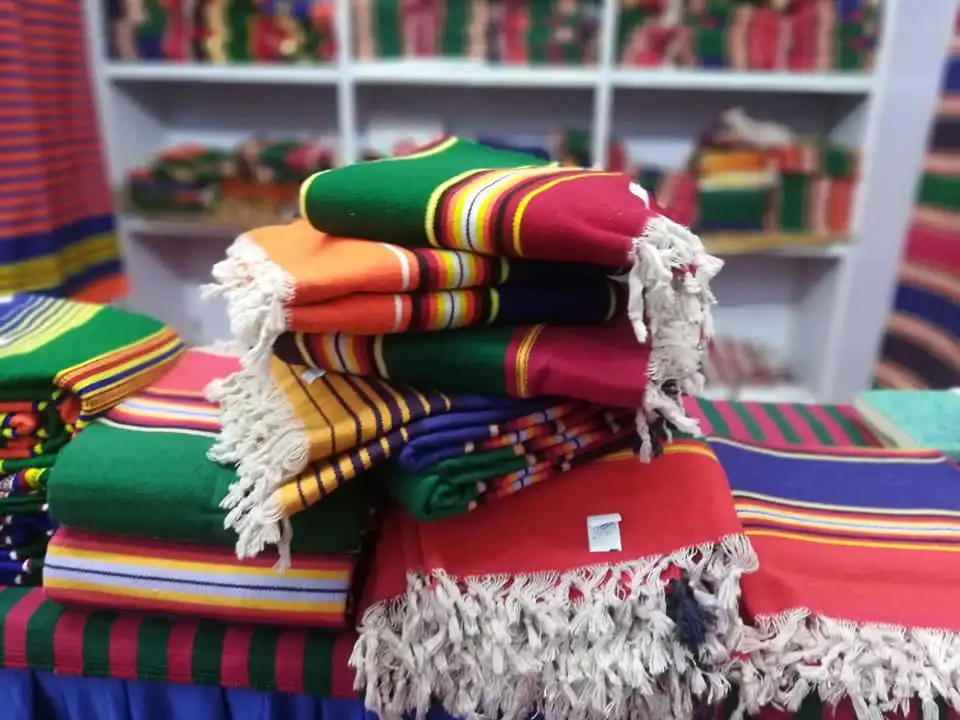
Bhavani Jamakkalam, a multidimensional name in the world of traditional Indian textiles, refers to handwoven blankets and carpets crafted in Bhavani, a town in Tamil Nadu’s Erode district. Recognized as a Geographical Indication (GI) in 2005–06, the jamakkalam underscores the region’s heritage and artisanal pride.
In This Article:
- Origins and Evolution
- Workforce and Craft Structure
- Global Reach and Export Market
- Decline Amidst Competition
- Voices on the Loom
- Bridging Tradition and Innovation
- Weaving a Future with Threads of Heritage
Origins and Evolution
In the late 19th century, faced with British textile competition, Indian weavers innovated new products. In Bhavani, a weaver community known as the Jangamars began weaving colourful coarse-thread blankets called jamakkalam. The craft gained popularity rapidly, replacing some traditional cloth-weaving practices in the region.
Two primary types emerged: one made using coarse cotton for bold-colored striped carpets, and another made with artificial silk threads allowing intricate border motifs. Jamakkalams are increasingly used in fashion items like backpacks, expanding beyond traditional floor mats.
Workforce and Craft Structure
Early on, jamakkalams were woven in individual homes. Over time, weaving shifted to a more organized system: master weavers lease handlooms to contract weavers. Trade merchants supply yarn sourced from nearby hubs like Coimbatore, Salem, and Karur. Approximately 1,500 workers, two‐thirds of them women, are engaged in the production of these heirloom textiles today.
Weaving is done on traditional pit looms, wooden looms embedded in ground-level pits. The artisan sits in the pit, operating foot pedals and shuttling colourful weft strands manually to interweave vibrant designs.
Global Reach and Export Market
Bhavani jamakkalams are exported to countries such as Sweden, Germany, Italy, the UK, the US, and Singapore. IKEA notably began purchasing these carpets from around 1993 for its international stores, helping bring the craft global visibility.
Decline Amidst Competition
Despite the GI certification, traditional weavers face existential challenges. Power looms, which produce cheaper imitations, pose stiff competition. Many importers and local traders sell lower-cost carpets from Solapur, Maharashtra, under the name ‘Bhavani jamakkalam,’ undermining authentic craftsmanship and violating the Handloom Reservation Act of 1985.
Sustainable livelihoods remain elusive. A study shows it can take around eight hours to weave a 4×6-foot jamakkalam, earning barely ₹250 per weaver daily. Even double-size pieces fetch limited returns, leaving many in poverty or debt. Reports estimate that two decades ago, over 20,000 workers produced these carpets; today only about 3,000 remain active, and many are part-time artisans due to low wages.
Voices on the Loom
At Kuruppanaickenpalayam village in Bhavani taluk, weavers toil in intense heat, weaving mats on cow-dung-smeared floors. Second- and third-generation artisans work barefoot in pits lined with oil bottles to lubricate wooden looms. They stress that despite GI status, innovation has stalled, and lockdowns and taxes have further shrunk their incomes.
Sixty-nine-year-old weaver Durai Raj recalls weaving complex patterns and human figures. Now, only about 13 skilled silk-border weavers remain in Bhavani Taluk, and his own children have opted out of the craft due to poor wages.
Bridging Tradition and Innovation
Efforts are underway to revive interest. Co-optex, the Tamil Nadu handloom cooperative, is training weavers across regions like Kumarapalayam, Erode, Salem, and Mahendranchavadi to produce jamakkalams. Contemporary variations include pastel shades, non-traditional color palettes, and fabric hybrids such as jute-cotton or silk-cotton blends. Designers are incorporating jamakkalam into shoes, bags, and home decor accessories to broaden appeal.
Weaving a Future with Threads of Heritage
Bhavani Jamakkalam is more than just a textile; it’s a living tradition, a symbol of regional identity, and a testimony to the artistry of Tamil Nadu’s handloom legacy. Though challenged by mechanization and market neglect, it continues to survive through the dedication of its remaining weavers. For this vibrant craft to thrive, it needs not only protection through GI tagging but also meaningful promotion, fair trade practices, and integration into contemporary markets. If supported well, the Bhavani Jamakkalam can reclaim its rightful place both in Indian homes and on the global stage, preserving heritage while embracing innovation.
By – Sonali