


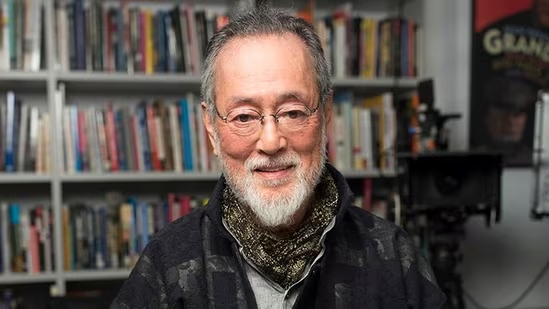
Tatsuya Nakadai, widely regarded as one of the greatest actors in the history of Japanese cinema, passed away on November 8, 2025, at the age of 92. The legendary performer, known for his commanding presence and remarkable versatility across seven decades of filmmaking, died from pneumonia after hospitalization for prior injuries. His death was announced on November 11 by his talent agency. Nakadai left behind an extraordinary legacy with over 160 films to his name and numerous accolades, including Japan’s prestigious Order of Culture, awarded in 2015.
From Shop Clerk to International Star
Born Motohisa Nakadai on December 13, 1932, in Tokyo, the actor’s path to stardom was unconventional. Growing up in poverty without access to formal university education, Nakadai worked as a shop clerk in Tokyo before a chance encounter with director Masaki Kobayashi altered the course of his life. Kobayashi cast the young man in “The Thick-Walled Room” (1956), marking the beginning of a transformative collaboration that would span 11 films over three decades.
Nakadai’s major breakthrough came through Kobayashi’s monumental war trilogy “The Human Condition” (1959–1961), where he played Kaji, a pacifist struggling against the brutality of World War II-era Japan. This role established him as a formidable talent and garnered him international recognition, rivaling his contemporary Toshiro Mifune in stature.
Masterpieces That Defined His Career
Nakadai’s collaboration with director Akira Kurosawa produced some of cinema’s most indelible works. His portrayal of Lord Hidetora Ichimonji in “Ran” (1985) Kurosawa’s adaptation of Shakespeare’s “King Lear” became his most iconic role internationally. The haunting image of his character, dazed and deposed, walking down the steps of a burning castle keep remains one of cinema’s most unforgettable scenes. In “Kagemusha” (1980), Nakadai delivered another powerful performance as a shadow warrior, further cementing his status as Kurosawa’s principal leading man.
Earlier, in Masaki Kobayashi’s 1962 masterpiece “Harakiri,” Nakadai played the aging ronin Hanshiro Tsugumo, a role he personally considered his finest. His performance earned him the Blue Ribbon Award for Best Actor, exposing the hypocrisy of a feudal clan’s honor system through the tragic act of seppuku.
A Lifelong Commitment to Theater and Teaching
Beyond his prolific film career, Nakadai remained deeply committed to theater throughout his life. In 1975, he founded Gendai Nohgaku-kai troupe and later established Mumeijuku, a renowned theater company and acting school where he mentored generations of aspiring actors. Among his notable students was Koji Yakusho, who became one of Japan’s most recognizable actors. Nakadai’s dedication to nurturing talent extended into his nineties, demonstrating his unwavering passion for the craft.
Global Recognition and Cultural Honor
Nakadai’s contributions to Japanese arts and culture earned him numerous prestigious accolades. He received the Medal with Purple Ribbon in 1996, the Order of the Rising Sun in 2003, and Japan’s highest cultural honor, the Order of Culture, in 2015. He was also honored as a Chevalier of the French Order of Arts and Letters and became an honorary citizen of Tokyo in 2024.
His final film appearance was in “The Pass: Last Days of the Samurai” (2020), demonstrating his enduring commitment to cinema even in his late years. Survivors include his daughter Nao Nakadai.
By – Sonali