


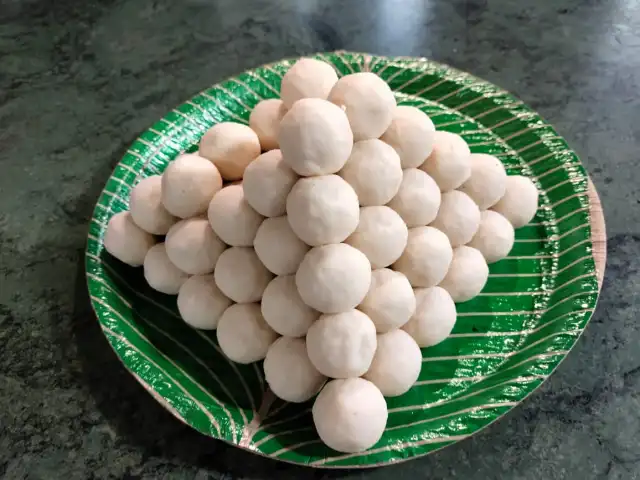
In the quiet lanes of Dhenkanal town, the aroma of slow-cooked milk and caramelised sugar is once again drawing attention to one of Odisha’s most distinctive sweets – Magji. Known for its off-white/cream appearance and cheese-based flavor, Dhenkanal Magji is witnessing a renewed surge in popularity as local artisans, food festivals, and digital storytelling bring regional Indian sweets back into the spotlight.
What is Dhenkanal Magji?
Magji is a traditional Odia sweet prepared primarily from thickened milk (buffalo milk chhena), sugar, and cardamom, cooked patiently over low heat until it acquires its signature dark hue. Unlike soft milk sweets, Magji is a dense, crumbly, and intensely flavoured, often laddoo-shaped and cut into bite-sized pieces.
What sets Dhenkanal Magji apart from similar milk-based sweets is its controlled caramelisation, achieved without artificial colouring, giving it a distinct taste that balances sweetness with a mild bitterness—a rarity in Indian mithai.
Roots in Dhenkanal’s Culinary History
Local historians and sweet-makers trace Magji’s origin back several decades, when sweet shops in Dhenkanal experimented with longer cooking times for milk solids to extend shelf life without refrigeration. Over time, this technique evolved into a recipe that became unique to the region.
Passed down orally within families of halwais, the recipe is still largely unwritten, with measurements based on experience rather than scales. This artisanal knowledge has helped preserve Magji’s authenticity, even as demand grows beyond district boundaries.
A Labour-Intensive Craft
Preparing Magji is a time-consuming process. Milk is first curdled and strained to make chhena, which is then combined with reduced milk solids and sugar. The mixture is stirred continuously for hours in large iron or brass kadais to prevent burning.
“The colour tells us when it’s ready, not the clock,” says a third-generation sweet-maker from Dhenkanal. “One mistake, and the batch is ruined.” This high level of skill explains why Magji production remains limited and why its taste varies subtly from shop to shop.
Festivals and Local Economy
Magji sees peak demand during Raja Parba, Durga Puja, Diwali, and wedding seasons, when Odia households favour traditional sweets over mass-produced alternatives. For many small sweet shops, Magji is not just a product but a seasonal economic backbone, supporting dairy suppliers, helpers, and local markets.
In recent years, Dhenkanal Magji has also found space at state-level food exhibitions and Odisha tourism events, helping it gain recognition among visitors unfamiliar with the region’s cuisine.
Modern Revival and Wider Reach
With social media reels, food bloggers, and Odisha-based homegrown brands showcasing regional delicacies, Magji is slowly entering conversations around heritage Indian sweets. Some shops have started vacuum-packing it for short-distance transport, while others are experimenting with hygienic packaging without altering the recipe.
However, sweet makers remain cautious about scaling up. “If you rush Magji, it loses its soul,” says a local vendor, reflecting a shared concern that over-commercialization could dilute its character.
Preserving a Sweet Legacy
As India’s culinary map increasingly celebrates hyperlocal foods, Dhenkanal Magji stands as a reminder that heritage doesn’t always come wrapped in silver leaf or international fame. Its strength lies in its simplicity, patience, and place-based identity. Dhenkanal Magji received a GI tag in 2024, thus protecting its legacy from vanishing.
A Taste That Tells a Story
More than just a dessert, Dhenkanal Magji is a story of time, technique, and tradition, one that continues to simmer slowly in Odisha’s heartland. As interest in regional foods grows, this humble caramelised sweet is finally getting the attention it has long deserved.
By – Sonali