


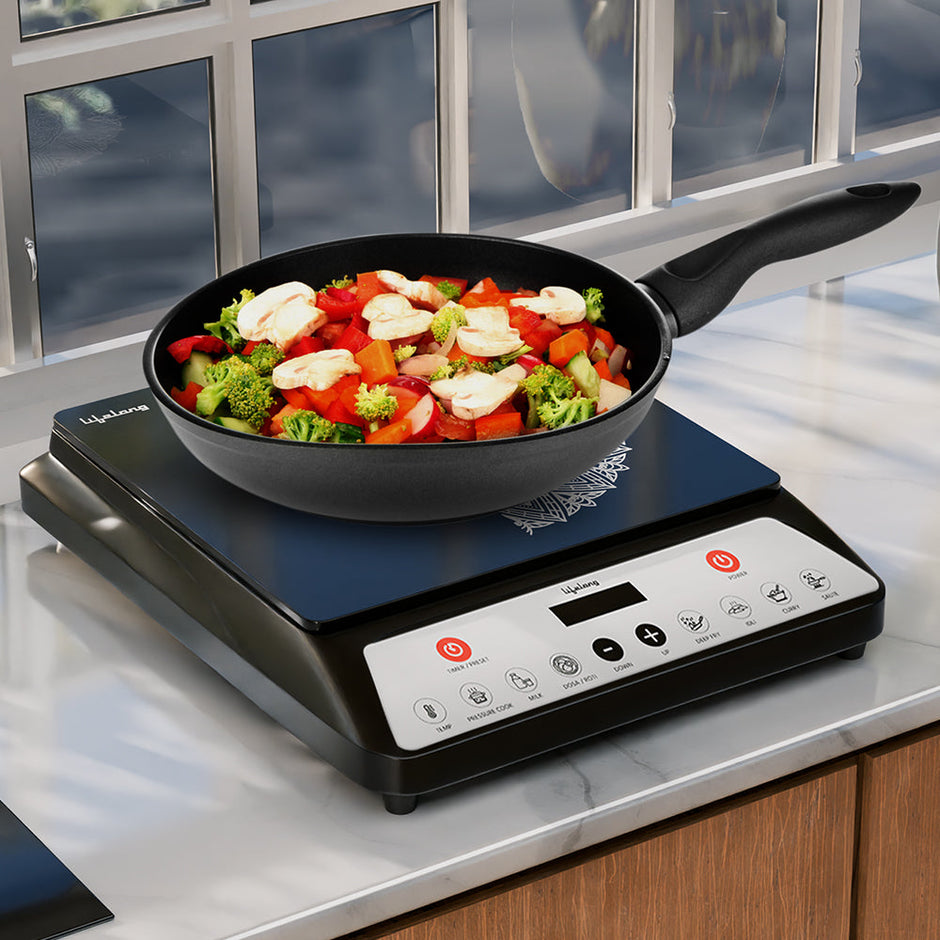
New Delhi, Mar 17 (PTI) With the war in West Asia choking supplies of liquefied petroleum gas (LPG) to India, experts have suggested a gradual expansion of electric cooking, especially in urban areas, as one key way to limit the country’s high reliance on imported cooking gas.
An analysis by the International Institute for Sustainable Development (IISD) shows that if 60 per cent of urban households — a high-growth scenario — adopt electric cooking as the primary mode of cooking, it would cut LPG imports by more than half.
However, for large-scale adoption of electric cooking, roadblocks such as high appliance costs, changes in cooking habits, and concerns about limited electricity supply will have to be overcome.
**Reason for high dependence on LPG imports Currently, India imports about 60 per cent of its LPG consumption, which is estimated at around 33 million tonnes, of which domestic production is around 13 million tonnes or 40 per cent.
In an interview with PTI, Sunil Mani, a policy advisor at IISD, explained the reason behind India’s dependence on imported LPG, saying, “Domestic LPG production in India is tied to crude oil refining and natural gas processing, where LPG is a secondary product or byproduct. The output is naturally capped by the volume of crude or gas produced, typically representing only 1 pc to 4.2 pc of the total output from a refinery.” Mani added that even at its full capacity, a refinery cannot switch to producing only LPG because its primary goal is to produce petrol and diesel.
“As a result, India imports around two-thirds of its LPG requirement annually, making it one of the largest importers globally after China,” he said.
This makes India highly vulnerable to global supply disruptions, geopolitical tensions, and shipping constraints.
Also, high import dependence exposes the country to price volatility in international energy markets, which could raise government subsidy burdens or increase household energy expenses.
**Benefits of adopting electric cooking Expansion of electric cooking could help not only reduce the dependence on imported LPG but also limit the amount the government spends on subsidies.
“LPG subsidies for Pradhan Mantri Ujjwala Yojana (PMUY) beneficiaries reached around Rs 13,000 crores in FY25, a 31 per cent increase from FY24… Promoting electric cooking will offer fiscal savings as well,” said Mani.
Besides this, the government compensates oil marketing companies (OMCs) for under-recoveries, as LPG is sold below market price, which could also be reduced with the expansion of electric cooking.
Mani stated, “The government compensated OMCs for under-recoveries, providing Rs 22,000 crore in October 2022 and approving Rs 30,000 crore in August 2025.” The IISD analysis showed that the use of electric cooking is 15 per cent to 20 per cent cheaper than LPG or piped natural gas (PNG) for a typical household consumer. This is because electric cooking is 80 to 85 per cent efficient, and LPG is only 57 per cent efficient.
“It means that in the case of electric cooking, whatever energy you provide to your meal, up to 85 per cent of it is actually heating the meal, making it more efficient. An exclusive electric cooking household would spend about Rs 5,800 to Rs 5,900 annually. At the current price of LPG (after the Rs 60 price increase), exclusive use of LPG would cost Rs 7,300, making electric cooking about 20 per cent cheaper,” said Mani.
**Overcoming the challenges The first major roadblock seems to be a lack of initiative on the part of the government, which will have to raise awareness about the benefits of electric cooking among urban households and get the industry involved in the process of expansion.
Karthik Ganesan, a researcher specialising in energy and environmental issues at Council On Energy, Environment and Water (CEEW), said, “Currently, we are not even providing enough signals to the industry. For example, Amazon and Flipkart have run out of induction heaters due to demand. Just like defence procurement, we must prime the industry to deliver before a crisis occurs.” He also noted that the adoption could start with richer urban consumers, who already use microwaves and kettles. This would leave LPG available for poorer consumers who cannot afford immediate alternatives.
Another issue is limited electricity supply, meaning numerous parts of India still witness low quality (voltage stability) and unreliable (higher power cuts) supply of electricity.
Mani said, “That’s why we suggest a gradual transition to electric supply… We should initially focus on urban areas where quality grid infrastructure already exists.” Speaking about the possible strain on power grids, Ganesan said for now, such a situation is likely to be 10 years away.
Currently, the government has to get appliances into people’s hands and help them understand how to use them, according to the researcher.
Ganesan said, “The government could model this after the PMUY (Ujjwala) scheme, where the connection was free, and the stove was provided through interest-free repayment over multiple bills.
“The government must evaluate the trade-off between the cost of the subsidy and the benefit of increasing energy security and making the system more resilient,” he said. PTI ALC RHL
Category: Breaking News
SEO Tags: #swadesi, #News, Electric cooking would reduce dependence on imported LPG, but challenges remain: Experts