


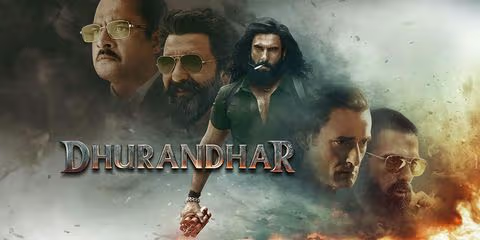
If you thought the real drama ends with the final scene, the internet would like a word. Ever since Dhurandhar landed on Netflix, eagle-eyed viewers have been rewatching it frame by frame—and now, credit by credit. And one tiny end-credits detail has reignited a long-running industry rumour around Ranveer Singh’s on-set setup.
What fans spotted in the end credits
According to reports, the “vendor transportation” section in the Netflix version lists three separate vans under the name of Ranveer’s character Hamza Ali Mazari. The entries that set social media off were: “Hamza Van,” “Hamza Staff Van,” and “Hamza Normal Van.”
That’s the spark. The fire came from what people believe it implies.
Why this is being treated like “confirmation”
The chatter around Ranveer allegedly using multiple vanity vans has floated around for months. The end-credits discovery gained traction because it appears to align with earlier reporting that claimed Ranveer travels with three vans—one for personal use, one as a gym, and one for a private chef/support.
So when viewers saw three vans listed for Hamza in the credits, many read it as a quiet “there you go” moment—less a leak, more a detail hiding in plain sight.
The detail that made it even juicier
There’s another nuance that added fuel: the naming pattern.
Reports note that other actors’ vans appear in credits under their real names, while Ranveer’s appear under character names—Hamza (and even Jaskirat, per coverage). That difference led fans to speculate whether the multiple-van arrangement was tied to the film’s demands, multiple looks, security/logistics, or even the actor’s famously immersive prep style.
What this does not prove (and why that matters)
Here’s the clean line between fact and internet inference:
- Fact (as reported): The end credits list three vans for Hamza under vendor transportation.
- Not proven by credits alone: That these were vanity vans specifically, that they were demanded by Ranveer personally, or that each van’s purpose matched the “personal/gym/chef” breakup.
“Vendor transportation” can include a lot—artist vehicles, staff movement, costume/makeup logistics, security convoys, or production-assigned units. The credits don’t come with an explanatory footnote, and there is no official statement in the cited coverage from Ranveer or the makers explicitly confirming the rumour as a personal requirement.
So yes, it’s a strong signal—but still not a courtroom “confirmed” stamp.
The bigger backdrop: vanity vans are now a status debate
This isn’t happening in a vacuum. The “how many vans does a star need?” conversation has become shorthand for rising production costs and celebrity ecosystems.
A prior report quoted vanity-van vendor Ketan Raval saying vans began as functional necessities for remote shoots, but have increasingly become about status and optics. And in that ecosystem, the number of units attached to an actor can quickly become a talking point—especially when producers are publicly discussing cost pressures across the industry.
Why this credits catch went viral so fast
Because it’s the perfect cocktail:
- a blockbuster now streaming on a major platform,
- fans with pause buttons and screenshot culture,
- an old rumour with just enough “evidence-looking” detail,
- and a star whose off-screen mythology is as headline-friendly as his on-screen intensity.
As India Today put it, the internet has effectively turned one line in the credits into a full-blown debate.
What’s next
Coinciding with this fresh wave of chatter, coverage also notes that the teaser for the sequel (Dhurandhar: The Revenge) dropped the same day—meaning the franchise is already back in the conversation for multiple reasons.
Bottom line – The end credits don’t “prove” motives—but they do show why the rumour has legs again. In 2026, even the credits aren’t safe from becoming content.
By – Juhi