


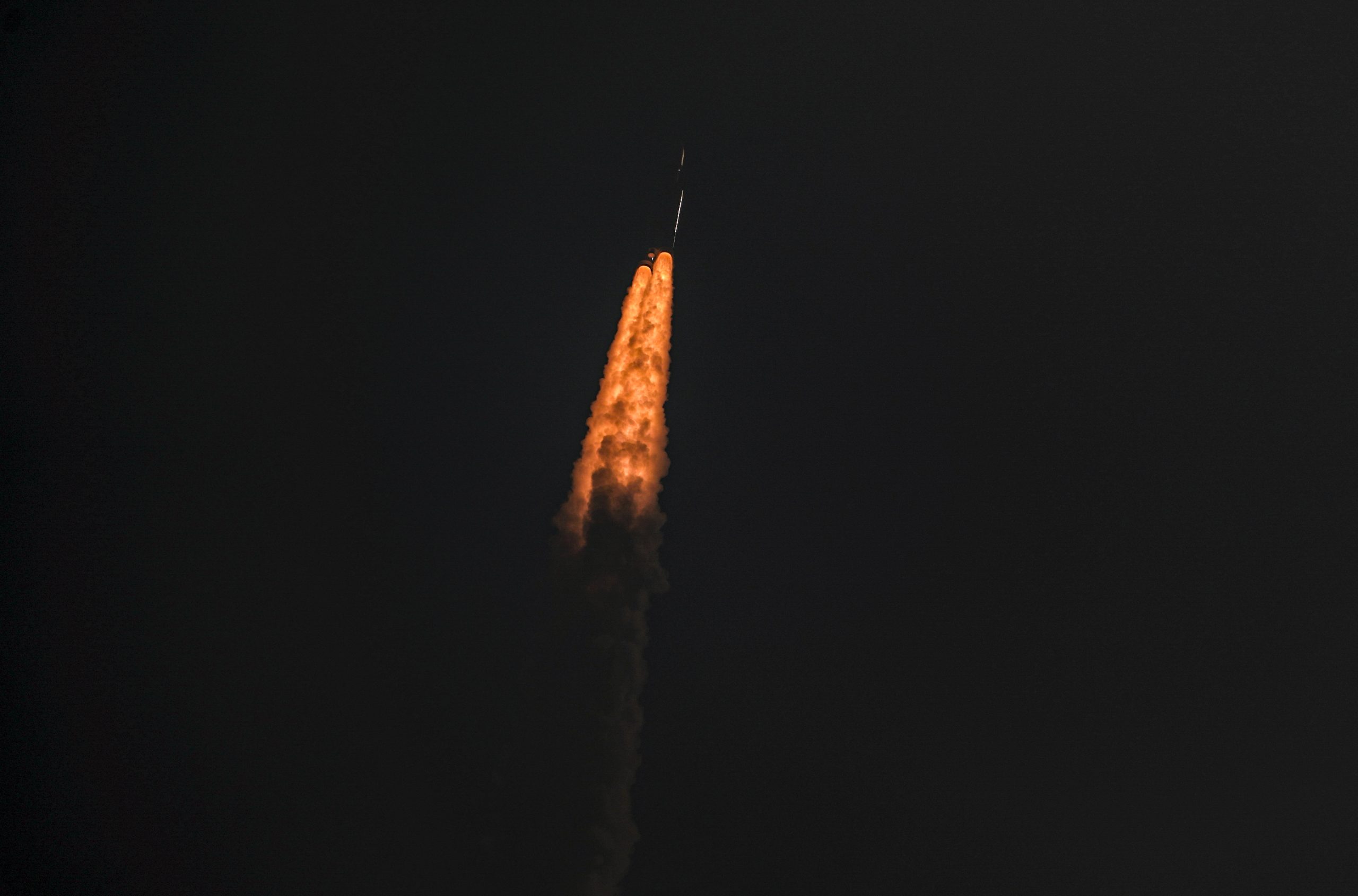
India’s space programme closed 2025 with a high-visibility commercial milestone: ISRO’s LVM3 mission for NewSpace India Limited (NSIL) successfully deployed AST SpaceMobile’s BlueBird Block-2/“BlueBird 6” satellite into low Earth orbit on December 24, 2025 (IST) from the Satish Dhawan Space Centre, Sriharikota. The satellite’s mass—about 6,100 kg—made it the heaviest payload delivered to orbit by India’s LVM3 to date, underscoring India’s expanding capability in heavy-lift commercial missions.
The mission also reinforced international confidence in India as a launch-services partner, with the Department of Space listing the dedicated commercial launch of BlueBird Block-2 for AST SpaceMobile as part of its scheduled mission set.
Launch cadence and mission diversity
Operationally, 2025 continued to demonstrate breadth across navigation, commercial, and technology missions. Early in the year, GSLV-F15 successfully injected the NVS-02 navigation satellite into GTO (January 29, 2025), adding resilience to India’s navigation architecture.
Looking ahead, the Department of Space has indicated seven major missions scheduled by March 2026, spanning commercial and Earth-observation launches and including human spaceflight programme components.
Parallel to near-term scheduling, India’s longer-run ambition is scaling: senior leadership has publicly spoken about moving toward ~50 launches per year by the end of the decade, contingent on infrastructure expansion and deeper industry participation.
Private space sector: from participation to production
A defining theme of 2025 has been the acceleration of India’s private space ecosystem—supported by IN-SPACe’s authorisation role and NSIL’s commercial execution layer.
- Agnikul Cosmos has continued to build credibility around advanced manufacturing and reusability ambitions, including expansion of additive-manufacturing capabilities and public articulation of fully reusable rocket plans.
- Skyroot Aerospace has advanced toward its first orbital-class launch attempt, with multiple reports indicating Vikram-I is being readied for an early-2026 window.
SSLV industrialisation: a major technology-transfer inflection point
In a significant shift toward industrial-scale private manufacturing, ISRO/NSIL/IN-SPACe signed a technology transfer agreement for SSLV with HAL in September 2025—positioned as a major step toward enabling non-ISRO production and operations for small-satellite launches.
Satellites and applications: EO-PPP signals market maturity
On the downstream side, India’s Earth-observation ambitions moved into a new commercial model. IN-SPACe announced that a private consortium led by Pixxel (with partners including Dhruva Space, PierSight, and SatSure) was selected to build India’s national EO constellation under a PPP framework, with an investment of over ₹1,200 crore over five years.
This model is important not just for capacity creation, but also for building a sustained domestic market for geospatial data products across agriculture, infrastructure, climate risk, and security-linked applications.
Policy and funding: lowering barriers for startups and MSMEs
Policy support in 2025 was reinforced through the Technology Adoption Fund (TAF), positioned at ₹500 crore, designed to help Indian companies mature technologies from lab-to-market and reduce import dependence.
Regulatory momentum: spectrum and authorisation clarity
India’s satcom and launch environment also saw steady movement on “rules of the road.” In 2025, TRAI issued recommendations on satellite spectrum assignment terms for commercial communication services, reflecting the broader push to align licensing and spectrum access with a more competitive satellite services market.
Youth and innovation: building the talent pipeline
Alongside hardware and policy, 2025 continued to widen the participation base through state-led and institutional innovation challenges, hackathons, and student competitions—expanding visibility for aerospace pathways and strengthening India’s future engineering pipeline.
Outlook: a sector transitioning from programmes to an economy
As 2025 closes, India’s space sector sits at a meaningful pivot: ISRO’s proven mission execution is increasingly complemented by private manufacturing, private launch aspirations, and commercial constellations. With a clearly signalled pipeline into early 2026 and an explicit national ambition to scale launch frequency dramatically, the next phase will be defined by execution capacity—industrial throughput, regulatory certainty, and the ability of startups to convert engineering progress into repeatable commercial operations.
By – Sonali