


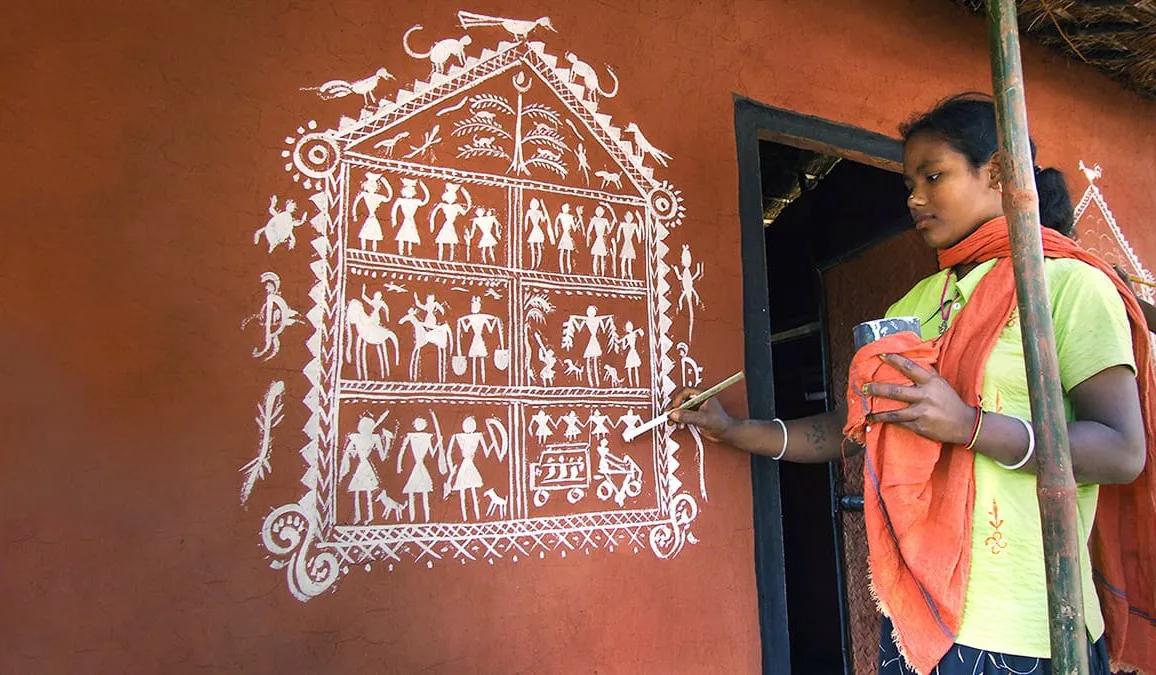
Lanjia Saura painting—also known as ittal/idital—is a ritual mural tradition practiced by the Saora (Saura) community of southern Odisha. Once largely confined to the interior walls of homes as a sacred act of worship, the art form has gained wider public visibility through documentation, curated collections, and heritage initiatives.
That renewed attention has also been reinforced by formal recognition: “Painting of Lanjia Saura (IDITAL), Odisha” has received Geographical Indication (GI) status, with the GI database listing the registration date as 02 January 2024.
A sacred art rooted in community life
Saora painting traditions are strongly associated with Odisha’s Rayagada, Gajapati, Ganjam and Koraput districts. The murals are not treated as decoration; they function as consecrated images created for specific occasions—honouring ancestors, seeking protection, marking festivals, easing childbirth, praying for a good harvest, or addressing illness.
Visual language and symbolism
Lanjia Saura murals typically depict stick-like human forms, animals, trees, celestial symbols, and scenes of everyday life—arranged in rhythmic rows and framed compositions. The wall becomes the shrine: the painting is executed on prepared surfaces washed with red ochre/geru, then built up with locally derived tools and pigments.
Ritual significance over aesthetics
Traditional Saora murals are created under ritual guidance. Documentation of the practice notes the role of the kuranmaran (community shaman) and the ittalmar (specialist painter), with ceremonies performed before and after painting to consecrate the mural’s purpose.
Materials are similarly rooted in place: white pigment is commonly derived from rice flour or ashes, with tamarind gum used as a binder; other colours may be sourced from indigo, turmeric, lamp black, and red ochre.
From mud walls to modern platforms
Even as the tradition remains anchored in ritual life, Saora painting has increasingly been documented and displayed through institutional platforms—helping the form reach audiences beyond the village setting. Collections and museum listings in Odisha, for instance, feature idital works as part of tribal heritage presentation.
Preserving a living heritage
Lanjia Saura painting demonstrates how indigenous art systems can be simultaneously sacred, social, and contemporary—provided preservation efforts keep community agency at the centre. With GI recognition now in place and institutional documentation expanding, the challenge ahead is to ensure the tradition thrives without being reduced to motif-only commercial reproduction.
By – Sonali