


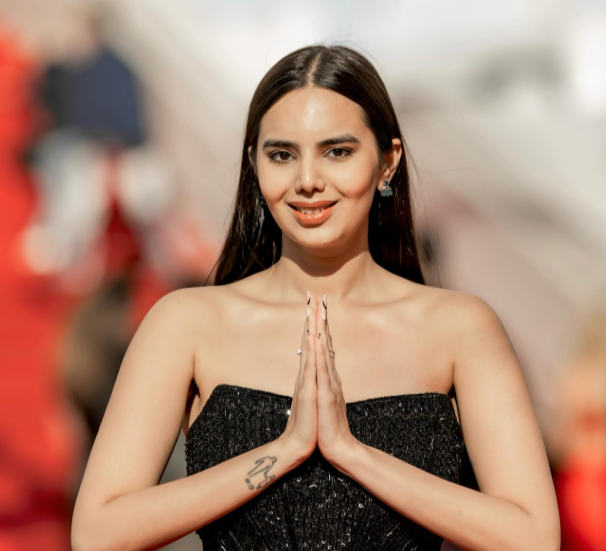
For Nandinee Khosla, acting wasn’t a sudden discovery; it was a spark ignited in early childhood and nurtured through years of passion and persistence. “I have always been the dramatic kind,” she laughs, recalling her days reciting Deepika Padukone’s iconic “Ek Chutki Sindoor” dialogue at family gatherings. Encouraged by her mother, who enrolled her in speech and drama classes, Nandinee’s flair for performance became more than a party trick: it became a calling.
In This Article:
- Building Blocks: Theatre to Television
- An Unseen Challenge, A Resilient Comeback
- The Role of Mona: Fiction Reflects Reality
- The Second Wind: A Story of Redemption and Hope
- Cannes 2025: From Zen to Red Carpet
- Redefining Feminist Cinema
- Social Media: A Double-Edged Sword
- What’s Next for Nandinee?
- Lessons from Cannes: The World is Bigger
- The Road Ahead for The Second Wind
Despite not hailing from a film background, she took the brave step of pursuing acting as a career. “Convincing myself was the biggest hurdle,” she admits. But that inner conviction eventually led her down a road less travelled from backstage prop handler to international red carpets.
Building Blocks: Theatre to Television
Nandinee’s professional journey began in theatre in 2018, where she first worked backstage before earning her first role in the play Khandani Golmaal. “Even moving props felt rewarding back then,” she shares as she loved being on stage.
Her on-screen debut was a TV commercial for Reliance Trends, followed by the digital series Tinder Swipe Right on Jio Cinema. Yet, it was The Second Wind, her feature film debut, that marked the real turning point.
An Unseen Challenge, A Resilient Comeback
Landing the role in The Second Wind seemed like another professional milestone, until life threw a curveball. Diagnosed with a slipped disc, Nandinee found herself on bed rest for three months. “I lost a lot of work. I doubted whether I’d even be able to complete the film,” she recalls.
It was her director, Indira Baikerikar, whom she affectionately called “Indi” who stood by her. Having previously collaborated in theatre and shared a mother-daughter dynamic on and off stage, Baikerikar waited patiently for Nandinee’s recovery. “That faith saved me,” she says. “My first day on set was also my ‘second wind’ in life.”
The Role of Mona: Fiction Reflects Reality
In the film, Nandinee plays Mona, a college student who is emotionally overwhelmed and sees her personal troubles as the worst in the world. “She reflects so many of us,” she says. Mona’s struggle with binge eating and strained relationship with her mother resonated deeply with Nandinee’s own experiences.
Reliving that emotional landscape was the toughest part. “I’ve been that 20-year-old who took out her frustration on her mother. It was a mirror to my past,” she reveals.
The Second Wind: A Story of Redemption and Hope
Directed by Indira Baikerikar, The Second Wind is a story of four women from diverse backgrounds who rediscover purpose through sport. While Indira plays a working mother, who is a real-life athlete and cancer survivor, Mayura plays herself, as does national-level sportswoman Mallika. Nandinee’s character brings youthful vulnerability to the mix.
“The film tells you that second chances aren’t just for people in their 50s. Even in your 20s, life can feel like it’s over. But there’s always a second wind waiting,” she reflects.
Cannes 2025: From Zen to Red Carpet
When she got the call about Cannes, Nandinee’s initial reaction was disbelief. “I asked Indira, ‘You mean the Aishwarya Rai wala Cannes?’” she laughs. But instead of basking in excitement, her mind raced through logistics—visas, flights, uncertainties. “I told my family not to tell anyone until I walked that carpet.”
Standing at Cannes alongside a fully woman-led cast and crew was overwhelming yet empowering. “We became each other’s safe space. We knew we had earned this moment, just us women,” she says with pride.
Redefining Feminist Cinema
Despite frequent skepticism, Nandinee firmly defends women-led narratives. “We’re not against men. We just want to tell stories from our perspective,” she clarifies. The Second Wind has been refreshingly well-received by male viewers too. “Some men came up to us and said, ‘I never thought this is what my wife might be going through.’ That was heartening.”
To critics who still label female-driven films as “niche,” Nandinee responds bluntly: “It’s only niche because we don’t have enough women writers or directors. Make the platform universal, and the stories will feel universal.”
Social Media: A Double-Edged Sword
As part of a generation raised on Facebook and Instagram, Nandinee acknowledges the double-edged nature of social media. “We’re overexposed, but we also connect directly with our audience,” she observes. Today, your Instagram is your acting portfolio. “You can’t have a private account as an actor anymore.”
Yet she finds the silver lining. “We’re also being held accountable now. No more pedestal treatment. We’re just regular people doing art.”
What’s Next for Nandinee?
Nandinee recently wrapped a project with Saregama and is returning to her theatre roots with her own script, this time as a writer-director. Her dream role? A big theatrical musical, preferably something Broadway-esque. On screen, she’s itching to break “molds—“Maybe something like ”Monjulika!”—and explore the world of OTT content.
Lessons from Cannes: The World is Bigger
One of the most eye-opening takeaways from Cannes, according to Nandinee, was realizing just how vast global cinema truly is. “We only know Bollywood and Hollywood. But Cannes showed me that the world has so many languages, cultures, and ways of telling stories.”
From interacting with a Cuban art director to discovering Eastern European cinema, she saw a world that doesn’t revolve around just mainstream industries. “Everyone is equal on that platform. No one’s bigger or smaller. That was beautiful to witness.”
The Road Ahead for The Second Wind
While The Second Wind is yet to be publicly released, Nandinee assures fans that exciting developments are underway. “We’re waiting for the right platform because this film deserves the best showcase.”
And when it does, she hopes it will have a lasting effect, especially on young viewers. “The worst thing you can do is lose hope,” she says. “This film is about finding it again.”
By – Sonali