


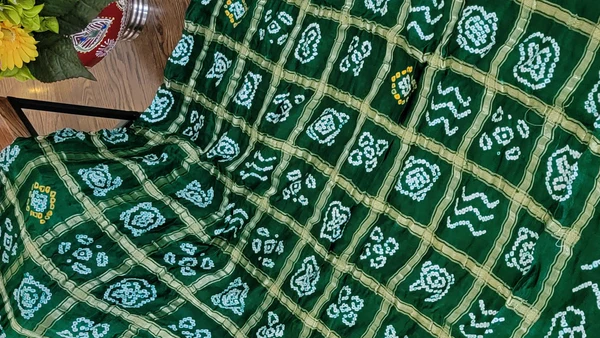
A centuries-old textile closely associated with Gujarati weddings has moved from family trunks to the national register of protected crafts. Gharchola, the checked, zari-flecked wedding sari traditionally worn by Hindu and Jain brides in parts of Gujarat, was formally registered as a Geographical Indication of India (GI) in late 2024, a step officials say will protect authenticity and help artisans access better markets.
What is Gharchola?
Gharchola is not a single technique but a layered craft: a silk sari woven with a grid of checks (the “chola,” or squares) and often finished with bandhani (tie-dye) and small golden zari motifs: peacocks, lotuses, and other auspicious emblems inside the squares. Traditionally produced in silk (historically cotton was also used), Gharchola’s visual identity is its regular, ritually significant squares filled with miniature motifs and bright, auspicious colours such as red, maroon, green, and yellow.
Ritual meaning and regional roots
The name itself carries cultural weight: local sources translate Gharchola roughly as attire associated with the home and marriage, a sari that symbolises a bride’s transition into her marital house. In Gujarati wedding custom the number of squares on a Gharchola is considered auspicious and meaningful; varieties with 12 or 52 squares (known in local naming traditions as patterns such as bar bagh and bavan bagh) are seen as carrying particular blessings. The sari has strong historical links to regions of Saurashtra, districts such as Jamnagar and Rajkot, where it has long been woven and gifted within families.
How it’s made – a hybrid technique
Craftspeople produce Gharchola through a combination of hand-weaving, tie-dye (bandhani) and zari work. Weft and warp silks form the base grid; artisans tie small portions to resist dye where needed, then add zari (metallic thread) to outline or fill motifs. The result is a textile that merges the precision of loom weaving with the slow, labor-intensive work of tie-dye and hand-embroidery – techniques passed down through family workshops and cooperative looms. Raw materials commonly cited include gajji silk and real or art-zari, while colouring traditionally favours festive red and maroon shades associated with bridal wear.
Why the GI tag matters
The Government of India’s GI registry entry for “Gharchola Craft of Gujarat” (Application No. 838) confirms the craft’s registration and places legal protection on the name and its geographic association. The GI tag, conferred during national-level presentations in late 2024, aims to restrict use of the ‘Gharchola’ name to authorised producers from the recognised region and to encourage market recognition and price stabilisation for genuine artisans. Local industry analysts and state handloom officials have argued that GI recognition helps curb cheap imitations and creates export and tourism opportunities for craft clusters.
Challenges and the road ahead
Despite symbolic value and recent recognition, Gharchola weavers face practical challenges: the craft is labor-intensive, demand is seasonal (peaking at wedding and festival times), and middlemen or mechanised look-alikes erode artisan margins. Younger generations of weavers are being pulled towards alternative livelihoods, while artisans who remain often lack design, marketing and digital-sales support. Experts recommend targeted training, easier access to raw materials, and branding help so the GI tag translates to better incomes rather than just a certificate.
Preservation through innovation
Some cooperatives and private designers are experimenting with contemporary Gharchola: lighter silks, smaller checks for ready-to-wear garments, and Gharchola motifs on stoles, lehengas and home textiles to widen the market beyond bridal wear. At the same time, connoisseurs and cultural organisations stress that innovation must preserve key elements – the checked grid, the embedded motifs and the traditional colour language that legally and culturally define Gharchola.
Closing stitch: from loom to legacy
The GI registration is a stitch in time for a craft woven through generations, but it is not the whole weave. For Gharchola to remain both a living tradition and a sustainable livelihood, the spark of national recognition must be matched by sustained policy support, design collaborations, and consumer awareness that values authenticity over imitation. When a bride drapes a Gharchola today, she wears a garment threaded with blessing, memory, and the steady hands of artisans – a living emblem of Gujarat’s textile heritage that now carries the country’s legal seal of identity.
By – Sonali