


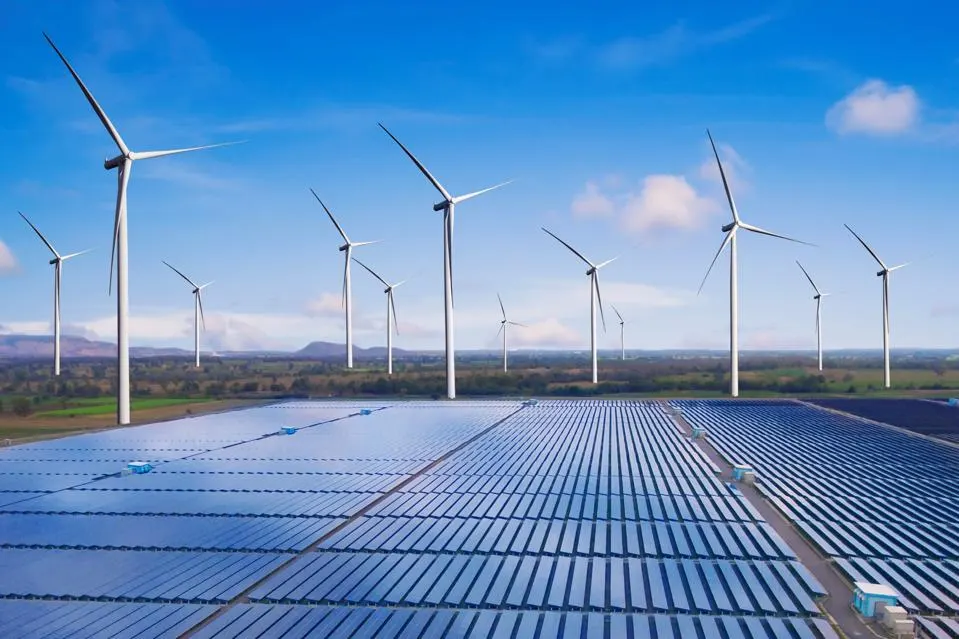
The transition from fossil fuels to renewables is entering a critical phase in 2025 as clean energy investment soars, renewable generation reaches record highs, and climate targets become more urgent. Despite growing momentum, fossil fuels still contribute significant shares of global energy and emissions, highlighting both progress and persisting hurdles in the race to decarbonize.
Clean Energy Surges Ahead
In 2024, renewables added a staggering ~600 GW of solar and ~125 GW of wind capacity, boosting grid storage by nearly 100% to approximately 170 GWh. Clean energy investment surpassed $2 trillion, roughly double that of fossil fuel investment, marking a historic tipping point. In the first half of 2025, clean electricity generation climbed to 6,405 TWh, a 6% year-on-year rise, and lifted clean energy’s share of the global electricity mix to over 43%.
Renewables Lead Generation Mix
According to Ember’s Global Electricity Review 2025, low-carbon sources, including renewables and nuclear, surpassed 40% of electricity generation for the first time since the 1940s. Renewables alone generated a record 858 TWh in 2024, a 49% jump over the previous record, accounting for the majority of clean supply growth. Solar generation has doubled in just three years, and China contributed over half of that growth, meeting 81% of its increased demand with clean sources in 2024.
Cost Advantages Fuel Adoption
Meanwhile, renewable projects have become more economically attractive: more than 90% of those commissioned in 2024 produced electricity cheaper than the cheapest fossil fuel alternatives. Solar is approx. 41% cheaper, and onshore wind is more than 50% cheaper than new fossil options. UN Secretary-General António Guterres declared the onset of a “clean energy age,” stressing that the transition has reached a point of no return.
Investment Deep Dive
The Energy Transition Investment Trends 2025 report highlights that global energy transition investment in 2024 rose 11% to $2.1 trillion. Clean technology spending now makes up more than two-thirds of all energy investment. Institutional investors, such as Dutch pension fund APG, are committing hundreds of millions to solar and battery projects, marking a surge in confidence and financing in regions like Australia.
National Policy Moves & Risks
Despite growth, several policy setbacks threaten momentum. In New Zealand, the recent reversal of an oil and gas exploration ban raised concerns about undermining its energy transition. In the US, the Trump administration rescinded offshore wind lease areas, slowing renewable deployment and prompting legal challenges. Meanwhile, within the EU, reliance on U.S. LNG and Chinese solar technology is sparking debate on energy security and dependence even as clean energy investments ramp up.
Regional Highlights: China & India
China, the world’s top renewable energy producer, expanded over 373 GW of renewables in 2024, reaching nearly 1,878 GW in total capacity. Renewables are projected to make up ~36% of China’s electricity in 2025, while coal’s share drops to historic lows near 53%.
India ranks third globally in renewable power. As of October 2024, renewables accounted for 46% of its installed capacity (~203 GW out of 453 GW), with a target of 500 GW by 2030. Solar PV combined with battery storage already meets demand reliably on most days.
Gaps and the Road Ahead
Despite rapid progress, nations are off-track to meet global targets. Countries agreed at COP28 to triple renewable capacity by 2030, but current national plans fall short: projected capacity totals only ~7.4 TW rather than the needed 11 TW. Only a handful of countries (e.g., India, Australia, and Brazil) have increased ambition. At the current trajectory, fossil fuel use still rose ~1% in 2024 and remains entrenched, pushing overall emissions up and underscoring the urgency of accelerated action.
Fossil Fuels to Renewables: No more a fiction
The global shift from fossil fuels to renewables is no longer theoretical; the economics, technologies, and investments are driving momentum. Clean energy now outpaces fossil fuels in both cost and growth. Yet despite record-breaking investment and deployment, fossil fuels still meet the majority of energy demand and emit record levels of CO₂.
Reaching ambitious climate goals will require closing policy gaps, scaling up capacity far beyond current pledges, and addressing emerging geopolitical and infrastructure risks. If countries raise their ambitions and stay the course, the energy transition could deliver both economic opportunity and planetary preservation in the decades ahead.
By – Sonali