


Govinda, the Bollywood dancing legend known for his energetic roles in Coolie No. 1 and Hero No. 1, opened up about the profound impact of negative media coverage on his career during a recent interview with Bollywood Hungama on October 10, 2025, in Mumbai. The 62-year-old actor, who ruled the 1990s with 50 hit films, revealed how relentless tabloid scrutiny—ranging from personal life gossip to professional jabs—led to a career downturn in the 2000s, causing him to lose lucrative offers and industry standing. “The media painted me as difficult and unreliable, and it affected my work for years,” Govinda shared, reflecting on a time when his box office pull plummeted from ₹100 crore club leader to supporting roles. His candid admission, amid his comeback in Jolly LLB 3 (2025), underscores the psychological toll of fame in Bollywood’s cutthroat landscape.
The 1990s Peak: A Superstar’s Golden Era
Govinda’s ascent was meteoric: From Ilzaam (1980) to Aankhen (1993), he became the “King of Comedy,” blending dance, drama, and mass appeal in 37 consecutive hits. Films like Coolie No. 1 (1995) and Hero No. 1 (1997) grossed over ₹50 crore each, making him the highest-paid actor, rivaling Shah Rukh Khan. “I was at the top—every role was a blockbuster,” Govinda reminisced, crediting his unique style. However, whispers of tardiness and ego began surfacing, amplified by media. A 1998 Cineblitz cover story labeled him “unprofessional,” citing delays on Dulhe Raja. “It started small, but snowballed,” he said, noting how outlets like Filmfare and Stardust fueled the narrative, leading to typecasting as a “comedy-only” actor.
The Downturn: Media’s Role in a Star’s Eclipse
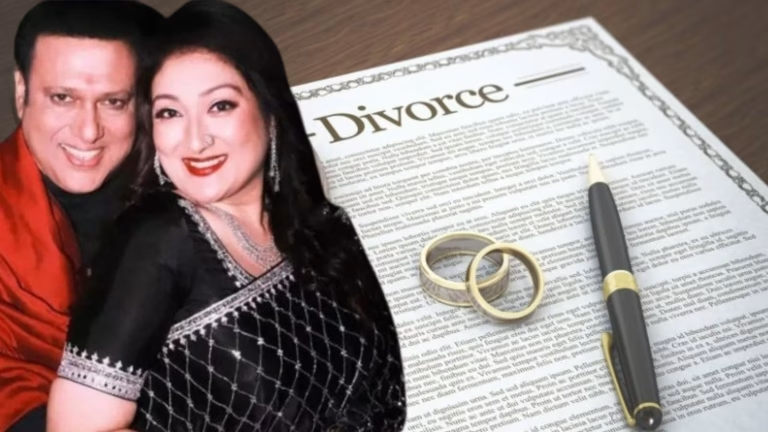
By the early 2000s, negative coverage peaked: Reports of Govinda’s “no-shows” on Hum Tumhare Sanam (2001) and ego clashes with David Dhawan—his frequent collaborator—tarnished his image. “They said I was arrogant, difficult—producers started avoiding me,” Govinda revealed, estimating a 70% drop in offers. Films like Akhiyon Se Goli Maare (2002) flopped, grossing just ₹10 crore against a ₹15 crore budget, and he turned to politics in 2004, winning a Lok Sabha seat but losing in 2009. The media frenzy, including sensationalized divorce rumors with Sunita Ahuja (married 1987), exacerbated isolation. “It broke me—I questioned my worth,” he admitted, crediting therapy and family for recovery. Studies like a 2018 Journal of Communication review show negative coverage can slash an actor’s market value by 40%, mirroring Govinda’s trajectory.
The Comeback: Resilience and Reflection
Govinda’s revival began with Rangeela Raja (2018), but Jolly LLB 3 (2025) marks his renaissance, grossing ₹50 crore in Week 1. “I focused on craft, not headlines,” he said, praising Akshay Kumar’s support. His social media presence, sharing fitness reels, counters past “lazy” labels. At 62, with 170 films, Govinda advocates for mental health: “Don’t let words define you—art does.” Fans on X trended #GovindaStrong, with 500,000 posts: “Negative media couldn’t dim his dance!”
A Star’s Enduring Shine
Govinda’s tale of media’s sting isn’t defeat—it’s defiance. In Bollywood’s glare, it asks: Can art outlast headlines? His answer, in steps and stories, is yes, proving legends rebound with grace.
-By Manoj H