


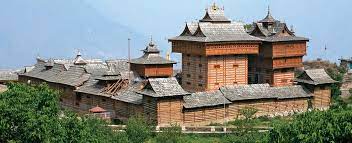
In the wake of devastating cloudbursts and flash floods that struck Himachal Pradesh in 2024, a peculiar pattern emerged from the debris-strewn valleys. While modern concrete structures crumbled like sandcastles, centuries-old wooden houses stood their ground, swaying with the earth’s tremors but refusing to fall. These survivors of nature’s fury are known as Kath-Kuni houses, architectural marvels that have defied earthquakes, avalanches, and the test of time for over 800 years.
An Ancient Engineering Marvel
Kath-Kuni architecture represents an indigenous construction technique prevalent in the isolated hills of Himachal Pradesh, particularly in regions like Kullu, Kinnaur, and Chamba. The word comes from Sanskrit, where “kashth” means “wood” and “kona” means “corner” or “angle.” It describes a method in which wooden beams are used instead of stone masonry. What makes these structures extraordinary is their complete absence of mortar, cement, or even nails; the entire edifice is held together by the sheer weight of materials and intricate interlocking joints.
Radiocarbon dating indicates some Kath-Kuni buildings are approximately 880 years old, with several structures having stood for over 300 years. The construction technique emerged from a profound understanding of the relationship between seismic activity, topography, climate, and native materials.
The Science Behind Earthquake Resistance
The genius of Kath-Kuni lies in its horizontal architecture. Unlike conventional reinforced cement concrete (RCC) structures built on vertical columns, these homes rely on horizontally layered alternative beams. This fundamental difference gives them remarkable resilience during seismic events.
“From a scientific and technical perspective, vertical columns aren’t as resilient to the sheer force of an earthquake. Horizontal beams, however, create a strong framework for the entire building, allowing it to absorb shocks more effectively,” explains architect Rahul Bhushan, founder of NORTH collective in Shimla’s Naggar.
The construction involves laying two wooden beams longitudinally parallel to each other, creating double-skinned cavity walls filled with loose stones and rubble. These criss-cross bracings, known locally as ‘maanvi,’ along with wooden joineries, provide the flexibility needed to withstand tremors. Research shows that Kath-Kuni buildings have a high damping ratio of 10% when they are not damaged. This is much higher than the 5% ratio for reinforced concrete, which greatly reduces seismic forces.
The structures feature strategic design elements: square plan dimensions offering comparable strength in both horizontal directions, smaller door and window openings that enhance wall strength, more stone in lower portions and timber in upper sections for improved stability, and raised stone plinths that protect from groundwater while dampening seismic forces.
Climate-Responsive Design
Beyond earthquake resistance, Kath-Kuni architecture demonstrates remarkable adaptation to Himalayan climate extremes. The thick double-layered walls function as natural insulators, trapping heat during frigid winters and keeping interiors cool in summers. Air gaps within walls help dissipate seismic forces while providing thermal regulation.
Traditional houses are typically oriented with their longer facades facing south to maximize low-angle solar gain during winters. The ground floor traditionally houses livestock, whose body heat rises to warm upper living quarters, a sustainable heating solution that has served mountain communities for centuries.
Steep slate roofs with substantial overhangs efficiently shed snow and rainwater while holding the structure firmly in place. The elevated stone plinth not only strengthens the superstructure but protects buildings from snow accumulation and water seepage.
Living Landmarks
Several magnificent Kath-Kuni structures are still leaving people in awe. Naggar Castle, built around 1460 AD by Raja Sidh Singh of Kullu, stands as one of the finest examples. Now converted into a heritage hotel managed by Himachal Tourism, the castle remarkably survived the devastating 1905 Kangra earthquake that claimed 10,000 lives, stunning Geological Survey officers who noted “the natural resisting power of their timber-bonded walls”.
Chehni Kothi in Tirthan Valley represents another architectural wonder, a 350-year-old, 12-story fortified tower rising approximately 45 meters high. This ancient building was built entirely using the Kath-Kuni method, with no cement or nails. It was originally a fort for defense, but now it is a temple for Shringa Rishi.
The Hidimba Devi Temple in Manali, constructed in 1553 by Raja Bahadur Singh, showcases the technique’s versatility in religious architecture. Its distinctive four-tiered pagoda-style roof and intricate wooden carvings demonstrate how Kath-Kuni principles extend beyond residential structures.
A Tradition Under Threat
Despite their proven superiority in earthquake-prone regions, Kath-Kuni houses face an existential crisis. Recent decades have witnessed an alarming replacement of traditional structures with concrete buildings. Chehni in Tirthan Valley remains the only village in Himachal Pradesh where all houses are still Kath-Kuni, while other settlements have embraced concrete construction.
Multiple factors drive this architectural shift. Government subsidies for concrete housing, rising timber costs, scarcity of skilled artisans, and changing aspirations tied to urbanization have accelerated the decline. “Locals think RCC structures are cleaner. Also, the design is such that Kathkuni houses are difficult to get around. For example, the staircase is too steep,” notes one observer.
The irony is stark: while concrete structures are perceived as modern and low-maintenance, they possess limited lifespans, significant ecological footprints, and vulnerability to the very seismic forces that Kath-Kuni designs effortlessly absorb. The transition represents not merely a material shift but a profound cultural loss with long-term implications for environmental sustainability and regional identity.
Revival Efforts and Future Prospects
A handful of conservation architects and urban planners are working to revive this indigenous wisdom. Rahul Bhushan has trained over 2,500 students through workshops and courses, creating communities of skilled artisans who now practice the craft. His approach involves blending old techniques with modern needs, developing hybrid architecture that respects tradition while addressing contemporary requirements.
“Kath kuni houses are built like Lego structures that can be dismantled rather than demolished, which opens a scope to reuse the material from old abandoned houses in the region,” Bhushan explains. This sustainable approach stands in stark contrast to concrete demolition, which generates massive waste.
The path forward requires policy reforms, awareness programs emphasizing the earthquake resilience and environmental benefits of traditional construction, investment in training programs for artisans to preserve woodworking and masonry skills, and integration of Kath-Kuni principles into modern building codes and disaster management strategies.
Lessons from the Hills
As climate change intensifies natural disasters and seismic risks persist in Himalayan regions, the enduring strength of Kath-Kuni houses offers more than architectural nostalgia; it provides a blueprint for resilient, sustainable living. These structures embody centuries of empirical knowledge, refined through countless earthquake cycles and harsh winter seasons.
The choice between concrete modernity and traditional wisdom is not merely aesthetic. It determines whether future communities will build structures that work with nature or against it, whether regional identity will be preserved or erased, and whether the accumulated knowledge of generations will guide construction or be forgotten beneath layers of cement.
In the shadow of the Himalayas, where mountains still tremble and rivers still rage, the answer may lie not in what is newest, but in what has already proven itself through centuries of storms: those elegant interlocking layers of wood and stone that bend but do not break, that shelter without destroying, and that remind us that sometimes the most advanced technology is the one that nature herself endorses.
By – Sonali