


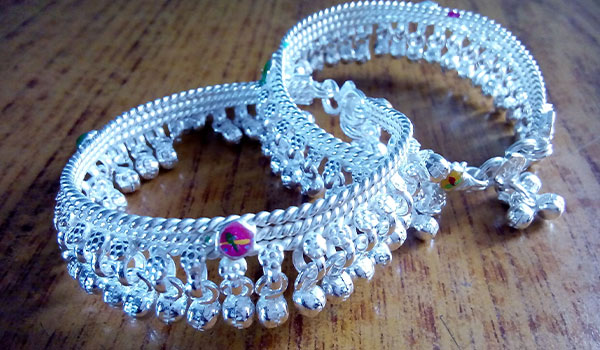
In Maharashtra’s Kolhapur district, Hupari wears its nickname—“Silver City”—with hard-earned legitimacy. For generations, the town’s workshops have supplied India with intricately crafted silver payals (anklets) and a wide range of ornaments, built on skill-heavy processes that still rely heavily on handwork. Now, with official GI protection in place and renewed export conversations underway, Hupari’s artisan economy is attempting a pivot—from a largely domestic, middlemen-driven ecosystem to a branded, globally marketable craft cluster.
A craft with deep roots—and clear industrial milestones
Government craft documentation traces Hupari’s silverwork roots back to the 13th century, while noting key milestones that shaped its modern industry: the first unit in 1904, the introduction of machinery in 1940, and the formation of the Chandi Karkhandar Udhyojak Association in 1944. These markers matter because they show Hupari’s evolution from a traditional artisanal practice into a structured cottage-industry network that still defines livelihoods in the region.
What makes “Hupari silver” visually distinct
Hupari’s signature lies in ornamental density and motif language—traditional patterns drawn from Indian aesthetics such as ambi (mango), pipal, champak, and other floral/leaf inspirations. The product range extends well beyond anklets into necklaces, rings, bangles, kamarpatta (waist belts) and functional/ritual items such as incense holders and diyas, reflecting the way the craft sits at the intersection of adornment and everyday religio-cultural life.
GI tag: protection, credibility, and a branding lever
A key turning point is the GI registration. Official records show Hupari Silver Craft is registered, with the certificate of registration dated 30 March 2024. In practical terms, GI status strengthens the case for authenticity—helping the cluster differentiate genuine Hupari-made work from lookalikes and giving artisans/associations a stronger legal and marketing framework to build brand value.
The scale: a large cottage industry, but with modern constraints
Hupari is not a niche micro-cluster. Industry coverage notes the town—described as a group of villages—supports over 40,000 artisans and roughly 1,200 units, with women forming a significant part of the workforce. Yet productivity and market access remain constrained by outdated machinery, manual processes, and limited export readiness, even as the skill level remains high.
The export push: training, awareness, and the “Common Facility Centre” idea
The Gem & Jewellery Export Promotion Council (GJEPC) has positioned Hupari as a potential silver export hub, citing the government’s recognition of Hupari as a “silver zone” and proposals around a Common Facility Centre (CFC) as building blocks for scale and standardisation. GJEPC notes it has conducted awareness seminars and export-oriented guidance—aimed at basics such as export requirements, product demand, technology upgrades, and quality expectations—while also highlighting that Hupari still lacks the ecosystem typically needed to move from domestic wholesaling to consistent export orders.
Competition and the price-pressure problem
Stakeholders also acknowledge a tough competitive reality. GJEPC-linked reporting points to how other centres can undercut costs or standardise finish more easily—citing casting-led efficiencies in Rajkot and quality/finish practices in Salem—while Hupari’s dependence on manual methods and inconsistent input quality can create friction when meeting global finishing standards. Add volatile silver prices and demand shifts, and many artisan households face income uncertainty even when skills remain intact.
The fashion-world spotlight: interest, not a deal
Hupari’s possible runway moment has also entered public conversation. A ground report by The Print said Prada is “considering” a collaboration pitch involving Hupari’s silver anklets, in the wider context of debates on credit, craft origin, and global fashion’s use of Indian heritage products. The report frames this as exploratory—an opportunity being discussed, not a confirmed partnership—yet it has injected optimism into a cluster looking for market revival beyond traditional domestic cycles.
What revival will realistically require
For Hupari’s “GI-plus-export” story to translate into artisan incomes, the roadmap is fairly clear:
- Technology and finishing upgrades (without flattening the craft identity)
- Cluster-level infrastructure such as a functioning CFC and quality systems
- Direct market access (digital commerce, brand-building, buyer discovery)
- Youth retention and skill continuity, so the craft remains a viable career path
With GI protection now formalised and export capability being actively discussed, Hupari has a credible opening to convert “Silver City” identity into global recognition. Whether it becomes a durable revival will depend on how quickly the ecosystem shifts from legacy production to export-grade consistency—while keeping the motifs, techniques and community labour model that made Hupari’s silver famous in the first place.
By – Sonali