


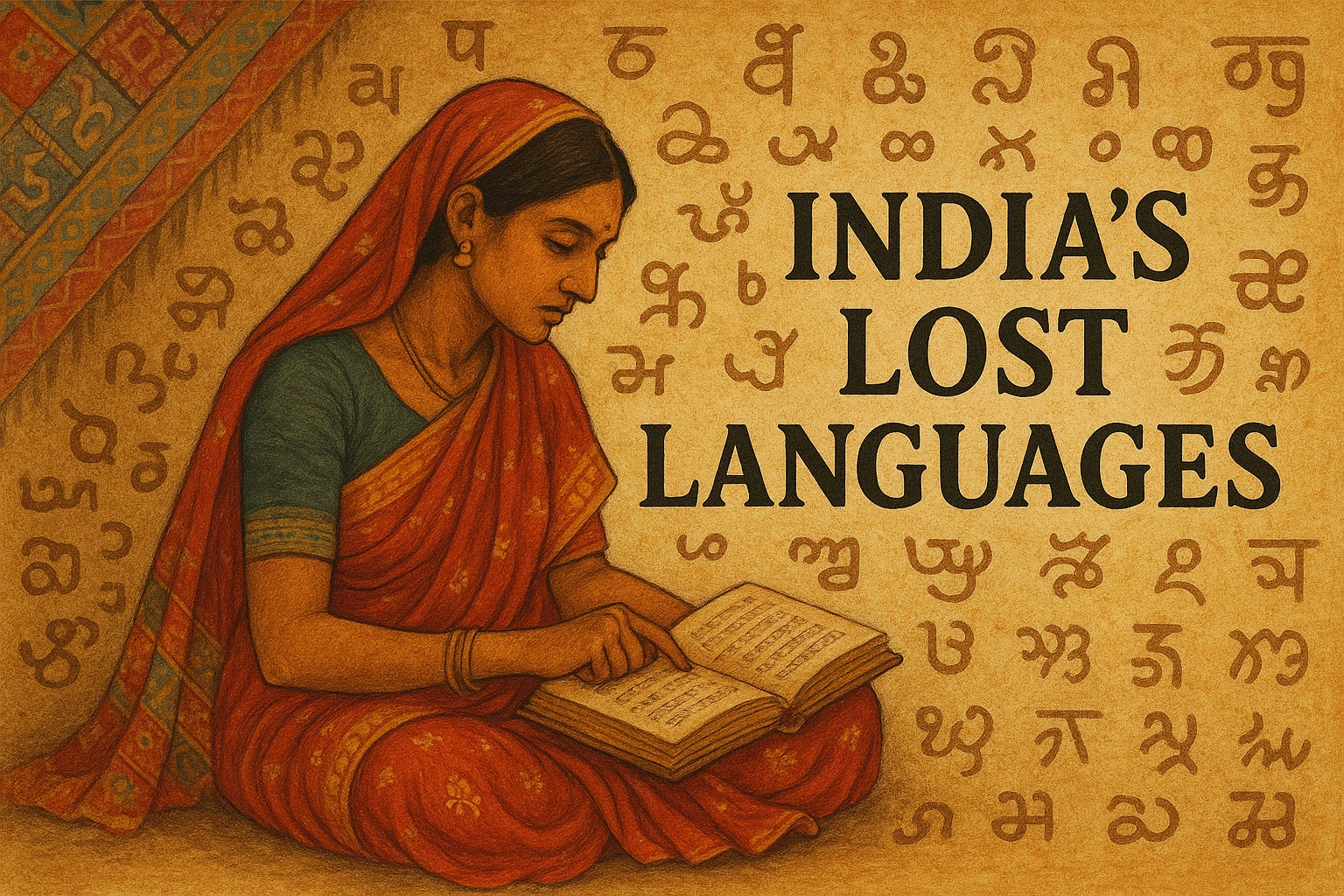
India, a linguistic mosaic with over 780 languages, has lost approximately 250 languages in the last 60 years, with 197 currently classified as endangered by UNESCO, according to a report. These losses, most acute in tribal regions like the Himalayas, Northeast, and Odisha, threaten cultural identities and knowledge systems. Driven by globalization, migration, and policy shifts, the decline is countered by efforts like the People’s Linguistic Survey of India (PLSI) and Google’s digital preservation initiatives, yet the race to save India’s linguistic diversity remains urgent.
In This Article:
A Linguistic Crisis
India’s linguistic diversity, second only to Papua New Guinea, spans Indo-Aryan (78%), Dravidian (20%), and Austroasiatic, Sino-Tibetan, and Andamanese families. However, languages like Ahom, Andro, Rangkas, Sengmai, and Tolcha, primarily from the Himalayan belt, are extinct, with no living speakers, per a 2023 Pratha Cultural School report.
UNESCO identifies 197 languages as vulnerable or critically endangered, with Majhi in Sikkim (four speakers) and Birhor in Jharkhand (2,000 speakers) at severe risk. The 1971 Census policy, excluding languages with fewer than 10,000 speakers from official counts, reduced recognized languages from 1,652 in 1961 to 108, accelerating their marginalization.
Cultural Loss and Causes
When a language dies, its cultural knowledge—folktales, medicinal practices, and ecological insights—fades, as noted by linguist Ganesh N. Devy. Globalization and urban migration push communities toward dominant languages like Hindi, English, or regional powerhouses, eroding tribal tongues like Koro (Arunachal Pradesh) and Nihali (Maharashtra). The lack of scripts for many languages, coupled with limited education in mother tongues, exacerbates the decline. For instance, Odisha’s 21 tribal languages face extinction despite the state’s 2006 Multi-Lingual Education (MLE) program, which appointed 3,385 tribal language teachers.
Preservation Efforts
The PLSI, led by Devy since 2010, documented 780 languages, uncovering gems like Gondi, rivaling French in sophistication. Google’s 2024 initiative digitizes 59 languages, including 15 with no prior digital footprint, enabling voice searches and translations via Gemini AI. Local heroes like Jageshwar Yadav, the “Brother of Birhor,” promote education and documentation, while the Living Tongues Institute records endangered languages like Birhor and Nihali. Constitutional provisions under Articles 350A and 350B mandate mother-tongue education and linguistic minority protections, but implementation lags.
A Call to Action
With 600 languages potentially endangered, India risks losing half its linguistic heritage by 2075, per Devy’s estimates. These languages carry unique worldviews, from Himalayan snow vocabularies to Odisha’s tribal epics. As India’s ₹101 billion entertainment sector embraces digital innovation, integrating endangered languages into education, media, and technology is critical to preserving the nation’s cultural soul.
-By Manoj H