


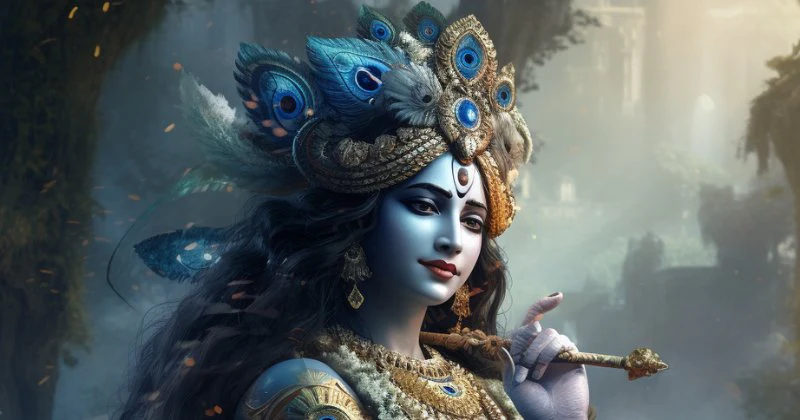
From timeless temple murals to contemporary cinema, Lord Krishna’s portrayals in Indian culture have evolved while retaining his endearing essence. Through the decades, Indian films, paintings, and performing arts have provided diverse lenses—religious, romantic, devotional, and even satirical—on this beloved deity. Here’s a look at that:
Heritage on Canvas: Art and Iconography
Pichhwai and Vrindavani Vastra
Pichhwai, a devotional textile art from Nathdwara, features vibrant scenes of Krishna’s leelas, crafted to narrate his exploits to the devout and illiterate alike.
In Assam, the 16th-century Vrindavani Vastra drape poignantly depicts Krishna’s childhood in Vrindavan, woven under Saint Srimanta Sankardeva’s direction.
Pahari Miniatures and Embroidery
The delicate Pahari miniatures from Kangra and Guler vividly render Krishna’s romance with the gopis, dancing and teasing in lush natural settings.
Similarly, embroidered covers (rumals) from the late 18th–19th centuries use silk and metallic threads to illustrate playful episodes like Krishna multiplying for each gopi in rapt devotion.
Modern Artistic Interpretations
The Progressive Artists’ Group member F. N. Souza brought a contemporary gaze to Krishna, portraying him amidst the gopis with bold, surreal flair in his 1971 work “Krishna & the Gopis”.
Rhythmic Narratives: Theatre & Dance Forms
Krishnanattam—Kerala’s Temple-born Drama
Originating in the late 16th century under the Zamorin of Calicut, Krishnanattam is an eight-part dance drama based on Krishna’s life. It remains vibrant today at Guruvayur Temple, performed with ritualistic devotion.
Kathak—The Dance of Divine Tales
Rooted in ancient recitations, Kathak emerged as storytelling through dance, evolving to highlight Krishna’s life, his childhood, pranks, and romance with Radha through expressive gats, kavitas, and thumris. These performances often use symbolic props like the flute (murli) to evoke Krishna’s presence.
Mega-Musical on the Rise
In a grand theatrical leap, “Rajadhiraaj: Love Life Leela” is promoted as the world’s first mega-musical centered on Krishna, recently staged in Mumbai and now continuing in Delhi’s Jawaharlal Nehru Stadium. The spectacle weaves life, love, and leela into an experiential narrative.
Silver Screen Reverence: From Reverence to Satire
Skin-Color Realism in Regional Cinema
A noteworthy trend in Telugu cinema is the authentic portrayal of Krishna’s dark-blue skin, a detail aligned with textual descriptions. Films like Mayabazar (1957), Sri Krishnarjuna Vijayam (1996), and the recent Kalki 2898 AD (2024) preserve this tradition. Audiences, especially on social forums, have lauded such portrayals for historical fidelity.
“Telugu film adaptations… have correctly portrayed… Krishna as dark-skinned or dark-blue.”
North Indian Adaptations—A Departure
Conversely, many Hindi and North Indian film and television adaptations, such as Ramayan (1987), Mahabharat (1988, 2013), and more, have regularly omitted this key attribute of Krishna’s description, opting for lighter-skinned portrayals.
Myth Meets Modernity
Bollywood continues to reinterpret Krishna-themed motifs through modern lenses:
- OMG: Oh My God! (2012) casts a contemporary deity challenging religious orthodoxy in satirical tones.
- Brahmāstra (2022) fuses mythic energy with sci-fi grandeur.
- Others, like Karan Arjun (1995) and Paheli (2005), reshape beliefs into narratives of destiny, tragedy, and love.
From Canvas to Camera: Krishna’s Living Legacy
As ink dries on this cultural dispatch, one thing is clear: Krishna remains as vibrant and adaptable as ever, his divine presence continually reshaped, reinterpreted, and renewed across mediums. Whether through the hush of a Pahari miniature, the thunder of a Kathak performance, or the glow of a cinema screen, his image evolves but never fades.
And with each generation of artists, filmmakers, and performers, Krishna’s narrative finds new breath: what traditional symbolism will the next filmmaker reclaim? What fresh aesthetic might the next painter invoke? In the end, Krishna’s portrayal isn’t just a reflection of myth; it’s a mirror to changing times, inviting us to ask, what comes next in his timeless dance?
By – Sonali