


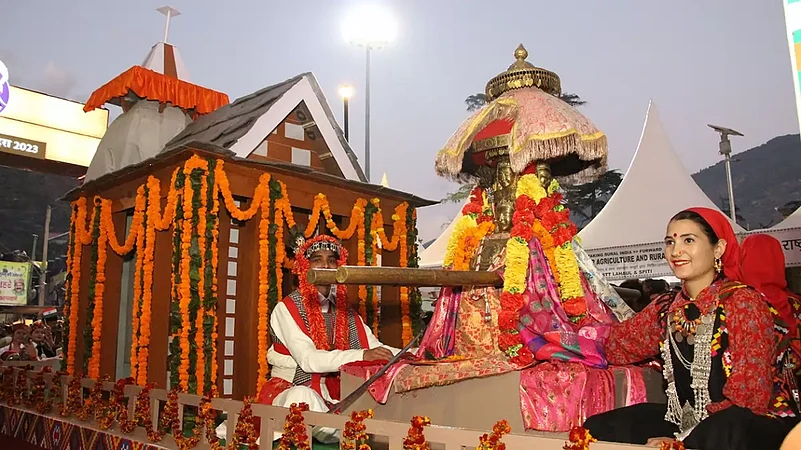
The crisp Himalayan air crackles with festive fervor as Kullu Dussehra unfolds in Himachal Pradesh’s scenic Kullu Valley. Unlike its pan-Indian counterparts, this week-long extravaganza transforms the sleepy town into a vibrant tableau of devotion, culture and camaraderie. From the ancient procession of deities to folk dances that echo through pine forests, Kullu Dussehra offers an unparalleled window into Himachali heritage.
A Unique Beginning: When Gods Converge
Legend holds that over five centuries ago, Raja Jagat Singh of Kullu invited the idols of 24 neighboring deities to his capital to seek refuge from invading forces. What began as a practical gesture blossomed into a ritual celebration, embracing both divine and human guests. Each morning, priests ceremonially summon these local gods, each housed in its own temple, to assemble in ornate palanquins at the historic Raghunath Temple. The procession’s melodic drums reverberate through the valley, announcing the day’s joyous proceedings.
The Procession of the Deities
On the festival’s first day, Raghunath Temple’s inner sanctum opens to the public for the grand “Rath Yatra.” Elaborately carved chariots bearing the deities, clad in silken robes and bejeweled crowns, advance from the sanctum to the manicured Parade Ground. Thousands of devotees line the route, showering petals and chanting ancient hymns. As dusk settles over the pine-clad hills, the deities converge in a ceremonial tableau, each idol positioned in a perfect semi-circle, symbolizing unity among Kullu’s hill communities.
Cultural Confluence: Music and Dance
Kullu Dussehra is as much a cultural festival as it is religious. Daily performances showcase Nati, the exuberant local folk dance, its swirling skirts and rhythmic footfalls reflecting centuries-old traditions. Men in vibrant caps and women in anklets perform to the beat of the dhimru and dhol, drawing enraptured crowds. Evenings are dedicated to Himachali folk songs, Chhaap and Saz where balladeers recount tales of valor, love, and harvest under starlit skies.
Marketplace of Traditions
Alongside religious rites and performances, the sprawling bazaar on the Parade Ground provides a feast for the senses. Artisans display intricately carved wooden masks, hand-woven shawls, and silver jewelry fashioned in traditional Himachali motifs. Stalls brimming with indigenous apples, walnuts and locally distilled majj (apple brandy) add to the valley’s rustic charm. Visitors often haggle good-naturedly, forging personal connections with traders who have passed down their crafts for generations.
Culinary Delights of the Hills
No festival in Himachal is complete without food that warms the body and soul. The aroma of sidu, steamed bread enriched with ghee and yeast, mingles with sizzling maachha thali (river fish curry) and steaming bowls of rajma madra, a creamy kidney-bean delicacy. Street-side vendors tempt revellers with thepla wraps and sweet mittha, a traditional rice flour pudding flavored with jaggery and cardamom. Every bite tells a story of mountain homesteads and hearthside gatherings.
Tourist Appeal and Practical Information
Drawing nearly 50,000 visitors each year, Kullu Dussehra has become a magnet for domestic and international travellers. The nearest airport at Bhuntar, 10 km from Kullu town connects via daily flights from Delhi. For a more scenic approach, state-run and private buses ply the winding roads from Chandigarh and Shimla. Accommodation ranges from heritage hotels to cozy guesthouses, many offering panoramic valley views. It’s advisable to book well in advance, especially for the festival’s climax on the seventh day.
Safety, Sustainability and Community Spirit
Local authorities partner with environmental groups to maintain the valley’s pristine beauty. Waste-separation bins dot the Parade Ground, and volunteers conduct daily clean-ups. Medical tents and fire-safety crews remain on standby throughout the festival. Despite the crowds, a spirit of communal harmony prevails, devotees from diverse faiths share in the celebrations, underscoring Kullu Dussehra’s ethos of unity.
Creative Finale: A Festival to Remember
As the final day draws to a close, lanterns bob like golden fireflies against the Himalayan backdrop. The deities return to their home shrines in a solemn procession, accompanied by the soft strains of shehnai and flute. The air, once charged with fervent hymns, now carries a gentle hush, a reminder that while the festival ends, its memories linger like mountain mist at dawn. In Kullu, Dussehra is more than a spectacle; it is the living heartbeat of a community, pulsing with faith, tradition and the timeless magic of the hills.
By – Sonali