


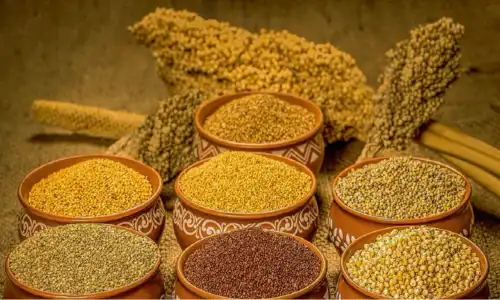
Millets—once unfairly labelled as “coarse grains”—are enjoying a strong comeback on Indian plates. The momentum accelerated after 2023 was declared the International Year of Millets by the UN, with India playing a leading role in pushing the agenda globally.
Today, millets are being reintroduced not just as “healthy swaps,” but as climate-smart staples with deep regional roots—now packaged for modern lifestyles.
Why Millets Are Trending Now
Millets (jowar, bajra, ragi, foxtail, barnyard, kodo, little millet and more) are valued for three big reasons:
1) Climate resilience
They generally need less water and fewer inputs than many staple cereals, and perform better under heat and drought. Depending on the millet and region, studies show substantially lower water footprints than rice—foxtail millet, for instance, has been reported at ~60–70% lower water requirement than rice in some contexts.
2) Nutrition density (when eaten as whole grains)
Millets are naturally gluten-free grains (helpful for people avoiding gluten; those with celiac should still look for certified, contamination-safe products). Many millets offer meaningful fibre and micronutrients; guidance notes also describe millets as nutritionally rich cereals with solid protein/fibre ranges overall.
3) Policy + market push
India’s “Shree Anna” positioning and state-level programmes have helped push millet awareness, procurement, and value-added products. Several states have also explored including millets in nutrition/public food programmes (implementation varies by state and scheme design).
How to Cook Millets (Quick Starter Guide)
Most millets cook like rice—but texture depends on the millet, whether it’s polished, and how much water you add.
Basic method (stovetop or pressure cooker)
- Rinse 1 cup millet well (this reduces dust and improves taste).
- Soak (optional): 20–30 minutes helps softer texture; 2–6 hours for some millets if you want extra tenderness.
- Cook: Use about 2 to 3 cups water per cup of millet (start at 2.5 cups if unsure).
- Pressure cooker: 2–4 whistles (depending on millet and soaking)
- Stovetop: 18–25 minutes simmer, then rest 5 minutes
- Fluff + rest: Turn off heat, keep covered for 5 minutes, then fluff.
Quick upgrades that actually help
- Dry-toast millets for 2–3 minutes before cooking for a nuttier aroma.
- Add salt and 1 tsp ghee while cooking for better mouthfeel.
- If you’re new to millets, start with khichdi, upma, pongal, or porridge—they’re more forgiving than “separate grains.”
Easy substitutions
- Replace rice in pulao/khichdi (start with 50:50 millet:rice if you want a softer transition).
- Use millet in idli/dosa batter (try millet + urad in your usual proportions; ferment as normal). Fermentation can also improve mineral availability and digestibility.
Myths vs Facts
Myth 1: “Millets taste bad” or “they’re hard to digest.”
Fact: Cooked well, millets are mild, nutty, and satisfying. If you jump from refined rice to high-fibre millets overnight, you can feel bloated—so start small, soak, and cook softer (khichdi/pongal style).
Myth 2: “Anti-nutrients block minerals, so millets aren’t worth it.”
Fact: Yes, millets contain phytic acid, but methods like soaking, sprouting, and fermentation can reduce anti-nutrients and improve mineral bioavailability.
Myth 3: “Millets are only for diabetics or weight loss.”
Fact: Millets can work for most people—kids, adults, elders—because they diversify grains, add fibre, and support steadier energy.
Important nuance (GI reality check):
Millet foods often show lower glycaemic responses than white rice/refined wheat, but highly polished millets can behave more like refined grains and test high GI in studies. Choose whole/unpolished millets and pair with protein/fat (dal, curd, nuts) for the best results.
Best Regional Millet Dishes You Must Try
- Ragi Mudde + Saaru (Karnataka): Finger millet balls with rasam/sambar—comforting and filling.
- Bajra Khichdi / Bajra Raab (Rajasthan–Gujarat): Winter staple—earthy, warming, best with ghee/curd.
- Jowar Bhakri (Maharashtra): Sorghum flatbread with pithla/thecha—simple, iconic, powerful flavours.
- Kodo Millet Upma (South India): Great “first millet breakfast” with curry leaves, peanuts, veggies.
- Foxtail Millet Pongal (Tamil Nadu): A pongal-style bowl that feels traditional but lighter than rice versions.
- Little Millet Biryani (Andhra–Telangana): Aromatic one-pot meal; works well with vegetables or chicken.
- Barnyard Millet Kheer (North India): Jaggery/cardamom dessert with a creamy finish.
A smart way to start (no overwhelm)
This week, pick one millet + one format:
- Foxtail millet pulao / pongal
- Barnyard millet kheer
- Jowar bhakri once on a weekend
Millets aren’t “forgotten grains.” When cooked right—and chosen whole/unpolished—they’re delicious, nourishing, and aligned with the future of climate-smart Indian food.
—By Manoj H