


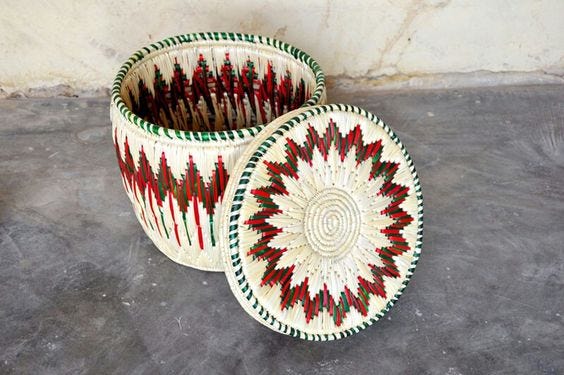
Uttar Pradesh’s age-old Moonj craft—an eco-friendly grass-weaving tradition—has been drawing renewed attention as artisans blend heritage skills with modern design and market demand. Supported through initiatives such as One District One Product (ODOP), Moonj products are increasingly positioned as sustainable alternatives at a time when consumers are actively seeking natural, low-impact handicrafts.
What is Moonj craft?
Moonj refers to the natural fibre derived from wild grass (often described as the outer layer of sarpat/munj grass), used along with supporting grasses like kaansa/kaans to create coiled and stitched products. Practised largely by rural women, the craft involves drying, bundling, soaking, and then hand-coiling the fibres into sturdy, functional forms.
Moonj weaving is strongly associated with eastern Uttar Pradesh, with clusters linked to districts such as Prayagraj and adjoining regions, where the grass grows near riverbanks and open wastelands.
Process and seasonal rhythm
Moonj grass typically grows once a year, and artisans harvest and dry it in winter. After sun-drying, fibres are tied into small bundles (locally called balla) and soaked before weaving to improve flexibility. Because raw material is seasonal, bundles are stored carefully so production can continue across the year.
The craft uses minimal tools—usually simple knives/needles—while the real precision comes from hand skill and tight coiling. Over time, artisans have added brighter colours and newer patterns, balancing traditional techniques with contemporary aesthetics.
Product range and market trends
Moonj craft has expanded well beyond traditional household storage baskets. Today, artisans create baskets (daliya), coasters, bags, decorative items, and other lifestyle products that appeal to urban buyers looking for eco-friendly décor and gifting options.
In Prayagraj, the Naini belt is widely cited as a key production cluster, with markets offering Moonj products through much of the year, and demand often rising during festive and wedding seasons.
Economic and social impact
Historically a supplementary livelihood alongside agriculture, Moonj weaving has become a more visible income stream with ODOP-led recognition and market access. Official statements and local reporting have noted that Moonj-linked livelihoods have benefited 500+ women artisans in the Prayagraj cluster alone.
A major milestone is the GI registration for “Moonj Craft of Uttar Pradesh”, with the GI registry listing a certificate of registration dated 30 March 2024—a step expected to strengthen authenticity, branding, and broader market confidence.
Challenges and the road ahead
Despite growing demand, artisans still face familiar constraints: seasonal raw-material dependence, price pressure from mass-produced substitutes, and uneven access to premium markets. The strongest growth opportunities lie in design collaborations, better finishing/packaging, GI-based branding, and digital commerce, helping Moonj craft scale without losing its handmade identity.
By – Sonali