


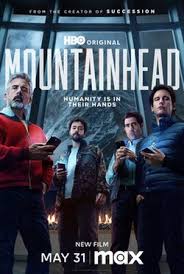
After redefining modern prestige television with Succession, Jesse Armstrong returns to HBO with Mountainhead, a dense, visually stunning, yet divisive tech satire that examines the narcissism, paranoia, and unchecked ambition of Silicon Valley billionaires. Released on May 31, 2025, Mountainhead marks Armstrong’s first major project since the Emmy-winning saga of the Roy family ended — but despite its grand ambitions, the film doesn’t quite reach the peak it’s aiming for.
In This Article:
A Battle of Billionaire Egos
Mountainhead centers around two fictional tech moguls — one a utopian idealist, the other a ruthless capitalist — who square off in the snowy wilderness of Colorado, where an isolated, self-sufficient compound becomes ground zero for a war of ideologies.
The movie’s title refers to a futuristic mountain facility, a cold and minimalist headquarters built for artificial intelligence research, spiritual awakening, and digital immortality. What begins as a debate on the ethics of AI soon spirals into a full-on psychological and symbolic conflict, echoing the real-world power struggles of tech giants like Elon Musk, Mark Zuckerberg, and Peter Thiel.
Thematically Rich, Emotionally Distant
The film tackles:
- AI and post-human ethics
- Digital feudalism and billionaire isolationism
- Toxic masculinity in tech culture
- The illusion of progress in the age of algorithms
Though intellectually stimulating, Mountainhead sometimes falters in emotional delivery. Its characters, while sharply written, feel like ideas more than humans—tools for argument rather than emotional connection.
Star Performances That Can’t Save a Cold Script
While the screenplay is as polished and cynical as Armstrong’s previous work, it lacks the crackling wit and emotional vulnerability that made Succession so gripping.
- Domhnall Gleeson plays the mountainhead compound’s architect — calm, philosophical, and disturbingly detached from reality.
- John Boyega shines as his corporate rival — aggressive, power-hungry, and sharply cynical.
- Cailee Spaeny, as an AI ethicist caught between the two billionaires, provides the film’s rare moments of human conscience.
Yet even these performances struggle to transcend the film’s emotionally sterile tone. The satire is biting, but the soul feels missing.
Cinematic Brilliance in an Isolated World
Visually, Mountainhead is a triumph. Directed by Mark Mylod (a frequent Armstrong collaborator), the film embraces stillness, symmetry, and sterile luxury. The cinematography captures the paradox of natural beauty and corporate control: untouched snow against soulless glass towers, silent forests shadowed by flying drones.
Key visuals include:
- Sweeping drone shots of the mountain facility
- Harsh lighting that echoes clinical sterility
- Isolated characters dwarfed by towering machines
Despite this, the narrative’s pacing and tonal detachment make it hard to stay fully immersed for the film’s 2-hour runtime.
Critics Divided: A Tale of Two Camps
Reactions to Mountainhead have been sharply divided. Some critics call it a bold philosophical exploration; others find it pretentious and inert.
“Clever and well-structured, but ultimately lacking urgency or emotional weight,” notes RogerEbert.com.
“Armstrong’s icy satire never really heats up, despite its topical ambitions,” writes The Verge.
According to The New York Times, “It’s a sharp rebuke of tech hubris, but not quite the landmark HBO hoped for.”
Meanwhile, audience reactions on Reddit, Twitter (now X), and Letterboxd show polarizing responses — some viewers hail it as the “Dr. Strangelove of the AI age”, while others abandon it halfway through due to its slow pacing and philosophical density.
A Post-Succession Identity Crisis?
For fans of Succession, Mountainhead will feel familiar in tone: sardonic, icy, filled with corporate language and emotional power plays. However, what Succession had in terms of familial drama, Mountainhead trades for abstract ideas and speculative tech.
This may explain the mixed reception — the film is less concerned with plot or characters and more focused on existential questions: What happens when power, wealth, and knowledge are left unregulated? When men believe they can play god through code? And who gets to decide the future of humanity?
These questions are timely and important. But they don’t always make for satisfying cinema.
Final Verdict: Smart, Stylish, But Not Fully Human
Mountainhead is undeniably a bold creative swing. Jesse Armstrong deserves credit for attempting something different and daring — especially in an era of safe, studio-tested storytelling. The film’s ideas will linger with viewers long after the credits roll. But so will its emotional emptiness.
If you’re a fan of Armstrong’s writing and enjoy dense, cerebral dramas with a satirical edge, Mountainhead is worth watching. Just don’t expect to be moved — expect to be provoked.
By – Nikita
Also Read – Wake Up Dead Man: Knives Out 3 Trailer Unveiled