


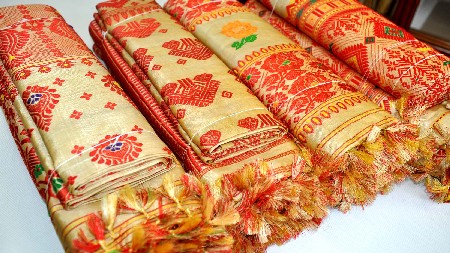
As of August 2025, Muga silk, Assam’s “golden silk,” remains a cultural jewel, but its future hangs by a delicate thread due to environmental and economic challenges. Crafted by artisans in Assam’s Brahmaputra Valley, this silk comes from the Antheraea assamensis silkworm. Known for its natural golden sheen, durability, and GI-tag status since 2007, Muga is a symbol of Assamese pride. Centered in Sualkuchi, dubbed the “Manchester of the East,” it thrives in Assam’s lush landscapes. With roots tracing back to the 4th century BCE, its prominence grew under Ahom patronage. Handwoven using traditional looms, its production faces threats from climate change and competition.
The Golden Craft of Assam
Muga silk, derived from the Antheraea assamensis silkworm, is exclusive to Assam, feeding on aromatic som (Machilus bombycina) and soalu (Litsaea polyantha) leaves. Its golden hue, which deepens with each wash, and tensile strength—30% stronger than mulberry silk—make it a global rarity. Historically reserved for royalty, as noted in Kautilya’s Arthashastra (3rd century BCE), Muga adorned Ahom kings and was gifted to dignitaries. Today, it graces mekhela chadors, saris, and modern designs like kimonos in Japan, with a single sari requiring 1,000 cocoons, per IIAD. In 2024-25, Assam produced 136 of India’s 158 tonnes, per Wikipedia.
A Labor of Love and Land
For weavers like Anjali, a Sualkuchi artisan, Muga is “our heritage, our identity.” The process is arduous: silkworms are reared outdoors, vulnerable to temperatures above 30°C or below 20°C, which can decimate crops. Farmers handpick leaves, monitor humidity (75-85%), and use bamboo chaloni sieves to transfer worms. Reeling, often done on traditional bhir looms, requires boiling cocoons—though ethical live extraction methods are rising.
Cultural Pride Meets Modern Struggles
Muga is woven into Assam’s soul, worn during Bihu festivals and weddings, symbolizing prosperity. A mekhela chador, priced from ₹35,000 to ₹1.5 lakh, is a bride’s heirloom, per IIAD. However, climate change, with erratic rains and heatwaves, disrupts silkworm cycles, while cheaper tussar blends undercut prices. Government initiatives, like subsidies and heat-tolerant breeds (NB4D2, Nistari), aim to boost production.
A Golden Future?
Muga’s allure lies in its eco-friendly roots—no chemical dyes, biodegradable fibers, and forest conservation. Yet, with only 30,000 families employed, down 15% since 2010, per IIAD, and youth shunning labor-intensive sericulture, the craft risks fading. Government-backed modernization, like advanced looms and disease-free silkworm eggs, offers hope.
-By Manoj H